
• This forum is the machine-generated translation of www.cad3d.it/forum1 - the Italian design community. Several terms are not translated correctly.

torque cylinder moment cable

  • Thread starter Thread starter Antony
  • Start date Start date

Antony

Guest
Hello everyone
in ansys workbench are struggling with a very simple problem of a cable cylinder to which a torque moment of 8000 nmm is applied on the external side surface.
the material is a simple construction steel.
for binding I applied a fixed suppot on one of the basic faces

geometric characteristics:
d = 40 mm
d = 28 mm
l = 100 mm

the resulting tau are 0.96 mpa (according to manual calculation).

Since the torque is constant on the whole length of the cylinder, why are tau not?
the maximum value I find it incorrespondence of the ink (about equal to that calculated by hand).
I was wrong to bind the system?
have I forgotten or misset any parameters? ?

graize to all
 

Attachments

  • tau.webp
    tau.webp
    99.9 KB · Views: 25
Look at the perfect return...


ig=3.14/32(de^4-)

0.84
 

Attachments

  • Capture.webp
    Capture.webp
    54.5 KB · Views: 22
when a cylinder made with solid elements is pressed, it is normal to see in the fem analysis an increase in the diameter that obviously does not exist in reality (it is an aberration of the fem meotodo). this (probably) leads to a decrease in tau in the section, due to the fact that at the same time, the tension falls due to the increase of the moment of inertia of the section.

Unfortunately, I don't find a bibliographical reference, but this should be the case. In fact, if you look at the example of eih64, he does not have the problem having used a shell modeling.
 
Hello everyone
in ansys workbench are struggling with a very simple problem of a cable cylinder to which a torque moment of 8000 nmm is applied on the external side surface.
the material is a simple construction steel.
for binding I applied a fixed suppot on one of the basic faces

geometric characteristics:
d = 40 mm
d = 28 mm
l = 100 mm

the resulting tau are 0.96 mpa (according to manual calculation).

Since the torque is constant on the whole length of the cylinder, why are tau not?
the maximum value I find it incorrespondence of the ink (about equal to that calculated by hand).
I was wrong to bind the system?
have I forgotten or misset any parameters? ?

graize to all
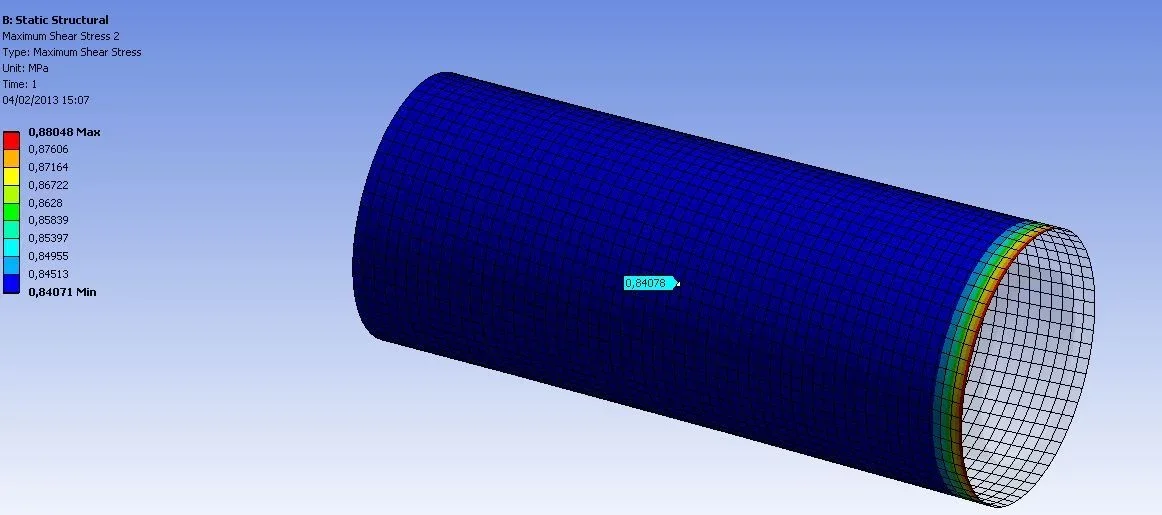
you applied the load on the outer surface, so the load is divided over the whole length. each section sees the load above and not the one below.
the section to the encroachment sees everything.
 
when a cylinder made with solid elements is pressed, it is normal to see in the fem analysis an increase in the diameter that obviously does not exist in reality (it is an aberration of the fem meotodo). this (probably) leads to a decrease in tau in the section, due to the fact that at the same time, the tension falls due to the increase of the moment of inertia of the section.

Unfortunately, I don't find a bibliographical reference, but this should be the case. In fact, if you look at the example of eih64, he does not have the problem having used a shell modeling.
I am sorry to deny hunter but the model is solid and if it was also shell the only certain thing is that the value of tau has to return.
aberration of the meotodo fem in this case has nothing to do with it.
greetings
 
when a cylinder made with solid elements is pressed, it is normal to see in the fem analysis an increase in the diameter that obviously does not exist in reality (it is an aberration of the fem meotodo). this (probably) leads to a decrease in tau in the section, due to the fact that at the same time, the tension falls due to the increase of the moment of inertia of the section.

Unfortunately, I don't find a bibliographical reference, but this should be the case. In fact, if you look at the example of eih64, he does not have the problem having used a shell modeling.
I am sorry to deny hunter but the model is solid and if it was also shell the only certain thing is that the value of tau has to return.
aberration of the meotodo fem in this case has nothing to do with it.
greetings
It is not an abberration of the fem method. the torque moment actually increases the diameter (ingobing function). the quaestio is that in the real world an ink is not as perfect as in the fem, and therefore in the real world that effect there is negligible.

to see if the problem is actually this, force the polka dot coefficient to zero and see if the phenation disappears.

(I hope I didn't say baggianate. . was nothing? ... boh... I should make two accounts, I don't remember)
 
It is not a problem of type of fem, elements or anything.
simply the load was applied on the side surface of the cylinder and then spread throughout its length. It's a distributed load.
the sections of the cylinder therefore see not all the load, but only the one upstream of the section itself.
If you look at the image of the results posted, you can see that stress goes from 0 to a maximum value. this precisely caused by the fact that the torque is distributed along the length of the cylinder and not concentrated on the head surface.
 
you put the moment on the outer surface of the cylinder, which means you distributed the moment along the cylinder axis, so the tau is linear.
If you put the torque moment at the end you will get constant tau.
on the aberration of the fem on axialsymmetric twists, it is purely graphic, and does not affect the calculation, limited to linear approximations.
the polka dot effect is negligible for this load/wine system.
with regard to the encumbrance functions, they do not detect for asymmetric twists.
 
It is not a problem of type of fem, elements or anything.
simply the load was applied on the side surface of the cylinder and then spread throughout its length. It's a distributed load.
the sections of the cylinder therefore see not all the load, but only the one upstream of the section itself.
If you look at the image of the results posted, you can see that stress goes from 0 to a maximum value. this precisely caused by the fact that the torque is distributed along the length of the cylinder and not concentrated on the head surface.
looking at us better... You're right.
with regard to the encumbrance functions, they do not detect for asymmetric twists.
Here... I remembered well then. . .
 
Thanks to all the boys for help.
In fact, the theory of construction sciences should only vary according to the radius and not the length of the cylinder.
therefore to say in short the gradient of tension must vary with the radius and be minimal on the internal one and max on the outer one, but along all length, for each layer (for each value of r) must be constant.

reflecting us better are fully in agreement with wave when it states that the load I had incorrectly distributed proportionally to the length of the axis for which they are maximum only on one side and decrease to the varying length.
therefore for any geometry the tocent mine should be applied on an orthogonal surface to the axis of revolution.

can this solution also be as a result of the fact that we are facing a state of tension plane?

on the enlargement of the section are still a bit skeptical....
 

Forum statistics

Threads
44,997
Messages
339,767
Members
4
Latest member
ibt

Members online

No members online now.
ciao
Back
Top