• This forum is the machine-generated translation of www.cad3d.it/forum1 - the Italian design community. Several terms are not translated correctly.

two-stage reducer design

Mattymecc

Guest
hello to all, I should realize the project of a two-stage parallel axle reducer following these indications:
1) the driving machine is an internal combustion engine, of 90kw power, which at a wheel rate of 2250 rpm
2) the machine operated, on a regimen, rotates to 375 rpm and is not subject to overload
3) the connection of the reducer to the drive machine must be carried out through a hard joint
4) the connection of the reducer to the user must be carried out through a grooved shaft
5) toothed wheels must be to helical teeth and should be designed with the formulas of lewis and hertz, if possible verify them according to norm uni 8862 through the tables
6) Trees must be checked statically and fatigued
7) Dissolve the bearings suitable for longer than 5000h
I would need your help because I am making this project for another person and at school I have not yet dealt with fatigue testing, in particular I have difficulty in verifying the sections weakened by the offices of the tabs, do I have to combine the effect of carving? What diameter do I consider? the outer one or the outer one minus twice the depth of the quarry?
I thought I'd build one-piece pins with cementing steel trees, while the two wheels build them in reclaim steel. Is that a valid idea? today I will begin to make some calculations and tomorrow I will posterior you the size of the wheels. thanks in advance.
 
Bye. How many complete gearboxes did we do on the forum? Just look.
sections that are subject to high loads and fatigue loads should be verified and may be intangible of various nature.
there is a well-defined theory for fatigue calculation and use the uncut diameter and cutting coefficient.

back to us... in 90kw input at 2250rpm... out 375rpm.

we calculate the total reduction ratio:
♪[ i=\frac{2250}{375}=6 \]I could actually do a single stage of reduction....but since the exercise asks two stages we see to make the first beautiful stage reported i1=3 and i2=2.

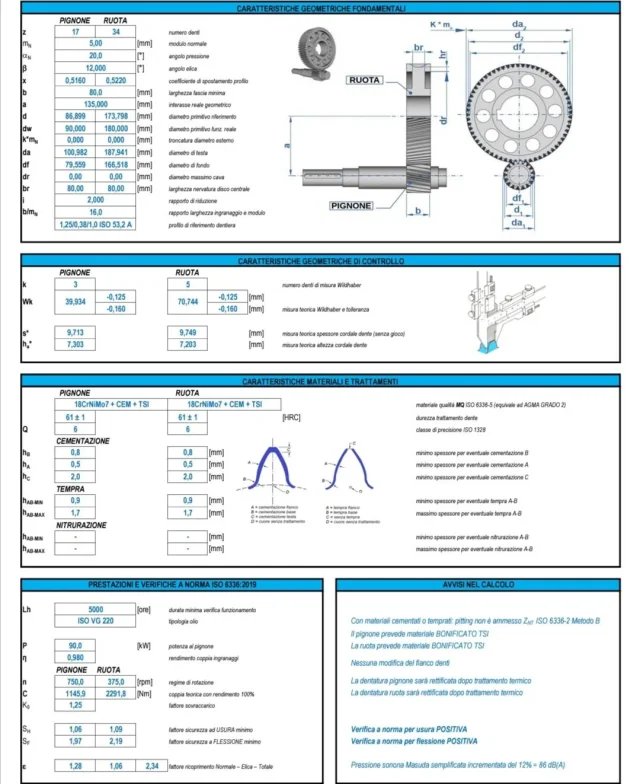
First stage:Screenshot_20201025_211311.webpSecond stage:Screenshot_20201025_212324.webpas you see it is not said that the pinions must be cemented and the hardened wheels.....depends on how they are or not verified.

I used a 1,25 coefficient to have a minimum guarantee for the irregularity of the combustion engine and a minimum total to ensure 5000 hours of operation.

calculates reactions due to the forces in play and determines by input, intermediate and exit shaft actions and reactions.
with this you make diagrams of the internal actions and with those you look for the most stressed sections and go to make a maximum sizing.

therefore for maximum sizing:Screenshot_20201025_213340.webpso determine d and the greater a little.
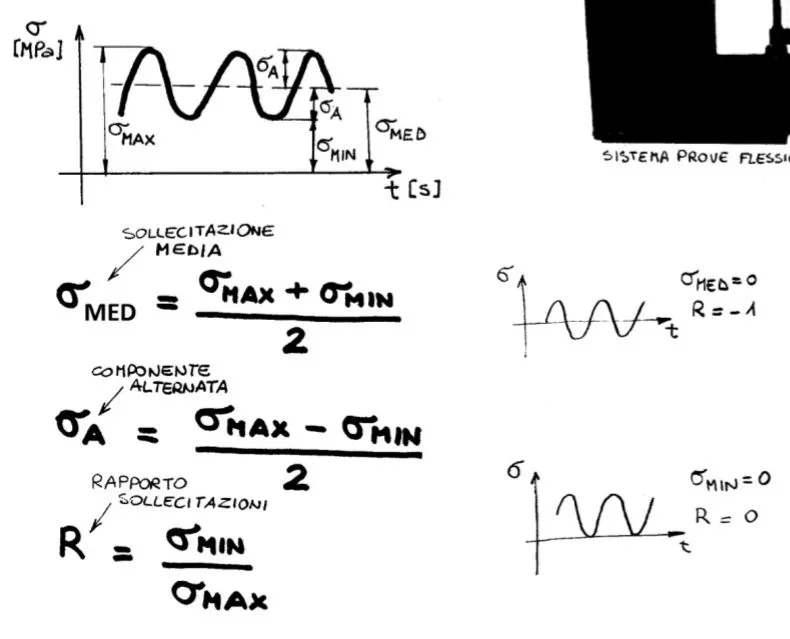
then do static verification:Screenshot_20201025_213439.webpthen do carving analysis and fatigue verification or calculating with goug pollardScreenshot_20201025_213717.webpScreenshot_20201025_213730.webpor in other ways, building the curve and determining the number of cycles.

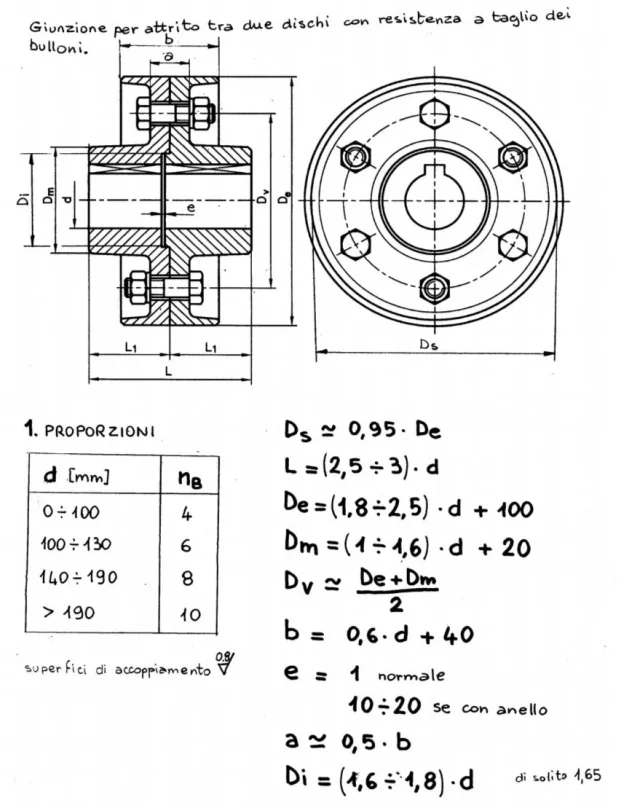
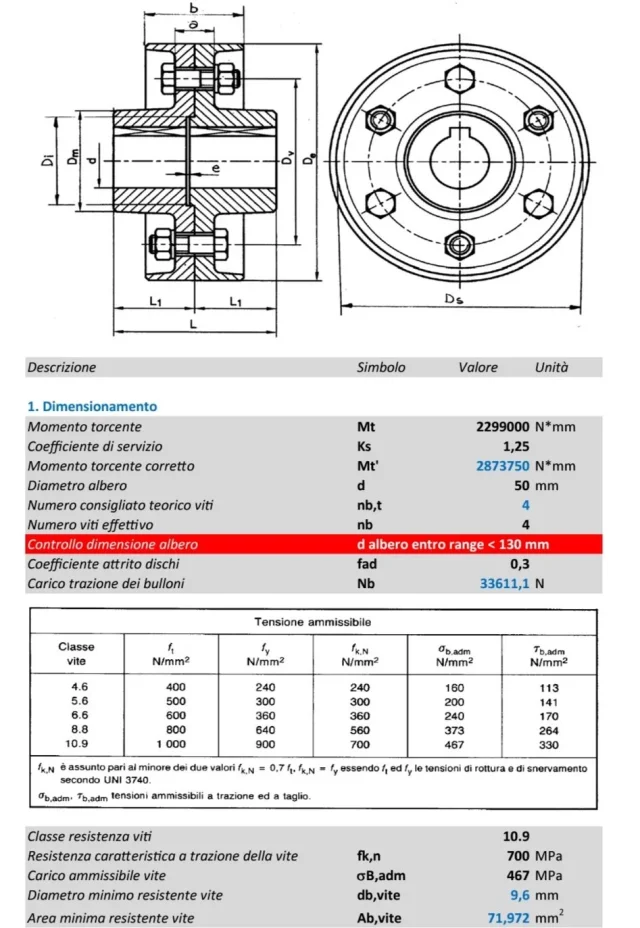
for the disk joint then, once you have the diameter you can dimensional and check the friction joint:Screenshot_20201025_214104.webpScreenshot_20201025_214124.webpit would be better for screws to use uni en 1993-1-8 but you can also do it with ex uni cnr 10011 even if withdrawn .... However for school you can use it if you have not seen anything else.
However it could look like this:Screenshot_20201025_214921.webpScreenshot_20201025_214935.webp
 
when you make the sizing of the trees, and you will get out of a diameter number, it should be increased approximately equal to the depth of the tab, so the subsequent verification should be better satisfied, even in the presence of additional carvings and fatigue stresses.
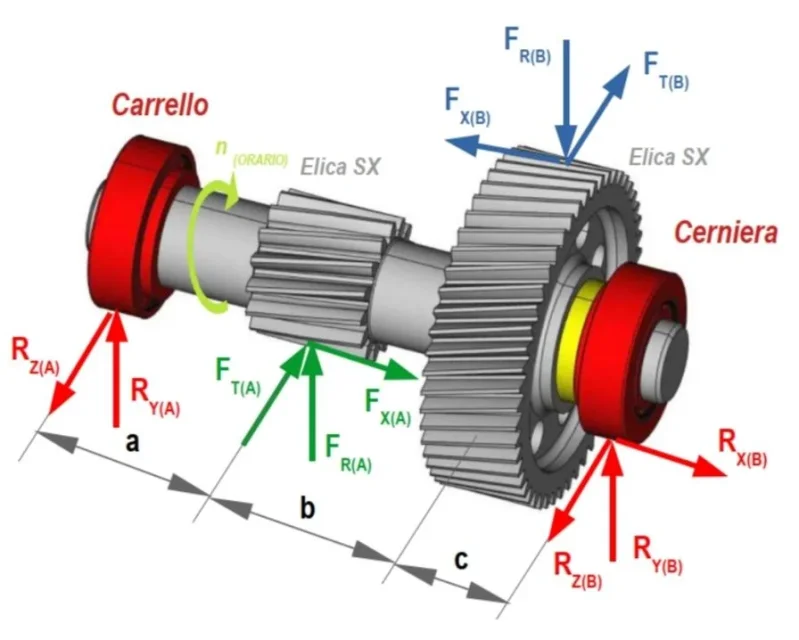
the intermediate tree I suggest you do the propellers in the same direction so you will subtract the axial component.Screenshot_20201025_223915.jpgObviously it will be a parallel axle reducer online otherwise forces change direction compared to the above scheme.
As for the forces I recommend you to use the skf training notebooks I mentioned several times or on the khk gear guides.
 
regarding static verification of the section with carving you have the following formulas:Screenshot_20201025_225202.jpgand therefore there is an increase in the diameter or a decrease in the permissible voltage due to the concentration of efforts in the carving.

kit is obtained from the special curves of geometry and applied force such as this:Screenshot_20201025_225411.jpgtherefore the reducer will be very similar to this below:
screenshot_20200406_204953-jpg.57285
 
Last edited:
hello mechanicalmg, thank you for already dimensionaling the dentate wheels according to norm, but I have to do it also through lewis and hertz, and for this last I would need to know the superficial hb hardness after cementation more hardening or only surface tempering, to do so can I use the hrc/hb conversion tables or should another criterion be used? I also thank you for everything else, especially the flanged joint. I found on the forum a chart similar to what you posted, but for the quarries of tongue, coming from the peterson's concentration factors; I use that by calculating nominal voltages with outer diameter? I'm sorry, but I don't understand this. I don't have to use gough-pollard, but the haigh plan with the sodeberg straight is an equally correct approach? thanks again for availability.
 
regarding durability you have to use conversion tables to switch from hrc to hb.
for carving charts there are a lot depending on whether you value a fitting, a tab or other. You have to use the specific one. the diameter is that of investigation and on each curve you find indicated the reference.
it is good to use haigh plan even if it is recommended with r=0. Actually it should be used whöler.
Screenshot_20201026_193218.webp
 
I would also have another question: are the depths of cementing and tempering that you put on the wheel calculation sheet always the same or vary? and on the basis of what do they get?
 
I would also have another question: are the depths of cementing and tempering that you put on the wheel calculation sheet always the same or vary? and on the basis of what do they get?
the depth of the heat treatment varies according to the size of the tooth and then the module. on specific books you can find formulas and considerations about it.
 
thanks for the clarifications if I can for today I make a draft of the design of the reducer. . .
 
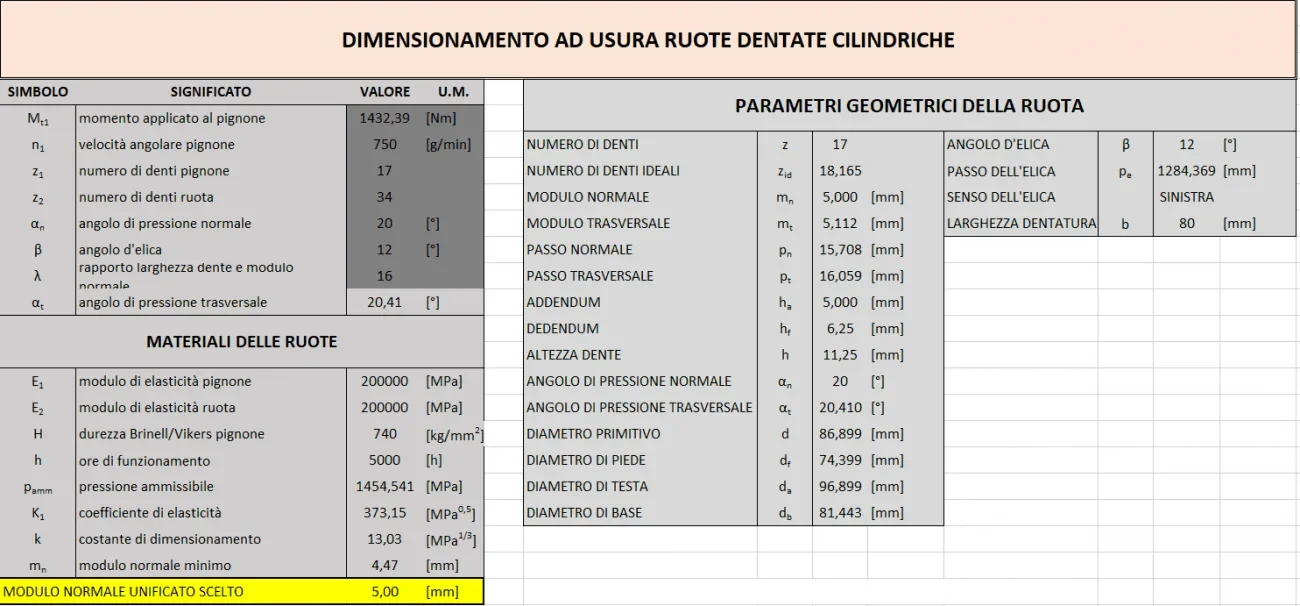
hi to all I managed to make the dimensioning of the dentate wheels with lewis and hertz, however to bending the second pinion is verified only if lower the safety coeff from 4 (as recommended by the manual of hoepli mechanics) to 3. is however acceptable as condition? Thank you.
pignone 1 usura.PNGpignone 1.PNGpignone 2 usura.PNGpignone 2.PNG
 
as you can notice, for lewiss you have a dimensioning i.e. an estimate, a search for value of the module, so you can use a coefficient ranging from 1 to 6. higher and more suitable for alternative cycles or with shocks.
instead with the wear calculation, do a verification and then see that the specific pressure can be applied for 5000 hours....

Why is the precision factor at different from peripheral speed? is a rounding for excess?
 
hello, thanks for clarification on lewis, to use to calculate the speed factor that is worth:
fv=a/(a+v)
where v is the peripheral speed of the wheel while at vary depending on the precision of the wheel.
a= 3 m/s for the little precise ones
a= 6 m/s for medium precision
a= 10 m/s for good accuracy
Am I wrong?
 
hello, thanks for clarification on lewis, to use to calculate the speed factor that is worth:
fv=a/(a+v)
where v is the peripheral speed of the wheel while at vary depending on the precision of the wheel.
a= 3 m/s for the little precise ones
a= 6 m/s for medium precision
a= 10 m/s for good accuracy
Am I wrong?
you are right, as I work with the norms have different names and different values.
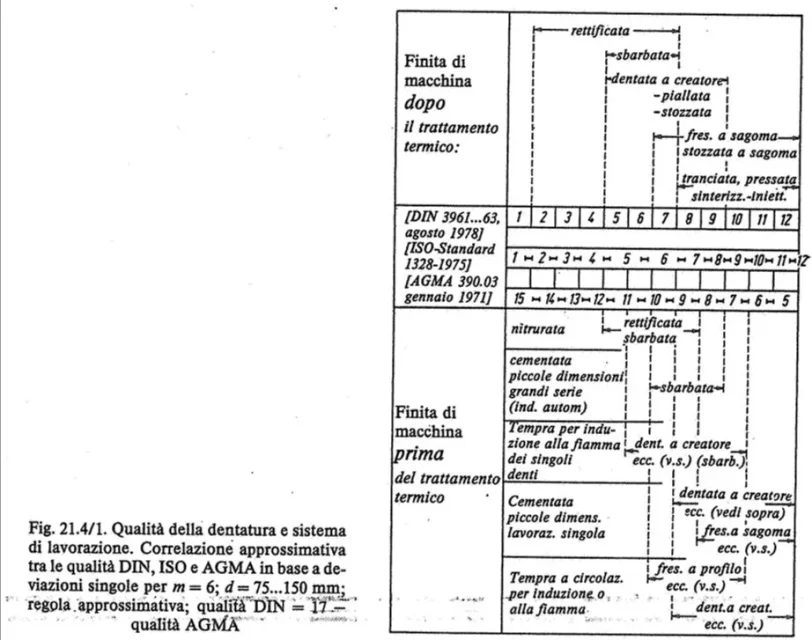
values from 3 to 10 are the degrees that standards call q....
according to the iso 1328 or din 3962 the scale is reversed, that is 10 coarse to 3 precise.
what you are using is agma 390.03 where numbers range from 15 to 3 and 15 sample gears and 3 cut with the cannello or almost.Screenshot_20201027_202457.webp
 
exactly, much more simply to us were given indicative values of a, without referring to any norm, but it works exactly as you said...
 
hello to all, since I have sized the wheels now I am dimensionaling to resist the forces due to the calettamento of the gears and checking the trees statically and fatigue as I said through the haigh-goodman plane, I have seen that there are several methods to verify the carvings, there are those who apply the kf fatigue coefficient kf to the average sigma and the alternating component, while others apply the kf only Is there a way to know if two relatively close successive carvings interact with each other (e.g. tongue quarry and adjacent shouldering)? How do the effects of the two carvings combine? Thank you.
 
the effects that are combined are evaluated with fem and experimental test. There are no other methods. you can try to evaluate them analytically but it is not said that it is real.
on the forum we talked about carving and fem on trees...it was an exercise of three trees...read it.

Take a good book of construction science and solve some doubts.
 
hi to everyone, taking this discussion as I would like to share an excel sheet for checking out trees and fatigue. Attached there are also all the formulas that I used for the development of the sheet and of this "design" that starts now to the conclusion. I want to thank mechanicalmg for the great hand he gave me with his straights.
 

Attachments

Forum statistics

Threads
44,997
Messages
339,767
Members
4
Latest member
ibt

Members online

No members online now.
Back
Top