• This forum is the machine-generated translation of www.cad3d.it/forum1 - the Italian design community. Several terms are not translated correctly.

use plugs with internal hole - standard un 6364

  • Thread starter Thread starter CapMec
  • Start date Start date

CapMec

Guest
Hello everyone, I'm an engineering student and I'd have the following problem to propose. I am redesigning a tool changer and at the point of work to which I arrived, I now have to redesign some thorns that allow the centering between the tool changer and the tool that then the robot will move. However, both because I probably carry some gaps, both because the cad file from which I leave is one of those that download from the sites of the companies, and that therefore it is not detailed, I can not understand how to redesign the plug. first I would have a theoretical doubt: What difference is there, in terms of use, between a cylindrical plug and one instead with internal thread hole? Does the inner thread hole only serve for the extraction of the plug or allows other features? 2 images of the plugs (uni 6364) with/without inner threaded hole.
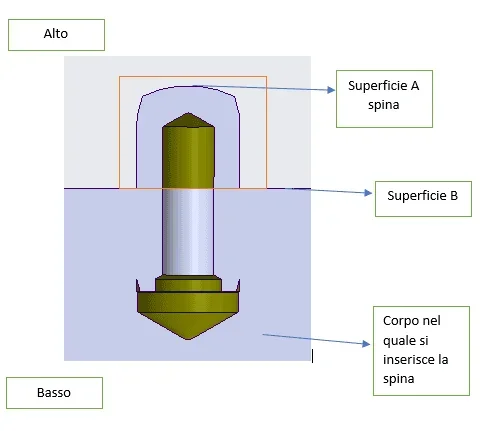
not having therefore understood how to use a perforated plug internally, I can not then interpret the cad from which I leave for redesign. i.e., if the inner thread hole only serves for the extraction of the plug (it is my guess that could be wrong) how would you pull the plug if the hole in which it fits is blind? I attach below 2 more images where I isolated from the model cad the plug and the body part with which it mates (from the last image it seems that the plug has been represented cut and only rested on the upper surface)
I hope I have expressed myself quite clearly and I thank in advance anyone who can answer me.
 

Attachments

  • Spine UNI 6364.webp
    Spine UNI 6364.webp
    15.9 KB · Views: 19
  • Spina sezionata CAD.webp
    Spina sezionata CAD.webp
    3.1 KB · Views: 18
  • Altra vista dal CAD della spina.webp
    Altra vista dal CAD della spina.webp
    4.1 KB · Views: 21
What difference is there, in terms of use, between a cylindrical plug and one instead with internal thread hole? Does the inner thread hole only serve for the extraction of the plug or allows other features?
the hole only serves for extraction
if the inner threaded hole only serves for the extraction of the plug (it is my guess that could be wrong) how would you pull the plug if the hole in which it fits is blind?
if one of the parts in which the plug is inserted has the blind hole serves the filletato hole in the plug for extraction; otherwise if the mating parts have hole passing the extraction you through percussion.
the two disehni that you have attached are unclear because you do not understand the plug and where the components to mate; make a silky design so that with the restraints you understand what you are looking at
both because the cad file from which I leave is one of those that download from the sites of the companies
What would that mean?
 
Thank you for the answers.
Then the problem is that I did not understand how the extraction process takes place. in the sense that, if the hole is blind and if, in fact, the plug has the surface to (see attachment) closed, how do I insert the extractor to be coupled to the inner threaded hole of the plug? Should I pierce from below the body in which the plug is inserted to insert the extractor? I don't think so, I guess I just don't know how the extraction process takes place.

I answer the second and third quote at once. the problem is this: if you go to the schunk site (company randomly), you can register on their site. once registered, if you are interested in their product, you can request to download a cad model from the site (for example a gripper - tire). However, the cad file you download is not complete. in the sense that, on the outside there are all the components of the model, however, if you go to dissect, you find that all the internal geometries have been removed (e.g. regarding the caliper can lack the internal piston, the holes that pass the pressurized air in the piston chambers, etc...). and of course they do this to protect their data, since they make available for everyone, so easily, their cad models.
then my cad file of the tool changer is of the same type. the external geometries are correct, but setiating it is seen that the model inside is "empty" or many simplifications were introduced. So, the sampling you said, I should introduce it, but if I did not understand how the plug was coupled in the hole (being the same unclear model), I would make a wrong sampling, which could lead to you too. Anyway, the little I figured out from the model, you find it in the attached image. the plug, should be the one in red, and it was coupled simply "for support" to the body (i.e. it does not enter), because of the simplifications introduced on the model I told you
 

Attachments

  • Spina1.webp
    Spina1.webp
    8.6 KB · Views: 31
Hello everyone, I'm an engineering student and I'd have the following problem to propose. I am redesigning a tool changer and at the point of work to which I arrived, I now have to redesign some thorns that allow the centering between the tool changer and the tool that then the robot will move. However, both because I probably carry some gaps, both because the cad file from which I leave is one of those that download from the sites of the companies, and that therefore it is not detailed, I can not understand how to redesign the plug. first I would have a theoretical doubt: What difference is there, in terms of use, between a cylindrical plug and one instead with internal thread hole? Does the inner thread hole only serve for the extraction of the plug or allows other features? 2 images of the plugs (uni 6364) with/without inner threaded hole.
not having therefore understood how to use a perforated plug internally, I can not then interpret the cad from which I leave for redesign. i.e., if the inner thread hole only serves for the extraction of the plug (it is my guess that could be wrong) how would you pull the plug if the hole in which it fits is blind? I attach below 2 more images where I isolated from the model cad the plug and the body part with which it mates (from the last image it seems that the plug has been represented cut and only rested on the upper surface)
I hope I have expressed myself quite clearly and I thank in advance anyone who can answer me.
the threaded hole can be used for extraction, as already mentioned, or to hold the plug in case the housing hole is made with tolerance so as not to allow fixing for interference of the plug itself. In that case, in order to avoid the spin of the group, the thorns fall, you can put a screw to hold the plug.

to be able to do the extraction of course you must have the threaded hole accessible. So, for example if you have a plugd10 with fil hole. m6, you will make a laminated hole, i.e. double diameter with the d10 centring hole in tolerance with depth, equal to the centring length you want to have (typically 1.5/2 * d) and a concentric hole passing d6,5, or more 'most simply put the plug with the threaded hole facing the outside. at that point to extract it, screw m6 and then with a tool similar to a lever fork and pull out.

In your case I think there is no contraindication to mount the thorns with the threaded hole visible from the outside.
 
perfect, thank you very much for the explanation. from the theoretical point of view everything comes back, so I think I understand that it is the cad model on which I am working not to correctly represent the plug coupling with internal thread hole and the body in which it is placed
 
in the sense that, if the hole is blind and if, in fact, the plug has the surface to (see attachment) closed, how do I insert the extractor to be coupled to the inner threaded hole of the plug?
I thought it was obvious that the threaded hole should be on the visible side.

for models that download makes sense that they are wanting if they are commercial parts with protected engineering (reducers, martines, cylinders), but not unified elements.
Are you sure you're not the one that misleads the files? I downloaded hundreds of files from various sites and never found the blank part internally (other than what difference does it make for the company to have the empty or full interior? )
attach this plug that turns out empty internally that you take a look at it
 
perfect, thank you very much for the explanation. from the theoretical point of view everything comes back, so I think I understand that it is the cad model on which I am working not to correctly represent the plug coupling with internal thread hole and the body in which it is placed
Do you send an unseated view of the quick schunk change? I've assembled a lot of these objects and I haven't usually had any major interpretation problems. Have you looked at the quoted 2d design of the catalog?
 
The file passed it directly to me, so I don't know how he dumped it.
I send you the whole model of the tool changer that I am remodeling, so maybe you make an idea of the thorns that are present in the model (I am 2). I am using creo parametric 7.0, so the file has extension prt. If you change extension manually, you should be able to open it with any other cad.
 

Attachments

Why? even the file I was past had this extension: toolchanger.1. so if I did not change extension manually in .prt, that is readable from creo, the file could end directly in the basket, being unusable
 
because if it was enough to change extension to switch from creo to solidworks to ca... there would be no proprietary extensions. nor would neutral formats exist
also how do cads have different functions and methods of modeling read the same files?
 
The file passed it directly to me, so I don't know how he dumped it.
I send you the whole model of the tool changer that I am remodeling, so maybe you make an idea of the thorns that are present in the model (I am 2).
to design you must absolutely look at the quoted design of the manufacturer's catalog, to understand what are the fixing holes, such as electrical connections, such as pneumatic ones, etc.

Get out of here.
and try to locate your specific group.

your file I couldn't open it.
 
those thorns are planted to interference and are not made to be extracted.
that hole you see in your images could be a modeling error, that is, those who shaped the object did not worry much and inserted the first plug, the correct size, available.
.1 is a file according to me creo to which the pre-extension prt was removed
here. a list of extensions of the various cad
 
perfect, if you tell me they can't be extracted then everything comes back. Thank you very much for your help. Thank you, too, hunter.
Good evening
 
thorns with extraction hole, which is the standardized wording of these cylindrical objects with a threaded hole, serve to center two objects among themselves. normally the holes are made in h7 and the thorns are in m6 or h6 depending if I want them to be practically non-removable or mobile.
The tool that is used to extract the coils, is called extractor. it is made by a 200-300mm long round with a threaded grain mounted in tip. on the bar flows a weight that beats to pull on the head of the bar. In this way you have the espionage manoeuvre.Screenshot_20201125_195615.jpg1 and 2 screw the bar in the plug
3 I carry the weight towards the plug
4 strong shooting at the bottom
I do several times until the plug comes out of the hole.
This is what is done in blind holes.

the thorns in m6 plant with the press and.... remove themselves if they are broken and they must be restored holes and thorns. It is not common practice to parade them....they are not made for that use.
 

Forum statistics

Threads
44,997
Messages
339,767
Members
4
Latest member
ibt

Members online

No members online now.
Back
Top