
• This forum is the machine-generated translation of www.cad3d.it/forum1 - the Italian design community. Several terms are not translated correctly.

circuit diagram

  • Thread starter Thread starter ector
  • Start date Start date

ector

Guest
Hey, guys, I have to make a plumbing circuit, could you help me do it?
I basically have to turn a hydraulic motor (in both directions of rotation) that must win a pair of 30 nm, at a speed of 250 rpm.
I have to connect it to a 24V powered electric motor.
I thought of the following scheme:
electric motor-joint- hydraulic pump- distributor- hydraulic motor.
My question is:
Where do I put the various valves?
What pressure does it work?
how can I gradually control the speed of the hydraulic motor?

If you can help me, I'd be grateful
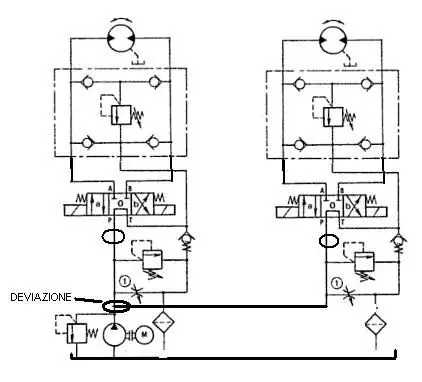
 
Hey, guys, I have to make a plumbing circuit, could you help me do it?
I basically have to turn a hydraulic motor (in both directions of rotation) that must win a pair of 30 nm, at a speed of 250 rpm.
I have to connect it to a 24V powered electric motor.
I thought of the following scheme:
electric motor-joint- hydraulic pump- distributor- hydraulic motor.
My question is:
Where do I put the various valves?
What pressure does it work?
how can I gradually control the speed of the hydraulic motor?

If you can help me, I'd be grateful
so is vague and all the schemes are fine.
better describe the work that has to do the engine.
Let me give you an example. I recently moved an oleodynamic engine in both directions. with the complication that had to sustain a "something" subject to gravity, and was rather heavy (about 4000 kg).
I used proportional valves both of pressure and flow and a counterbalance valve.
Can it be your case? or do you have no gravity/instance to consider?
 
so is vague and all the schemes are fine.
better describe the work that has to do the engine.
Let me give you an example. I recently moved an oleodynamic engine in both directions. with the complication that had to sustain a "something" subject to gravity, and was rather heavy (about 4000 kg).
I used proportional valves both of pressure and flow and a counterbalance valve.
Can it be your case? or do you have no gravity/instance to consider?
I have to turn a cylinder around its axis, the load of the cylinder is about 2000n and moreover, the torque must be 30 nm as previously said. once the load is practically zero because it rotates on bearings.
But I have to control the rotation speed from zero to max (250 rpm-300rpm) and also the system must allow rotation in both directions, blocking the cylinder when it stops in any position.

I hope to have been clearer....obviously what said above still applies.

thank you very much for the straights, projector
 
a couple of considerations. . .
I see you put the valve in closed centres. this will block (or almost) the engine when the valve is closed. You okay?
I see that block next to the engine. I interpret it as a vent valve in both directions, to set a different working pressure for each engine. But so the pressure will be the same as you turn in one way or another. You okay? or will you have different needs turning time or anti-clockwise?
I see that the control valves are on-off type. Are you okay or do you need to do soft-start? will you always travel to the maximum reach? or do you think it might be useful to use a proportional valve?
I do not see any emergency brakes/stations on the engine. You don't need it or you forgot?
Could the load moved by the engine drag the engine itself to inertia? If so, with this solution you cannot control and limit this phenomenon.
 
a couple of considerations. . .
I see you put the valve in closed centres.
I'm sorry what would it be? Can you tell me with the numeretto?this will block (or almost) the engine when the valve is closed. You okay?
Yes, I want the engine to stop when they don't operate or interrupt the drive.I see that block next to the engine. I interpret it as a vent valve in both directions, to set a different working pressure for each engine. But so the pressure will be the same as you turn in one way or another. You okay?Yes, it must behave in the same way both in one sense and in the other.or will you have different needs turning time or anti-clockwise?
no, nn ne ho.I see that the control valves are on-off type. Are you okay or do you need to do soft-start? Perhaps it would be better a gradual command, of the type more prone the lever or I press the button and the more the speed increases.it must be gradual or instant the drive.will you always travel to the maximum reach? noor do you think it might be useful to use a proportional valve?the circuit must be extremely simple.I do not see any emergency brakes/stations on the engine. You don't need it or you forgot?I forgot... where would it be inserted?Could the load moved by the engine drag the engine itself to inertia? no, absolutely.consider that I connect it to an endless screw gear, therefore theoretically, having the latter the characteristic of irreversibility should not drag the engine.If so, with this solution you cannot control and limit this phenomenon.
I'm sorry, but as you see, I'm very little practical, that little one I learned from the texts... I've attached the same pattern but with some numeretto to identify the components so that I can better understand you when I indicate the various parts.
 

Attachments

a couple of considerations. . .
I see you put the valve in closed centres.I'm sorry what would it be? Can you tell me with the numeretto?
You didn't put the numeretto.
so I attach an explanatory image. . .


I see that the control valves are on-off type. Are you okay or do you need to do soft-start?Perhaps it would be better a gradual command, of the type more prone the lever or I press the button and the more the speed increases.it must be gradual or instant the drive.
Okay. You can coarse it with manual control valves, lever. those that are used on earth moving means, so much to understand us
If you need to command electrically, you have to fall on proportions, with all annexes and connected ....

I do not see any emergency brakes/stations on the engine. You don't need it or you forgot?I forgot... where would it be inserted?
engines have no brake. but they can have the gearboxes. see with the supplier what can put as an accessory. for safety, it should be a positive brake. ie it is always stuck and if you send oil in pressure it unlocks. then you must also predict a circuit to unlock the brake. or set a valve, or with a valve or pick the oil from the engine power.
 

Attachments

  • LAYOUT2.webp
    LAYOUT2.webp
    23.7 KB · Views: 35
You didn't put the numeretto.
so I attach an explanatory image. . .


Okay. You can coarse it with manual control valves, lever. those that are used on earth moving means, so much to understand us
If you need to command electrically, you have to fall on proportions, with all annexes and connected ....


engines have no brake. but they can have the gearboxes. see with the supplier what can put as an accessory. for safety, it should be a positive brake. ie it is always stuck and if you send oil in pressure it unlocks. then you must also predict a circuit to unlock the brake. or set a valve, or with a valve or pick the oil from the engine power.
I know that in the end I will have to opt for proportionals, I would not want the movements to be too "brush".
the engine is connected to a reducer, so theoretically it should stop when the power stops, so I think the brake can be avoided. . .

How do you say it's okay?
Does something change at the scheme level with a proportional valve? I don't think...
a further question, when I go to dimension, since as data I only have the couple and the turns that need hydraulic engines, how do I proceed? i.e. the pressure of the plant I establish it and proceed on that road?
in correspondence of the deviation what happens? halves the flow, the pressure.. .

Thank you very much for your help.
 
I know that in the end I will have to opt for proportionals, I would not want the movements to be too "brush".
the engine is connected to a reducer, so theoretically it should stop when the power stops, so I think the brake can be avoided. . .
Be careful.. endless screw gearboxes are not always irreversible.
depends on the reduction ratio. and however in the presence of oscillating loads, vibrations and other amenities can also turn. depends on your project...if it is a problem or if the involuntary rotation of these pieces can cause damage to people, a brake is urgent.
How do you say it's okay?
bho, conceptually yes, you will have to refine it a bit and declare all the components used
Does something change at the scheme level with a proportional valve? I don't think...
Of course it changes. the proportional valve has a different symbol.
if it is electrically operated servo-driven, moreover, you must predict power supply and drainage even for the rider, unless it is internal. depends on what valve you take.
a further question, when I go to dimension, since as data I only have the couple and the turns that need hydraulic engines, how do I proceed? i.e. the pressure of the plant I establish it and proceed on that road?
in the catalogs of hydraulic motors you can also find information on the necessary pressure and the required flow rate, depending on the torque and number of turns of the engine.
Be careful with pressure. the temptation to go to 250 bar is strong, but the components for 250 bars cost... and give trouble.. .
in correspondence of the deviation what happens? halves the flow, the pressure.. .
Good question.
Let's say that if you oversize the plant and then during the work the valves will not be aperet to 100% you can also whistle what happens there.
if size to the hair, perhaps better start thinking about a flow divider. but it is not so reliable, especially if the two engines must turn at the same speed
 
only one considered.. .
all these components you will have to buy them sooner or later.
I understand that it is good to "learn" to arrange for yourself, but since the oleodynamics is a "bad beast", I highly recommend you to lay out the scheme in collaboration with your supplier. it certainly has more experience than me and you put together, it will also suggest suitable valves for the purpose, make measurements, recommend the "astute" that we would not have thought. . .
 
engines have no brake. but they can have the gearboxes. see with the supplier what can put as an accessory. for safety, it should be a positive brake. ie it is always stuck and if you send oil in pressure it unlocks. then you must also predict a circuit to unlock the brake. or set a valve, or with a valve or pick the oil from the engine power.
only a small clarification....in the field machines earth movement the tea brake described is called negative type: it cools mechanically with springs and rubs with pressure....while the positive brake is the opposite: it cools when it is pressed and rubs through springs when it is not fed.... is it correct?
In the first case it will be necessary to provide a braked lag valve, since the brake in question is static, only cool when the rotation is firm....usually this delay is done with one-way adjustments
Bye.
 
for mbt post 10 in the last part you wrote that it should mount a positive brake, perhaps you're confused "it's the negative brake that unlocks when pressure mandium" however this brake does not serve to control a rotating blackberry but only for safety, to do what is described it takes a group of valves block and control, try to hear the g fluid Mr. guglielmo him and a magician of these chores.
 

Forum statistics

Threads
44,997
Messages
339,767
Members
4
Latest member
ibt

Members online

No members online now.
Back
Top