
• This forum is the machine-generated translation of www.cad3d.it/forum1 - the Italian design community. Several terms are not translated correctly.

thermal expansion

  • Thread starter Thread starter athlon
  • Start date Start date

athlon

Guest
Bye to all,

I have a doubt about the thermal expansions, I designed a small "type" that you can see in the annex.

The stamp is the square bit at the end of the arc, the cylinder at the center is the pin around which the piece rotates.


I wanted to make it all in steel but before I leave with the realization I have a doubt that it amazes me... when the piece will become warm (about 400°) the face of the stamp will continue to have the same orientation of when the piece is cold or the semicircle will be extended, going to cover more than 180°


I don't care if the stamp moves to the center or moves away but it's important that the lower face of the stamp stays parallel to the reference plane


if you need more details please ask

Thank you.
 

Attachments

  • timbro.webp
    timbro.webp
    105.2 KB · Views: 63
I forgot, is there any software that shows me how to spread a piece to vary temperatures and materials?
 
First of all welcome
I invite you to present yourself in the appropriate area.
However, for steel, the thermal expansion coefficient is about 11x10-6 1/°c
Knowing the length of the bow and delta t, you can calculate the length and therefore how much your parallelism will vary.
honestly, if you don't need extreme precision, I think you don't need a specific sw... Just a hand-bug
 
:finger: made presentation


When I return to the piece, I need extreme precision, in the sense that the modification of parallelism must be mathematically zero, i.e. the expansion of the arc must be compensated exactly, otherwise the mechanism is jammed.


instinctively I would think that the 180° arc still remains a concentric 180° arc compared to the cold arc.
if we think of a cold tube and a hot tube the geometry does not change.
simply dilates into a larger and concentric circle
 
Yeah, but you don't have a pipe.
you have a folded square section wire with circle arch.
the pipe dilates because it can not do otherwise... .
 
Okay, seeing it as a square wire, I see it in another way, and it's right that the arch is flooded.

But now I have another doubt, let's say that the bow stretches instead of covering 180° it covers 182°.

Does the plaque eventually remain radially oriented or does it take a different orientation?


p.s. thanks 1000 for answers
 
I need extreme precision in the sense that the modification of parallelism must be mathematically zero
then give up. mathematical precision, in nature does not exist.
at 400°c the steel changes state allotropic, the crystalline structure changes, the dislocations migrate. That's enough for you to lose mathematical precision.

Let's go back to the real world, because taking into account what I said above is engineerically a ca*ata.

therefore. thermal expansion, geometrically, is a sharp transformation. In the case of isotropic steel (so not rolled in a particularly directional way) the matrix is a k*i. in Italian more drinking, it is as if it were a climb, then the arc remains 180°.

in practice, imagine to stand out a vector between two points of your object (for example between two vertices of your face); At dilation, the carrier has elongated a certain amount, but has remained parallel to itself.

I am safe at 99.5%, for the remaining 0.5%, someone forgets me.. .
 
:smile::smile::smile::smile:

Okay, so the timbre's face remains parallel to itself, but is it also radial oriented?


I mean, if before the expansion, the pivot rotation axis was to match the timbre face, even after the expansion, this property is maintained?


I did a second design where in red I drew a hypothetical dilated stamp, is it correct as a hypothesis of expansion?


Thanks again
 

Attachments

  • dilatazionetimbro.webp
    dilatazionetimbro.webp
    157.9 KB · Views: 36
but did you also consider a "vergulation" outside the bow?
I wouldn't rule out this hypothesis. :rolleyes: (in practice a slight deformation)

Hi.
p-h
 
but did you also consider a "vergulation" outside the bow?
I wouldn't rule out this hypothesis. :rolleyes: (in practice a slight deformation)
Hi.
p-h
:eek::eek: I had just put my soul in peace by trashing me into the sweet idea that my deductions were correct when you come to put the flea in my ear :frown:


at this point I believe that the ideal is to feed the model to some suitable software
 
Okay, seeing it as a square wire, I see it in another way, and it's right that the arch is flooded.

But now I have another doubt, let's say that the bow stretches instead of covering 180° it covers 182°.

Does the plaque eventually remain radially oriented or does it take a different orientation?


p.s. thanks 1000 for answers
that bow, in addition to stretching, will be deformed in a very difficult way. the less you "enlarge" losing the circularity and therefore your plaque hardly (impossible) will maintain the same orientation and will go out of its original axis.

greetings
Mar
 
the vector has elongated of a certain amount, but remained parallel to itself.
I am safe at 99.5%, for the remaining 0.5%, someone forgets me.. .
I wouldn't swear. is that 0.5% we care:biggrin:
that piece has such a varied conformation that it is unlikely to calculate (and then possibly anticipate it during the project) the deformation. for me and experience, he'll go somewhere he likes.
at this point I believe that the ideal is to feed the model to some suitable software
Not even.
The ideal would be to make a prototype and test it. but.. you would not have the certainty that all future pieces behave in the same way:rolleyes:

greetings
Mar
 
:eek::eek:
@sampom: if you took me to the bat you hurt me less:biggrin:


In summary, I have a piece of which it is impossible to calculate the dilation behaviour and also by making a prototype (but how much would it cost? ) there is no certainty of behavior :frown:
 
Wait, wait.

We're getting confused.
if it is right what I say, and the probability climbed to 99.9%, the piece actually behaves as posted by athlon some posts ago. This is the theory, and that's what would give you any fem.

If you notice, in my post, I speak of a perfectly isotropic material, which alas, once again, does not exist in nature.

any piece worked, will have both residual tensions, and anisotropity of the material, and I think that is what they want to express almost all posts between my last and this here.

Of course, we are talking about imperfections of the material. If you build two pieces, one in Russian and one in africa, do you really think they're acting the same way? If that were the case, guys, we made it all wrong. the world does not need engineers!! !

Waiting therefore that "zero deformation" is an unrealizable dream, we want to try to give some tolerances of parallelism as dictated by our friends norms? otherwise we speak different languages.
 
....you guys got it all wrong. the world does not need engineers!! !
Why, did you have any doubts? :biggrin: She ran away. I don't think so.
Waiting therefore that "zero deformation" is an unrealizable dream, we want to try to give some tolerances of parallelism as dictated by our friends norms? otherwise we speak different languages.
Right. .
but he asks "absolute accuracy." .
However if you can, stabilizing it and working it. But as you say, a little tolerance takes us.
then if you find me the hypertropic so much better:smile:

greetings
Mar
 
Why, did you have any doubts? She ran away. I don't think so.


Right. .
but he asks "absolute accuracy." .
However if you can, stabilizing it and working it. But as you say, a little tolerance takes us.
then if you find me the hypertropic so much better

greetings
Mar
"absolute" accuracy at 400°c :eek:

azz... and I who blasphemy in 18 languages because if I change the temperature of some degree (the few) I go away the thousandths... :cool:

:smile:

Bye!
p-h
 
At this point learned that the stamp "smarts" according to you it is possible to play with the elasticity of the bow to make sure that under effort the bow deforms that much that is enough to put the timbre back on or would break the bow?

working conditions are a tempering range from 300° to 500° with 160 "cuts" per second


to give you an idea of the size the square that stamps is 25mm x 25mm and between a stamping and the other the wheel piece of 45° around the central prey
 
Bye to all,

I have a doubt about the thermal expansions, I designed a small "type" that you can see in the annex.

The stamp is the square bit at the end of the arc, the cylinder at the center is the pin around which the piece rotates.


I wanted to make it all in steel but before I leave with the realization I have a doubt that it amazes me... when the piece will become warm (about 400°) the face of the stamp will continue to have the same orientation of when the piece is cold or the semicircle will be extended, going to cover more than 180°


I don't care if the stamp moves to the center or moves away but it's important that the lower face of the stamp stays parallel to the reference plane


if you need more details please ask

Thank you.
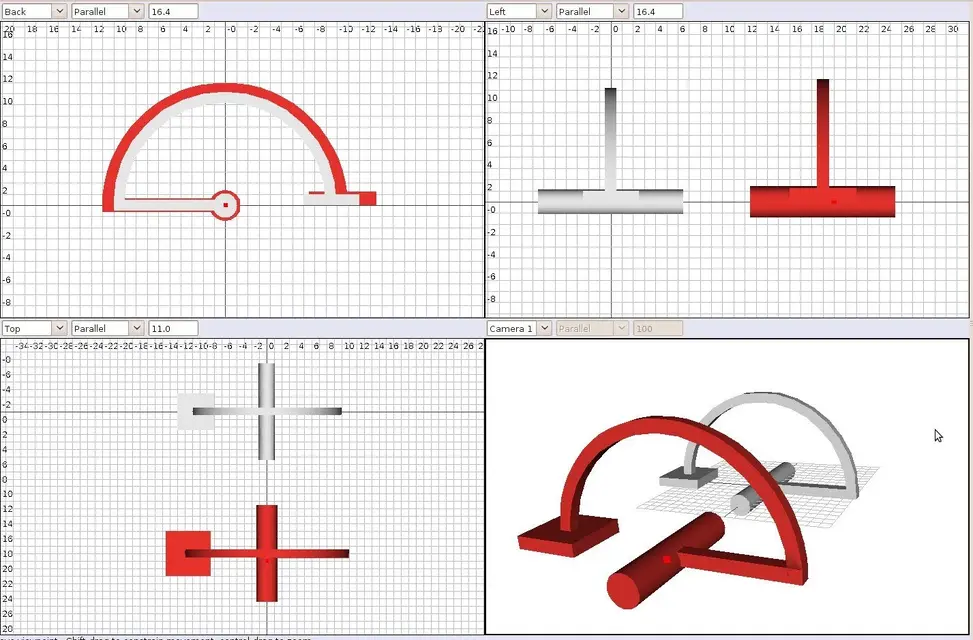
As you talk about a real material with a not negligible thickness, you will certainly have a dilation in radial direction (and then the semicircle will be bigger once heated), but also a circumferential expansion (then will also increase the angle described by your arc).
 

Forum statistics

Threads
44,997
Messages
339,767
Members
4
Latest member
ibt

Members online

No members online now.
Back
Top