• This forum is the machine-generated translation of www.cad3d.it/forum1 - the Italian design community. Several terms are not translated correctly.

volandia

  • Thread starter Thread starter Er Presidente
  • Start date Start date
I mean! I was "paparazed" at every step!!!! !
I ask to be put in immediate possession of the original material, penalty a good complaint to the competent "organs"!
 
I mean! I was "paparazed" at every step!!!! !
it was indispensable!
In the debate on the request for damages, hunting and I will be able to demonstrate that we have been or to look at or behind the objective. what was touching all over you:
I ask to be put in immediate possession of the original material, penalty a good complaint to the competent "organs"!
as written above, you should do little advertising, other than you can seenunce:smile:. you will still have all the pictures in full format :wink:
as you can see however there was also who, not having to keep an eye and brake, as touched in lot to me and hunt in the morning, with the arrival of meccbell in support of the afternoon, intelligently enjoyed the fresh.
 

Attachments

  • al fresco.webp
    al fresco.webp
    631 KB · Views: 37
it was indispensable!
In the debate on the request for damages, hunting and I will be able to demonstrate that we have been or to look at or behind the objective. what was touching all over you:


as written above, you should do little advertising, other than you can seenunce:smile:. you will still have all the pictures in full format :wink:
as you can see however there was also who, not having to keep an eye and brake, as touched in lot to me and hunt in the morning, with the arrival of meccbell in support of the afternoon, intelligently enjoyed the fresh.
Unfortunately I did, I interist, a Romanist son and without the "fire sacrum in the veins" of the aviatory art.
All because of bad companies!
 
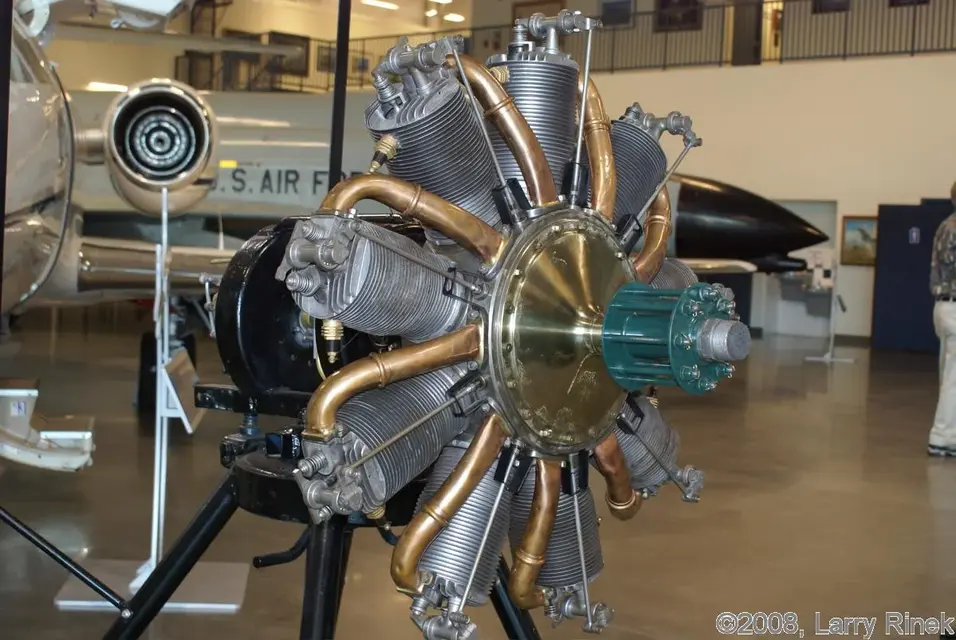
first we must recognize the three basic models of rotational engines (French).
gnome, rhone and clerget.
the gnome and rhone melted and therefore often the engines are indicated as gnome the rhone without distinction.
the gnome was the first, called monosoupe (monovalvola).
had only one valve in the controlled (unloaded) head and suction valve in the automatic piston sky.
the rhone had two valves in the head controlled by a single rod "push-pull", while the clerget had two valves in the head controlled by two traditional rods.
externally the gnome is recognized for the absence of an aspiration manifold towards the head and the single rod, the rhone is unmistakable for the intake manifold alongside each cylinder and the single rod the clerget could deceive because it has the manifold behind the cylinder and maybe not seen, but the two rods in front of the cylinder can not give rise to doubts.
 

Attachments

  • Gnome_N-9_rotary_view.webp
    Gnome_N-9_rotary_view.webp
    264.2 KB · Views: 10
  • Rotary_lerhone.webp
    Rotary_lerhone.webp
    133.8 KB · Views: 6
  • Le_Rhone_view_2.webp
    Le_Rhone_view_2.webp
    127.3 KB · Views: 8
  • Clerget_9B.webp
    Clerget_9B.webp
    301.2 KB · Views: 6
  • engine-clerget-06.webp
    engine-clerget-06.webp
    130.8 KB · Views: 4
first we must recognize the three basic models of rotational engines (French).
I'm just writing to point out that these photos were taken, who knows where but not flying, you never see that one leaves us on purpose and then doesn't find them!

However, the next time you go to see something with the president, I recommend participation, it's always patient, even with those who ask for explanations like the undersigned.....it's not even as threatening as it might appear from his writing style... :biggrin:
 
I'm just writing to point out that these photos were taken, who knows where but not flying, you never see that one leaves us on purpose and then doesn't find them!

However, the next time you go to see something with the president, I recommend participation, it's always patient, even with those who ask for explanations like the undersigned.....it's not even as threatening as it might appear from his writing style... :biggrin:
Damn it! You're right, the pictures I took from goggol and I didn't realize it could be misleading.

p.s.: I look peaceful, but only with the people I stimo.
There are a lot of witnesses around my temper!
:biggrin:
 
Let's start with some photos of the flyer museum.
Right away, you need to open a bracket on the rotational motors we see here on display.
so in light of what is exposed, it will not be difficult to correctly identify the engines object of the photos.

If the hydro cap has a rhone, the bleriot seems to have a gnome.

we checked on the tag and it would seem so, but the good hunter, moved by the typical curiosity and ocque stroke of those who have mechanics in the blood, rightly noticed the second row of holes unused on the carter, just for a second series of rods.

the bleriot is a replica made of wedge (as written on the sign) and in my opinion, the engine was also replicated.
probably had to be born as a clerget, then the contingent requirements required a monosoupe gnome, when some "macchinata" had already been made.
 

Attachments

  • volandia_2010 285.webp
    volandia_2010 285.webp
    586 KB · Views: 5
first we must recognize the three basic models of rotational engines (French).
gnome, rhone and clerget.
the gnome and rhone melted and therefore often the engines are indicated as gnome the rhone without distinction.
the gnome was the first, called monosoupe (monovalvola).
had only one valve in the controlled (unloaded) head and suction valve in the automatic piston sky.
the rhone had two valves in the head controlled by a single rod "push-pull", while the clerget had two valves in the head controlled by two traditional rods.
externally the gnome is recognized for the absence of an aspiration manifold towards the head and the single rod, the rhone is unmistakable for the intake manifold alongside each cylinder and the single rod the clerget could deceive because it has the manifold behind the cylinder and maybe not seen, but the two rods in front of the cylinder can not give rise to doubts.
I did not understand how it was possible that the biellas were not intertwined when the base turns and the motor shaft stands still, here is the solution:http://www.youtube.com/watch?v=ku1nicumdj0&feature=relatedIt has nothing to do with it, but I attach a stellar engine model in step format, whose original (for solidworks) is at this address.http://solidworks.cad.de/lib_motor01.htmIt should be aeromodel stuff seen the size.
 

Attachments

Last edited:
I did not understand how it was possible that the biellas were not intertwined when the base turns and the motor shaft stands still, here is the solution:http://www.youtube.com/watch?v=ku1nicumdj0&feature=related
...
It's proof of relativity.
In reality nothing changes absolutely compared to a fixed star engine, you just have to pretend to be an aristotle attached to the engine shaft and think to be in the center of the universe and that everything revolves around you.
:biggrin:
 
and this is a small "divagation" that the goats were granted in the period of the Autharchical "Grandur". :eek:
PICT0030.webpPICT0031.webp
 
Shit! I had heard about it, but reported to German engines, at least that seemed to me.
really interesting and anyway, a smart solution!
but how did you not even manage to start it?
And to think that I imagined it was the first thing you would touch as soon as you entered the capron pavilion.

(but in fact in my list of your possible "tentations" there was another, but I keep aside, to do the "bottom" :biggrin:)
 
In the meantime, congratulations on the trip, I'm intruding a moment:biggrin:, was this at the museum?
http://it.wikipedia.org/wiki/fiat_as.6I have seen it a few years ago at the museum of the lingotto is really a beautiful beast :finger:

bye, I expect other photos:biggrin:
This is in the valley vineyard.
"casually", on the occasion of the silver wedding, I organized a short holiday on the lake of bracelet for the next week.
But if my wife "sgams" my real intentions don't get to the gold ones, not even at 26!

p.s.: if someone, always "casually", was located near the bracelet. . .
 
This is in the valley vineyard.
"casually", on the occasion of the silver wedding, I organized a short holiday on the lake of bracelet for the next week.
But if my wife "sgams" my real intentions don't get to the gold ones, not even at 26!

p.s.: if someone, always "casually", was located near the bracelet. . .
that mornings:biggrin:, I was a little at the bracelet museum, unfortunately I was too small and I do not remember a stern:cool:.
I would like to come but I am under exams, fortunately the last:biggrin:
 
and this is a small "divagation" that the goats were granted in the period of the Autharchical "Grandur". :eek:
This is about exatem, I don't know what to say apart from doubting the "aerodynamic" qualities!
:biggrin:
When the president calls... time to collect some paper and here I am!
Italian minisommergibili

Among the many fascist propaganda of the twentieth century, there was a manifesto whose purpose was to underline the great naval power of Italy. on the profile of the peninsula were reported the position of the armies and the coastal batteries while the Mediterranean was filled with the silhouettes of the ships of the fleet and a huge amount of submarines. the latter constituted a continuous and impenetrable line throughout the coast. the poster was surmounted by the writing “is Italy vulnerable? No!”It is known that propaganda hides the magagne by giving a false image of reality but, as far as the submarines concerned, the manifesto had not “bared”. In fact, on 10 June 1940, the Italian Navy had 115 submarines, 38 oceans and 77 coasters.
It was a second underwater fleet only to the Russian one that, however, was divided into four fleets operating in different seas very distant from each other.
to this superiority were about to add white smg. and torelli, 6 other ocean submarines and 6 pockets.
numbers that, during the napoli naval magazine, also impressed hitler.
of this imposing fleet, there were also 26 small submarines called “tascabili”.
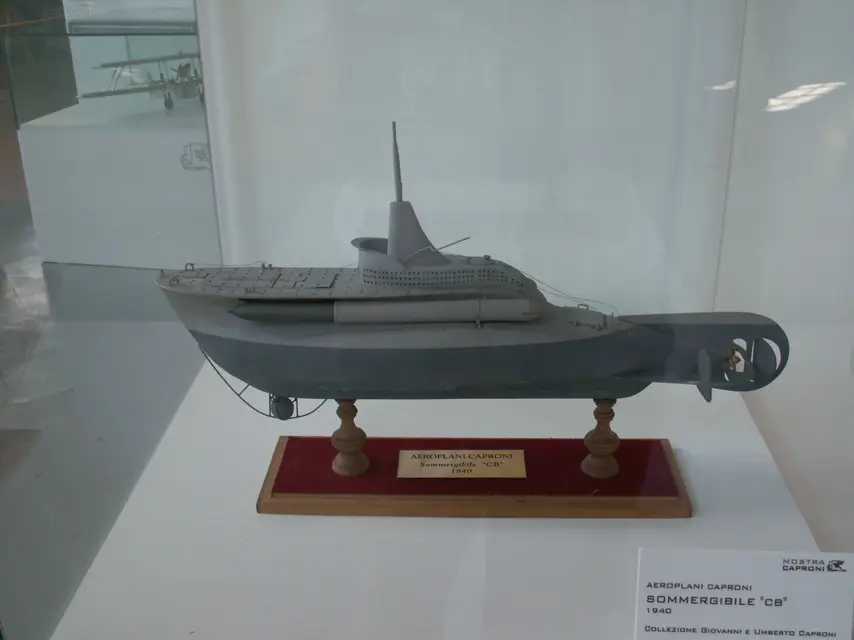
first were the c.a., designed by the caprons of taliedo. Caproni, with the support of a naval advisor (wine goeta), gave rise to the goeta-caproni project, which was presented after a few months to the ship design committee of the r m. the project was presented at the beginning of 1936 and was approved three months later. They entered service in April '38 and then experimented on the Lake of Exiseum. the first tests were positive and with small corrections to materials were accepted.
the company called this means “submersible motorboat”, but in fact it was a mini submarine. the construction began in the factory of taliedo (mi). had a strong hull with semi-low hats at the two extremes. ballasts, lancers and equipment installed externally to the resistant hull. measured 10 meters x 1.9 x 1.6. displaced 13.5 tons (16.4 in dive). the crew was two men: the command officer with access to the periscope and controls, the second was instead the driver (in position lying for lack of space).
c.a.1 and c.a.2 were experimental boats and did not give the hoped results. They proved unstable even at periscope altitude with calm sea. the motor apparatus consisted of a 60 hp diesel and 1 25 electric diesel that allowed a speed of 6.5 and 5 knots respectively. the autonomy was limited to 700 miles (57 dive) and the armament consisted of 2 450mm torpedoes. the tests continued in Venice where three officers began the trials. the two mini-submarines were sent to spice. the displacement of 4 tonnes was increased, for a final weight of 20 tonnes.
the two prototypes were abandoned in a warehouse where they were found by x flotilla mas. in 1941 the two minisommergibili were transformed into means for the transport of men range (assault divers). in fact the x mas had plans to use a c.a. to attack the port of New York. According to the plans a specially adapted ocean submarine should have transported the pocket submarine to the mouth of the hudson, after which the “tastable” would be carried by itself, transporting the divers of the tenth.
the incursors would have had the same equipment as on the slcs consisting of a rubber change and a circuit respirator closed with pure oxygen...
the two available c.a. were started to work. After the necessary restoration work at the manufacturer's firm, changes were made. The torpedoes replaced by eight explosive charges of 100 kg and periscope were landed. the diesel engine was removed and left only the electric motor. While the transformation was underway, the construction of two more boats with improved characteristics was required, c.a.3 and c.a.4. Meanwhile the oceanic submarine to be won, destined to be submersible "mother" was also subjected to transformation work. the transport and release tests of the minisommergibile began on 9 September 1942 in burgundy with a positive outcome. but although the tests showed the feasibility of the project, this was never completed. planned for December 1943, the action against New York was dismissed due to the armistice of September 1943.
 
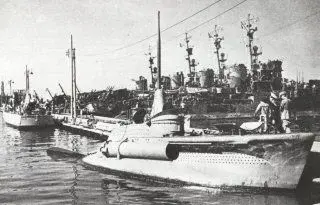
the project of a new type of pocket submarine, the type b coast (c.b.) that introduced significant improvements compared to c.a. but very limited tonnage, the cb were real jewels. were equipped with all the equipment of the older brothers. the resistant hull with external counters allowed 50 meters of depth (it reached also 65 meters) while the underwater propulsion allowed 12 knots. the engine system consisted of a small diesel engine and an electric motor that operated only one axis of propeller. In surface navigation, a road diesel was used. horizontal and vertical timoons were hydraulically moved as well as flooding and air vents. inside the hull it was not possible to stand if not to the periscope therefore it was navigated seated or lying (a mattress for the rest, in turn, of the 4 men of crew). 450 mm launch tubes were outside the hull.
for the “listening” there was a hydrophone initially placed on the deck but later moved to the keel.
the tests gave good evidence and 72 specimens were ordered, but only 22 boats were built. the other 50 were ordered by the use in Adriatic but the small industrial capacity allowed the construction of only 10 specimens in the period 1944-45. the first six were delivered between January and May 1941 and later employed in black mar well behaved (those that were requirements from the USSR remained in service until 1955). then the program underwent a long period of stasis and 6 other units were delivered only in late 1943, in fact when one realized that the allies sooner or later would attack the "soil patrio" the small submersible cb class would be very useful since for its size would be easily carried in the landing zones. in reality no submarine of this class was used for such a task. the desperate war situation led to improper use of the cb that were used as real submarines causing serious losses.
below the story of the 22 cb.
cb 1, delivered on 27.1.1941, was sent in black mar where he arrived on 2 May 1942. the armistice was ceded to the Romanesque; sabotaged in August 1944
cb 2, delivered on 27.1.1941, was sent in black mar where he arrived on 2 May 1942. on June 18, 1942, under the command of the Russian Adolescent, attacked and sank the Russian submarine sc-208. the armistice was ceded to the Romanesque; sabotaged in August 1944
cb 3, delivered on 10.5.1941, was sent in black mar where it arrived on 2 May 1942. the armistice was ceded to the Romanesque; sabotaged in August 1944
cb 4, delivered on 10.5.1941, was sent in black mar where it arrived on 2 May 1942. the armistice was ceded to the Romanesque; sabotaged in August 1944
cb 5, delivered on 10.5.1941, was sent in black mar where it arrived on 2 May 1942. was sunk during an air raid on yalta on 13.6.1942
cb 6, delivered on 10.5.1941, was sent in black mar where it arrived on 2 May 1942. the armistice was ceded to the Romanesque; sabotaged in August 1944
cb 7, delivered on 1 September 1943, was captured by the Germans in Pula on 9.9.1943; later disassembled and used for spare parts.
cb 8, delivered on 1 September 1943, at the armistice reached taranto, where it remained for the duration of the war; dismantled by peace treaty in 1948.
cb 9, delivered on 1 September 1943, the armistice reached taranto, where it remained for the duration of the war; dismantled by peace treaty in 1948.
cb 10, delivered on 1 September 1943, at the armistice was at taranto, where it remained for the duration of the war; dismantled in 1948.
cb 11, delivered on 1 September 1943, at the armistice reached taranto, where it remained for the duration of the war; dismantled by peace treaty in 1948.
cb 12, delivered on 1 September 1943, at the armistice reached taranto, where it remained for the duration of the war; dismantled by peace treaty in 1948.
cb 13, fell into the hands of the Germans in Pula on 11.9.1943 while he was in preparation, assigned to the siege and completed with pieces of the cb 7; he was sunk to the pole during an allied air raid on 23.3.1945
cb 14, fell into the hands of the Germans in Pula on 11.9.1943 while he was in preparation, assigned to the siege; he was sunk to the pole during an allied air raid on 23.3.1945
cb 15, fell into the hands of the Germans in Pula on 11.9.1943 while he was in preparation, assigned to the siege; was sunk in a pola during an allied air raid on unspecified date.
cb 16, fell into the hands of the Germans in Pula on 11.9.1943 while he was in preparation, assigned to the siege; in dry at senigallia on 1.10.1944, fell into British hands; unknown fate.
cb 17, fell into the hands of the Germans in Trieste on 10.9.1943 while he was in preparation, assigned to the siege and renumbered cb 6; he was sunk by allied planes on 3.4.1945 before Catholic.
cb 18, fell into the hands of the Germans in Trieste on 10.9.1943 while he was in preparation, assigned to the siege; sunk on 31.3.1945 before weighing, repeated in 1946 and later dismantled to venetian.
cb 19, fell into the hands of the Germans in Trieste on 10.9.1943 while he was in preparation, assigned to the siege; dismantled at the end of the war.
cb 20, fell into the hands of the Germans in Trieste on 10.9.1943 while he was in preparation, assigned to the rsi. captured by the partisans of titus in Pula at the end of April 1945 and included in its marina under the name of p901 malisan.
cb 21, fell into the hands of the Germans in September 1943 to Milan while he was in preparation; transported to pole and finished, it was spurned and sunk by a German transport on 29.4.1945 while heading to ancona to surrender.
cb 22, fell into the hands of the Germans in September 1943 to Milan while he was in preparation; was never completed at the end of the war and was purchased by the war museum in Trieste, where it is still now.
disCB.webp
Caproni CB.webp
cb1.webp
 

Forum statistics

Threads
44,997
Messages
339,767
Members
4
Latest member
ibt

Members online

No members online now.
Back
Top