
• This forum is the machine-generated translation of www.cad3d.it/forum1 - the Italian design community. Several terms are not translated correctly.

solidworks può fare questo? (che fa inventor)

  • Thread starter Thread starter braunfish
  • Start date Start date

braunfish

Guest
I use inventor, but I was wondering if solidworks can handle this process that I use now in inventor. I will make a simple example.

Suppose we have to create a welded set of 3 single parts (inventor manages the axiemi-saldati), together that then will be worked by another supplier of mine.
I must:
a) draw single parts and order them to the supplier
b) once in the workshop, take single parts and make bevels before welding them
c) weld parts so you get the welded as I need
d) to perform mechanical processing by an external supplier

to manage all this I in inventor I have the possibility of:
a) model single parts and transfer drawings to the supplier
c) mating single parts in a welded assembly, whose untouched mass I need to physically weld the pieces in the workshop.
important: (point b) for each part that forms the axieme, I can make preparations (smusses, cyanphrines) and decide, if I want, to have the putting on the table (as well as the "preparated" assemblies) also of the individual parts prepared, without that this overwrites the drawings of the individual parts to the point a. Indeed, this does not overwrite even the files of the single parts, is all stored in the file together.
d) I can model the work together, and decide to make the table of the very only welded (carpentry) or welded and worked (work)

with solidworks can handle this?
 
I use inventor, but I was wondering if solidworks can handle this process that I use now in inventor. I will make a simple example.

Suppose we have to create a welded set of 3 single parts (inventor manages the axiemi-saldati), together that then will be worked by another supplier of mine.
I must:
a) draw single parts and order them to the supplier
b) once in the workshop, take single parts and make bevels before welding them
c) weld parts so you get the welded as I need
d) to perform mechanical processing by an external supplier

to manage all this I in inventor I have the possibility of:
a) model single parts and transfer drawings to the supplier
c) mating single parts in a welded assembly, whose untouched mass I need to physically weld the pieces in the workshop.
important: (point b) for each part that forms the axieme, I can make preparations (smusses, cyanphrines) and decide, if I want, to have the putting on the table (as well as the "preparated" assemblies) also of the individual parts prepared, without that this overwrites the drawings of the individual parts to the point a. Indeed, this does not overwrite even the files of the single parts, is all stored in the file together.
d) I can model the work together, and decide to make the table of the very only welded (carpentry) or welded and worked (work)

with solidworks can handle this?
solidworks, proe, catia nx, spaceclaim, solidedge (to quote the cads I know) can do what you want, the important thing is to know how to use them (in swx for example, in addition to the welded joints, I would use the features of together and the configurations for the need to put into the table of different versions of the same piece).
 
Yes, in solidworks I have seen that I can create for example 2 combination configurations, for example 1)carpentry and 2)work, and for each processing feature decide to suppress it in carpentry configuration.

The only thing is that inventing I find very comfortable the fact that directly inside the feature tree I see divided and automatically assigned features of assembly and mechanical processing feature together.
 
The only thing is that inventing I find very comfortable the fact that directly inside the feature tree I see divided and automatically assigned features of assembly and mechanical processing feature together.
Could you post an image that shows what you mean? with swx you can also work in another mode in addition to what you mentioned, with the welding environment each welded assembly is represented by a multibody part and only after modeling "assieme" you will focus on the export of solid bodies into new parts to make the tables of details.
the advantage of this mode is to create and manage few files until the project is approved, only after you go to export the bodies and create the tables.
 
solidworks allows you to manage your components individually or in the field of assemblies using the configurations.
Therefore, you can insert one of your components in "grip" mode in a table, in the next sheet you can insert the same detail in the "short for welding" configuration, and so on.
in the axieme board you can enter a view (previously configured) relating to the rough and alongside the work. the basic concept is to prepare the configurations (discuss the redundancy of the concept), after which you can do what you want.
I hope I've helped you.
Good job
 
Yes, in solidworks I have seen that I can create for example 2 combination configurations, for example 1)carpentry and 2)work, and for each processing feature decide to suppress it in carpentry configuration.

The only thing is that inventing I find very comfortable the fact that directly inside the feature tree I see divided and automatically assigned features of assembly and mechanical processing feature together.
I think you've seen badly, the welding environment is partly and not together.
I recommend you go to youtube and type weldment and solidworks and see the videos that clear your ideas.
If we want to be honest, the working method of solidworks is more correct than that of inventor.
I have never seen working when a piece is already welded.
the bevels and holes you make them just after cutting and if you are equipped, during cutting.
 
I do not use much welded structures but with swx I found myself well enough to work on multibody parts, then exporting single solids for the necessary puts on the table.
good cutting distinction, a little dubious comfort attribution of the properties.
 
I have never seen working when a piece is already welded.
the bevels and holes you make them just after cutting and if you are equipped, during cutting.[/QUOTE]Do I know Sicuro?
 
I have never seen working when a piece is already welded.
the bevels and holes you make them just after cutting and if you are equipped, during cutting.
How not? I come to mind, for example, the base of a tool machine where ball recirculation guides, screws etc. are installed. I see hard working the structure before welding it
 
How not? I come to mind, for example, the base of a tool machine where ball recirculation guides, screws etc. are installed. I see hard working the structure before welding it
I must inform myself, in modena, about the emilia road that leads to bologna there is a famous company that produces machine tools.
it's expensive to work after welding.
However, even if it were, they are rare, specific cases and bound to objects that require high precision that not even laser cutting or oxide can't hold.
 
I must inform myself, in modena, about the emilia road that leads to bologna there is a famous company that produces machine tools.
it's expensive to work after welding.
However, even if it were, they are rare, specific cases and bound to objects that require high precision that not even laser cutting or oxide can't hold.
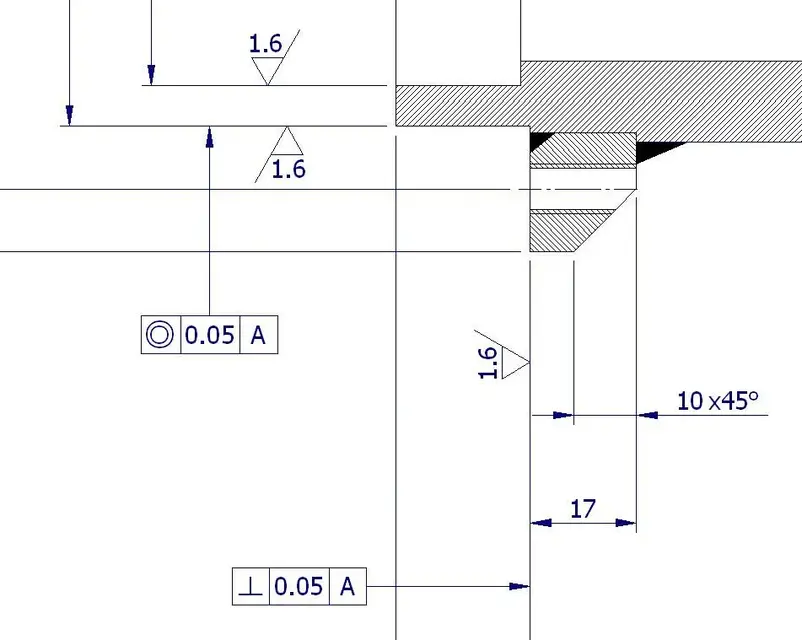
It's actually very common practice in precision mechanics. sometimes between welding and processing at m.u. a passage of thermal expansion of welded, if the importance of the piece makes it advisable.
 

Attachments

  • saldato-lavorato.webp
    saldato-lavorato.webp
    39.4 KB · Views: 56
exact hunter, we do so always, for certain things it is necessary.
welding (also 60/70 parts), thermal expansion, mechanical processing.

While this is our requirement, and inventor can work exactly in this way, i.e. by assigning works that he knows to be done after welding, my request was to know if there was a similar way/environment of working in swx, avoiding to configure every time each work together depending on whether it is pre or post.
hello and thanks to all those who are intervening.

ps: I realize that maybe someone confuses processes on monoblocks welded with "welding environment" that is used to make parapets etc, in which they assign structural elements to a 3d sketch.
 
Last edited:
exact hunter, we do so always, for certain things it is necessary.
welding (also 60/70 parts), thermal expansion, mechanical processing.

While this is our requirement, and inventor can work exactly in this way, i.e. by assigning works that he knows to be done after welding, my request was to know if there was a similar way/environment of working in swx, avoiding to configure every time each work together depending on whether it is pre or post.
hello and thanks to all those who are intervening.

ps: I realize that maybe someone confuses processes on monoblocks welded with "welding environment" that is used to make parapets etc, in which they assign structural elements to a 3d sketch.
I can confuse all the times that one asks questions in a generic way.
If you had been more detailed in your requests, maybe I would have addressed you more accurately.
However you could design your welded structure inside the part, insert it together and perform the assemblies.
the processing of assemblies can be only:
1)Extrusion cutting
2)cut of revolution
3)smuses and rays (from 2011)
4)healing (new type since 2011)
5) holes
 

Attachments

  • salda.webp
    salda.webp
    14.8 KB · Views: 62
In my sector we also work many parts after welding. I make the example of a plain, generally composed of a virola, a flange and a series of ribs. the plan after welding has deformations that arrive at 3-4 mm quietly and the ralla requires a perfect plan.
also a tube to which a compass is soldered within which bronzes or bearings will need post welding processing, interasses errors and the ovalization of the bushing would be excessive.
regarding the use of welded... there are the "machine" and "welded" configurations that serve precisely to differentiate the model from the rough to the toolwork (after welding).
However, the road that you are currently using with inventor, such and which remains open.
 
ps: I realize that maybe someone confuses processes on monoblocks welded with "welding environment" that is used to make parapets etc, in which they assign structural elements to a 3d sketch.
be careful that that method, if used in a smart way opens your eyes and tells you one that has always seen it wrong..... .
 
In my sector we also work many parts after welding. I make the example of a plain, generally composed of a virola, a flange and a series of ribs. the plan after welding has deformations that arrive at 3-4 mm quietly and the ralla requires a perfect plan.
also a tube to which a compass is soldered within which bronzes or bearings will need post welding processing, interasses errors and the ovalization of the bushing would be excessive.
regarding the use of welded... there are the "machine" and "welded" configurations that serve precisely to differentiate the model from the rough to the toolwork (after welding).
However, the road that you are currently using with inventor, such and which remains open.
but are these machine and welded configurations already present or to set ex novo?
 
but are these machine and welded configurations already present or to set ex novo?
no, they are created automatically when you insert a welding from the insert-->Saving menu.

p.s. unfortunately the original English "as welded/as machined" becomes in Italian:
"welded / machine"...

but to whom do they translate solidworks? :biggrin:
 
In my sector we also work many parts after welding. I make the example of a plain, generally composed of a virola, a flange and a series of ribs. the plan after welding has deformations that arrive at 3-4 mm quietly and the ralla requires a perfect plan.
also a tube to which a compass is soldered within which bronzes or bearings will need post welding processing, interasses errors and the ovalization of the bushing would be excessive.
regarding the use of welded... there are the "machine" and "welded" configurations that serve precisely to differentiate the model from the rough to the toolwork (after welding).
However, the road that you are currently using with inventor, such and which remains open.
I'm sorry, sir, but 3-4 mm, I feel like a lot.
Is welding hand-made without equipment?
We also get up but have no mistakes so great, and taking into account that we have low thicknesses and deformations feel even more.
 
no, they are created automatically when you insert a welding from the insert-->Saving menu.

p.s. unfortunately the original English "as welded/as machined" becomes in Italian:
"welded / machine"...

but to whom do they translate solidworks? :biggrin:
What is it?
what version of sw does it exist?
 
It's actually very common practice in precision mechanics. sometimes between welding and processing at m.u. a passage of thermal expansion of welded, if the importance of the piece makes it advisable.
I'm sorry, but are these jobs all after welding?
could not be done before and a spin between the two pieces would guarantee a precise positioning and welding would only serve for locking?
Is welding necessary?
make a slight recess and fix the nose via screws?
Could weld be no longer internal, avoiding having to mill to remove any subsequent welding?
 

Forum statistics

Threads
44,997
Messages
339,767
Members
4
Latest member
ibt

Members online

No members online now.
Back
Top