
• This forum is the machine-generated translation of www.cad3d.it/forum1 - the Italian design community. Several terms are not translated correctly.

sizing tubes ventures

  • Thread starter Thread starter mambo1988
  • Start date Start date

mambo1988

Guest
Hello, guys, I'm a graduation in G.M., I'm doing an internship and I'm working on the design of a cleaning machine.
This machine must also work with the cleaner. I immediately thought about the venturi effect as it works in scooter carburetors where it mixes air and gasoline.I must mix steam and detergent.
the problem is that I have the input pressure and the section, but I do not know everything else.. how could I size this tube? ? ?
I could use bernulli:
p1+1/2rho1v2+rho1gh1=p2+1/2rho2v2^2+rho2gh2

also come into play, viscosity, inclination with which you reach this restricted section and other

I hope you can help me. . .
Thank you.

Matteo
 
I thought I didn't understand a thing.
What do you want to do? like paint guns, those that stick to the compressor and below (not above!) have the tank?

If you know the pressure and input section and know the speed, you can calculate the pressure drop in the duct.
 
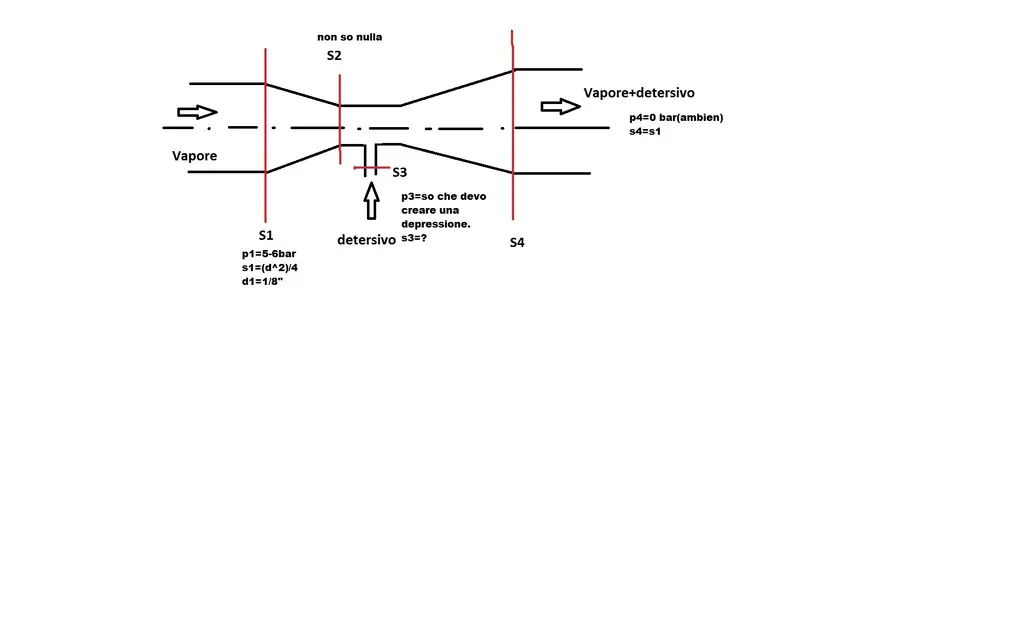
good, the system is similar, it creates a depression in the throat section, and it happens "the aspiration".as data I only have 5 -6 bar input pressure and 1/8 inch input section....how do I know which section of the throat?
 
i'm not very practical and i might be wrong, but can't you apply bernoulli?

in the input section the speed is zero and the pressure and 5-6 bar. in the output section the pressure is zero and the speed is that given by bernoulli. if you know the load losses you have characterized all the conduct. what am i missing?
 
mhhh I have not followed you so much anyway thank you very much for your answers...then the data are_: p1=5-6bar s1=1/8" v1=I do not know it is the speed of the steam at the entrance, then I will have a section of golda(pg,sg,vg that I do not know) and then a p2=0 bar(environment) v2=(I do not know it but still less than v1) s2=
 
Hello, guys, I'm a graduation in G.M., I'm doing an internship and I'm working on the design of a cleaning machine.
This machine must also work with the cleaner. I immediately thought about the venturi effect as it works in scooter carburetors where it mixes air and gasoline.I must mix steam and detergent.
the problem is that I have the input pressure and the section, but I do not know everything else.. how could I size this tube? ? ?
I could use bernulli:
p1+1/2rho1v2+rho1gh1=p2+1/2rho2v2^2+rho2gh2

also come into play, viscosity, inclination with which you reach this restricted section and other

I hope you can help me. . .
Thank you.

Matteo
Bye!

I would personally use a convergent/divergent: in the converging section you lose pressure to advantage of kinetic energy until you reach a value of (de)pression able to recall the liquid to be injected into the conduit (and it is a given of the problem). in the second reconverted kinetic energy in itching, until you return to the value of zero bar relative to the environment.
I would apply energy conservation in mechanical form for (at first beat) incomprehensible fluid by neglecting frictions (bernouls) and the equation of continuity.
You should be able to calculate everything! attention to the design of the divergent tract that is the most critical for load losses: you should find in literature several examples of proportionality, I try to recover you someone!
 
another thing: usually the load losses of a venturi are considered by multiplying the theoretical flow (obtained as mentioned above if you consider the incomprehensible outflow) by an efflux coefficient, given by empirical relationships or reported on norms (referred however mainly to vents used as flow meters).
do you know the product range to be sprayed?
 
I have attached an image to you to better understand my problem.. .
I hope you can help me
 

Attachments

  • Tubo.webp
    Tubo.webp
    26.6 KB · Views: 49
I know only the mandata pressure and the section where the steam passes
...and I think you have to know also the flow of steam and detergent otherwise you have not yet defined the application well.

For the rest, as already widely suggested, you have to apply bernoulli.
 
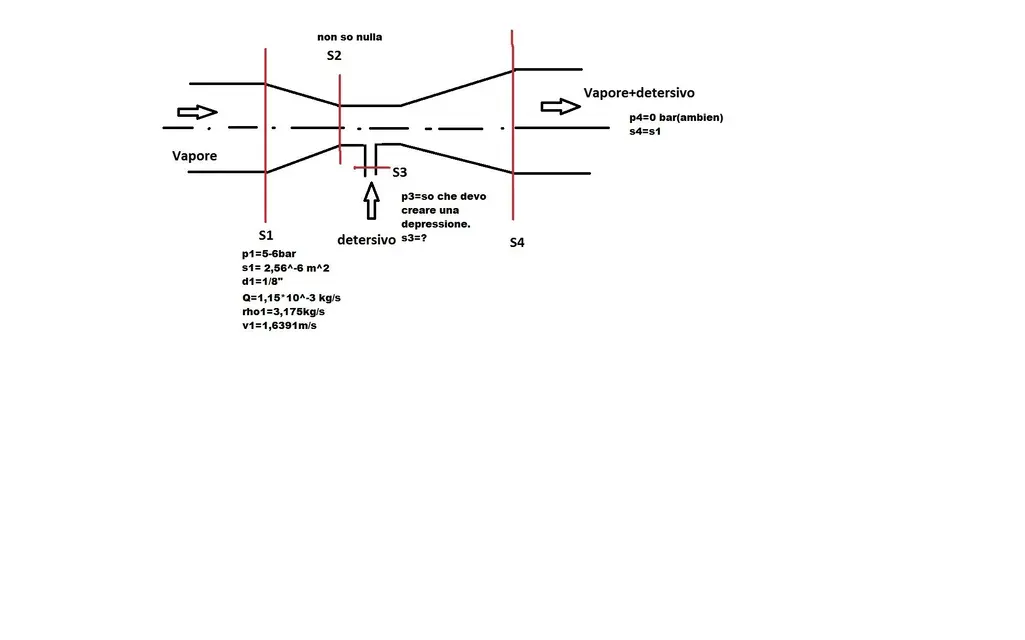
then guys maybe I turned around, now I also discovered the steam flow of 1,16^-03 kq/s and so I also know the speed
 
good evening to all guys early,I found out to have all the conditions in the s1.... now the doubt is how to size the pipe?? use bernoulli for s2?? how do I do it?? ? help me
 

Attachments

  • Tubo.webp
    Tubo.webp
    33.3 KB · Views: 18

Forum statistics

Threads
44,997
Messages
339,767
Members
4
Latest member
ibt

Members online

No members online now.
Back
Top