
• This forum is the machine-generated translation of www.cad3d.it/forum1 - the Italian design community. Several terms are not translated correctly.

demand on turbocharged air flows

  • Thread starter Thread starter snaroz
  • Start date Start date
Wait. I think the speech is quite complicated:biggrin:
Can you first tell me if what I write now is correct?
We consider an aspirated engine that works at a number of laps and which is delivering some power. if you want to increase the power provided by the engine, you need to do two things:
1) increase the amount of fuel entered in the combustion chamber;
2) increase the amount of air entered in the combustion chamber (in order to reach the stechiometric ratio).
in an injection gasoline engine, these two needs are met simply as follows: the accelerator, connected to the butterfly valve, provides to increase the air flow in the cylinder and simultaneously an electronic control unit orders the injector to spray more gasoline. Moreover, as a result of all this the engine turns increase.
Are they here?
Thank you so much!! ! ! ! !
Vedil motor turns as "result" of dynamic balance between drive torque and strong torque: they increase when you have a positive difference between the first and second. the variable "independent" we say is the so-called "load", indicative of the couple that is releasing the motor and tied to the command organ (% butterfly opening in an eight motor - amount of injected in a diesel).

you may have high turns and low loads, such as when you accelerate vacuum, motor tending to pack: Minimum resistant couples, at the limit only the internal frictions, and therefore low loads necessary to accelerate the motor, forces on the predominantly inertial manovellism.
high loads and low turns, as when you want to resume from low turns to long marches maybe uphill (high "road load") accelerator pressed, high thermal load, forces on the manovellism mainly due to gases.

so it is not said that if you press the accelerator more the motor accelerates! depends on the dynamic balance of the same! :smile:
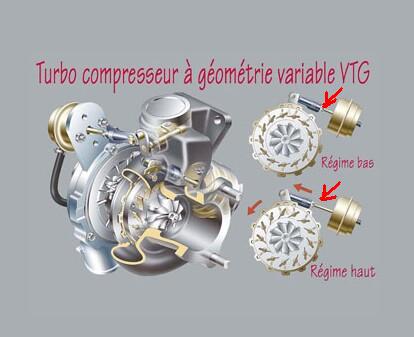
 
to the low regimes the palettes are short, so to have little inertia and therefore to make sure that the turbine starts blowing from the lowest regimes; at the heights instead the palettes become long therefore bring more air (and consequently more power), and there are no problems of inertia as, of course, the turbine is already in motion.
Yes, there are variable geometry turbines
but we do a couple of clarifications
first, the palettes always have the same length. changes the angle of incidence compared to the impeller.
varies the response of the turbine and you gain something in terms of engine response.
However, given the mechanical complications, it is used in diesel engines. on gasoline, the only specimen using a variable geometry should be porsche 911 turbo (series 997)
Wait. I think the speech is quite complicated:biggrin:
Can you first tell me if what I write now is correct?
We consider an aspirated engine that works at a number of laps and which is delivering some power. if you want to increase the power provided by the engine, you need to do two things:
1) increase the amount of fuel entered in the combustion chamber;
2) increase the amount of air entered in the combustion chamber (in order to reach the stechiometric ratio).
in an injection gasoline engine, these two needs are met simply as follows: the accelerator, connected to the butterfly valve, provides to increase the air flow in the cylinder and simultaneously an electronic control unit orders the injector to spray more gasoline. Moreover, as a result of all this the engine turns increase.
Are they here?
Thank you so much!! ! ! ! !
points 1 and 2 must be reversed
you conceptually first open the butterfly, then follow the gas flow to maintain the stechiometric ratio.
it should be said that this brings the engine to provide a greater pair (at equal treatment)
As a result, the balance between the torque supplied by the engine and absorbed by the transmission is no longer valid. the torque supplied by the engine is exuberant and as a result the engine tends to accelerate until a new point of balance is found.
 
to avoid problems with low turns, a "variable geometry turbine" is not used. . ?

the "variable geometry" (i.e. the length of the turbine blades) serves to vary the air flow that the turbine blows.
to the low regimes the palettes are short, so to have little inertia and therefore to make sure that the turbine starts blowing from the lowest regimes; at the heights instead the palettes become long therefore bring more air (and consequently more power), and there are no problems of inertia as, of course, the turbine is already in motion.

the variable geometry is like having "two turbines" one instead of the other, which give the change when needed: thus combining the beneficial effects of both.
post-6735-1208590879.jpeg
enigma
Hello, everyone!

for what I know, in variable geometry turbines, the turbine blades are fixed. upstream, immediately after the radial entrance of exhausted gases, there are mobile deflectors (which precisely make the geometry "variable"), lightningcrates approximately in their half-way, and that rotate. In this way, they change the passage section for exhaust gases, trying to keep the flow rate constant on the turbine blades.
ready to be denied and/or correct, if I had written chestnuts....

probably is a great solution, given the wide use (and with excellent solution I mean excellent results, and excellent economic-constructive compromise). However, if I do not remember, but I go to memory, some have bmw on series 5, adopted a different solution, probably better (personal speaking), which probably entails more costs: the biturbo. not in the purely performance sense (the veyron mounts 4, for the 4 pallets of the monstrous 16 cylinders), but in the sense that two turbochargers, fixed geometry, but of different dimensions, connected by a by-pass valve were adopted. to the low regimes, exhaust gases pass through the smallest turbo, which having minor inertias to win, accelerates more quickly, going almost to cancel the famous "turbo-lag". when the rotation regime increases, the amount of exhausted gases increases and the above mentioned valve enters into play, which deviates the flow towards the larger turbo, until the smaller one, which at this point is no longer necessary......
I've described it in a very brutal way, but it should work more or less like this. Of course, everything must be seasoned with the experience of a house like bmw and electronic partners, with the result of having a very pleasant thrust fluidity (according to the magazines of the sector, which at the time of the exit tested the car).
I had to settle for their words....:redface:
 
Yes, there are variable geometry turbines
but we do a couple of clarifications
first, the palettes always have the same length. changes the angle of incidence compared to the impeller.
varies the response of the turbine and you gain something in terms of engine response.
However, given the mechanical complications, it is used in diesel engines. on gasoline, the only specimen using a variable geometry should be porsche 911 turbo (series 997)


points 1 and 2 must be reversed
you conceptually first open the butterfly, then follow the gas flow to maintain the stechiometric ratio.
it should be said that this brings the engine to provide a greater pair (at equal treatment)
As a result, the balance between the torque supplied by the engine and absorbed by the transmission is no longer valid. the torque supplied by the engine is exuberant and as a result the engine tends to accelerate until a new point of balance is found.
Okay, let's now take a turbocharged engine that is delivering a constant power, and suppose we want to increase its power (e.g. because we have to accelerate). increasing the amount of fuel entered in the cylinders is simple: just give order to the injector to spray more gasoline.
but, since in a supercharged engine is the compressor to regulate the air inflow in the combustion chamber, how do you increase the air flow? one might say: well, increase the speed of rotation of the compressor; but the point (if I understand correctly) is that the speed of rotation of the compressor can be increased only by exhaust gases, which are a consequence of the increase of power. So I assume that when I'm driving a turbodiesel and start accelerating from a constant speed, there must be another device that increases the air flow in the cylinders, device that cannot be the compressor, or is it wrong?
I hope to have explained:biggrin:
As for my questions, I am absolutely ignorant about it. I am a simple mechanical engineering student passionate about motors. I know that I could answer these questions simply by studying, but they are only for the second year and certain things still do not know:
 
probably is a great solution, given the wide use (and with excellent solution I mean excellent results, and excellent economic-constructive compromise). However, if I do not remember, but I go to memory, some have bmw on series 5, adopted a different solution, probably better (personal speaking), which probably entails more costs: the biturbo. not in the purely performance sense (the veyron mounts 4, for the 4 pallets of the monstrous 16 cylinders), but in the sense that two turbochargers, fixed geometry, but of different dimensions, connected by a by-pass valve were adopted. to the low regimes, exhaust gases pass through the smallest turbo, which having minor inertias to win, accelerates more quickly, going almost to cancel the famous "turbo-lag". when the rotation regime increases, the amount of exhausted gases increases and the above mentioned valve enters into play, which deviates the flow towards the larger turbo, until the smaller one, which at this point is no longer necessary......
I've described it in a very brutal way, but it should work more or less like this. Of course, everything must be seasoned with the experience of a house like bmw and electronic partners, with the result of having a very pleasant thrust fluidity (according to the magazines of the sector, which at the time of the exit tested the car).
I had to settle for their words....:redface:
not only bmw mounts the turbines "in series". also fiat
now they have come also to have a "tri-turbo", to have answers from the very low regimes
but this involves costs, weight, mechanical and electronic complications, complicated quantum gas flows... .
It's not exactly a "easy" solution.
 
Okay, let's now take a turbocharged engine that is delivering a constant power, and suppose we want to increase its power (e.g. because we have to accelerate). increasing the amount of fuel entered in the cylinders is simple: just give order to the injector to spray more gasoline.
but, since in a supercharged engine is the compressor to regulate the air inflow in the combustion chamber, how do you increase the air flow? one might say: well, increase the speed of rotation of the compressor; but the point (if I understand correctly) is that the speed of rotation of the compressor can be increased only by exhaust gases, which are a consequence of the increase of power. So I assume that when I'm driving a turbodiesel and start accelerating from a constant speed, there must be another device that increases the air flow in the cylinders, device that cannot be the compressor, or is it wrong?
I hope to have explained:biggrin:
As for my questions, I am absolutely ignorant about it. I am a simple mechanical engineering student passionate about motors. I know that I could answer these questions simply by studying, but they are only for the second year and certain things still do not know:
First of all, are we talking about turbo-diesel or turbulent?
I decide, let's talk about turbulent.
the engine is working at a certain regimen, delivering some power
exhaust gases come out of the engine, pass in turbine and exit
the aspired air is compressed by the compressor, cooled by the intercooler, partialized by the butterfly valve and put into the engine.
I need power
Lighter, the accelerator opens the butterfly valve that allows entry into the engine of more air.
the carburetor, or injection, adapts the opening time of the injectors according to the new flow rate
the engine burns this mixture, turns it into gas that passes into turbine... and the round continues.. .

in diesels, same speech, but without the butterfly!
when I speed up, it makes it easy to increase the flow of oil!
 
not only bmw mounts the turbines "in series". also fiat
now they have come also to have a "tri-turbo", to have answers from the very low regimes
but this involves costs, weight, mechanical and electronic complications, complicated quantum gas flows... .
It's not exactly a "easy" solution.
I will....interesting....

Obviously, as you say, that the whole system is complicated, as management but above all in reliability!

One question: why are you talking about "in series" turbines? If I have well understood the operation should not be a system "in parallel"? the progressive "activation" (pass me the term) of the larger turbine should not exclude the smaller one, or both remain in operation?
 
I will....interesting....

Obviously, as you say, that the whole system is complicated, as management but above all in reliability!

One question: why are you talking about "in series" turbines? If I have well understood the operation should not be a system "in parallel"? the progressive "activation" (pass me the term) of the larger turbine should not exclude the smaller one, or both remain in operation?
In reality it is a "mixed" operation, since at certain regimes two turbines work simultaneously.
from a fluid dynamic point of view I think they are connected in parallel, with valves electronically controlled that hijack the flows to one or another.
I'm not sure, though.
 
but, since in a supercharged engine is the compressor to regulate the air inflow in the combustion chamber, how do you increase the air flow? one might say: well, increase the speed of rotation of the compressor; but the point (if I understand correctly) is that the speed of rotation of the compressor can be increased only by exhaust gases, which are a consequence of the increase of power. So I assume that when I'm driving a turbodiesel and start accelerating from a constant speed, there must be another device that increases the air flow in the cylinders, device that cannot be the compressor, or is it wrong?
in both cases increases the load of the engine, or opening the butterfly (which follows a greater flow of gasoline) or increasing the injected into a diesel. increasing the load increases the ethpia of exhaust gases and therefore the power supplied by the turbine that also accelerates the mechanically collected compressor to the first. the dynamic balance of the turbo moves at a higher speed with a certain delay, responsible for the "fumatine" of the tds when it strikes of cask (temporary air shortage).

edit: I had not seen the answer of mbt:)
 
In reality it is a "mixed" operation, since at certain regimes two turbines work simultaneously.
from a fluid dynamic point of view I think they are connected in parallel, with valves electronically controlled that hijack the flows to one or another.
I'm not sure, though.
:smile:
 
First of all, are we talking about turbo-diesel or turbulent?
I decide, let's talk about turbulent.
the engine is working at a certain regimen, delivering some power
exhaust gases come out of the engine, pass in turbine and exit
the aspired air is compressed by the compressor, cooled by the intercooler, partialized by the butterfly valve and put into the engine.
I need power
Lighter, the accelerator opens the butterfly valve that allows entry into the engine of more air.
the carburetor, or injection, adapts the opening time of the injectors according to the new flow rate
the engine burns this mixture, turns it into gas that passes into turbine... and the round continues.. .

in diesels, same speech, but without the butterfly!
when I speed up, it makes it easy to increase the flow of oil!
ahhh, here's what was the foul in my reasoning. Take a turbulence that is delivering a constant power. I thought all the air "dipped" from the compressor was used in combustion. If this had happened, in case it was necessary to accelerate, I did not understand how it was possible to cope with the increase of the air demand since the compressor, driven by the turbine in turn operated by the exhaust gases, could not increase its speed. instead you are telling me that not all the air out of the compressor is used in combustion; and in fact you said that there is the butterfly valve that only sends the necessary one. So now I understand how it is possible to accelerate: just open the butterfly more and get more air in. Right?
Thank you!
 
ahhh, here's what was the foul in my reasoning. Take a turbulence that is delivering a constant power. I thought all the air "dipped" from the compressor was used in combustion. If this had happened, in case it was necessary to accelerate, I did not understand how it was possible to cope with the increase of the air demand since the compressor, driven by the turbine in turn operated by the exhaust gases, could not increase its speed. instead you are telling me that not all the air out of the compressor is used in combustion; and in fact you said that there is the butterfly valve that only sends the necessary one. So now I understand how it is possible to accelerate: just open the butterfly more and get more air in. Right?
Thank you!
in the gasoline is right so!!
in td, as mtb wrote in the post, is the amount of diesel that regulates everything: all air sent by compressor goes into the room, not the partials and you will not find the butterfly valve.
 
Last edited:
ok for tb:)
for the turbodiesel I don't understand: if all the air coming out of the compressor goes to finish in the combustion chamber, and I need little power, the air/gas oil ratio then is no longer respected!
Where is the error:)?
Perhaps it is a problem when there is little air and too much fuel (the fuel cannot be burned completely) and not when there is too much air and little fuel (as in td)?
 
ok for tb:)
for the turbodiesel I don't understand: if all the air coming out of the compressor goes to finish in the combustion chamber, and I need little power, the air/gas oil ratio then is no longer respected!
Where is the error:)?
There's no mistake!
There is no stechiometric ratio in diesels!
can work with very high dilution ratios (poco diesel, lots of air)
the limit is higher, in the sense that you can not shoot too much oil, smoking penalty
 
There's no mistake!
There is no stechiometric ratio in diesels!
can work with very high dilution ratios (poco diesel, lots of air)
the limit is higher, in the sense that you can not shoot too much oil, smoking penalty
Perfect! ! !
p.s: I changed the previous message.
 
therefore in the combustion of the gasoline it is necessary that you always have a perfect stechiometric ratio, while in that of the diesel no.
This is explained why in the tb there is the butterfly valve and in the td no. in tb the butterfly valve is necessary to limit the air flow out of the compressor and into the cylinders and to ensure a perfect air/benzine ratio. in the tds, as you said, there is no stechiometric ratio, and so I can safely send all the air coming out of the compressor in the cylinders. Right?
 
in the gasoline is right so!!
in td, as mtb wrote in the post, is the amount of diesel that regulates everything: all air sent by compressor goes into the room, not the partials and you will not find the butterfly valve.
There had been some studies on the 1.9 mjet 16v (year 2002/2003) to check what the butterfly valve insertion involved, especially in the widening range of egr intervention: in practice we wanted to choke the aspiration also of diesel so as to increase the deltap exhaust collector/suction manifold and thus increase the scope of egr even to the higher loads.
I had carried out theoretical simulations at the control level together with other colleagues for the crf, perhaps they had also made some evidence at the counter, I lost a little the wrist of the thing and I don't know if it was ever adopted as a standard solution. the risk if I do not remember badly was to go to "rovinare" combustion with too many inerts, as well as other repercussions on the dynamics of the turbo precisely.
I came out quite "pretty" from the motor field:frown:
 
therefore in the combustion of the gasoline it is necessary that you always have a perfect stechiometric ratio, while in that of the diesel no.
This is explained why in the tb there is the butterfly valve and in the td no. in tb the butterfly valve is necessary to limit the air flow out of the compressor and into the cylinders and to ensure a perfect air/benzine ratio. in the tds, as you said, there is no stechiometric ratio, and so I can safely send all the air coming out of the compressor in the cylinders. Right?
to say that there is no stenchiometric relationship is a force... it exists.
the diesel engine is made to operate in excess of air, in particular fixes a minimum value of excess under which you try not to go down to avoid bad combustion and problems on the engine (the most obvious is smoking, but there are others...). As far as the maximum of excess is regulating, there is no limit (well, if you push too far the combustion does not happen) but depends strongly on the emissions of pollutants. to give you an idea consider these two points:
1. so much air = production of a few hc and co, but very nox;
2. little air = contained production of nox but many hc and co.
 

Forum statistics

Threads
44,997
Messages
339,767
Members
4
Latest member
ibt

Members online

No members online now.
Back
Top