• This forum is the machine-generated translation of www.cad3d.it/forum1 - the Italian design community. Several terms are not translated correctly.

my opinion on creo by user catia

  • Thread starter Thread starter lelevt
  • Start date Start date
But no idea! a multibody modeler allows you to have inside a separate body part file. who can be separated and with father-son relationships (and will be partly related to modeling history) or separated without any relation father-son (and have no relationship with each other in the tree of history).
"to separate bodies" or "play it as a set", is conceptually the same

It is clear that if they relatize body or feature between them, I cannot reorder them, but while in the body that I then intersect, I can decide which of the two models first (always within the limits of the geometric relationships between them); in a feature based this is extremely difficult to happen, because it requires an ad hoc reasoned approach, which in simple cases can be done, in more complex ones, does not make sense.

in this context, of the multibody, I have to repeat a "but not even by idea!" feature based means that it is based on features and those reorders according to the parent relationships. If you work on two, three or n. disjoined bodies within the same part the various bodies can reorder them as you like in the tree of history. in swx you can, within a part, import a part from a file that can be neutral or native to swx. the imported part is placed on the existing geometry using the constraints that there is also in the axioms
in a feature based, if you have the possibility to have body, at the first level of logical tree, the body are like features for the system, and I don't feel there are very particular functions, such as fixing a specific material for a specific body and not to the whole part.
In the example that you make solidworks with external mathematics, you do as well with creo through the advanced assembly, with part or all the math copied and imported through surfaces (command: copy_geometry), it is always a feature, but in the end instead of creating a body, you perform the solidification of the surfaces (by volume or by cutting).


I think you mess with the terminology. on hybrid modelers as if or nx I do not express myself having never tried them but there is a part of chce modeling is multibody and feature based and you can have a part of modeling that they call "sincrona" that if I remember well is histoy free, analogously to what happens with a contextual cad.
my intent was to be as simple as possible to answer the phrase "solidworks is a multibody".
- - - updated - - - -
the net detachment with the caty past has done it passing from v4 to v5, is that to which I refer. They don't even look like each other.
the passage to v5-v6 instead is not of substance, is a little like the passage from pro-e to creo.
OK, or you're siamo....
 
Did you get to use the advanced assembly?
It may be that in the future they add multibody to align themselves with competition. . .
I can confirm in my experience that at first I also believed that there was a lack in creo given the absence of the multi-body. However, once I associate the workflow with the ax (advanced assembly) I can say I have found a smart way to do the job. I do not believe that the ptc never decide to introduce this function, also because knowing how the speech work align with competition does not marry a certain corporate policy. advice to [MENTION=2946]lelevt[/MENTION] to deepen the use of aax instead of externalizing its multi-body pro vents
 
I can confirm in my experience that at first I also believed that there was a lack in creo given the absence of the multi-body. However, once I associate the workflow with the ax (advanced assembly) I can say I have found a smart way to do the job.
provided to buy the add-on module at n-mila euro plus for annual maintenance. :rolleyes:

by ptc user (ex cocreate) are really annoyed by these continuous requests of additional modules to realize tasks that in other packages are widely understood in the basic module.
 
provided to buy the add-on module at n-mila euro plus for annual maintenance. :rolleyes:
by ptc user (ex cocreate) are really annoyed by these continuous requests of additional modules to realize tasks that in other packages are widely understood in the basic module.
hunting, with or without module a solution is always found. you have to find otherwise you do not finish the job and it is a mess. the module however from an extra march if exploited well. there are also promos that allow after the update to take in 2 or more extensions (in my time it was so!).
However from the commercial point of view they have structured a nice business there is nothing to say.
 
provided to buy the add-on module at n-mila euro plus for annual maintenance. :rolleyes:

by ptc user (ex cocreate) are really annoyed by these continuous requests of additional modules to realize tasks that in other packages are widely understood in the basic module.
like all the others and usually depends on what you need to design, don't believe that a cat gives you at your disposal all at once in a single license, as well as all the others.

If you work with so many external maths on which you have to create your components with a certain level of bond, you are practically obliged to have it as a package.
 
Excuse me if I interfere once again, suggesting you look here
http://www.cad3d.it/forum1/threads/50266-multibody-con-nx?p=397215&viewfull=1#post397215I repeat the concept, the multibody and the assembly have nothing to do with each other at least in nx which is a multibody cad, the others do not know them so I don't pronounce.
I'm sorry, I don't know nx, but from the video of the link, I see in the head the logical tree the name "model history" and then all the features and body at the same level, my question is: at the end of everything, with nx you can enclose everything in a body and then join it with other created within the same modeled exnovo part?
 
Sorry, I don't know nx, but from the link footage, I see in the head of the logical tree the name "model history" and then all the features and body at the same level,
is the representation that there is in nx, the various features are in sequential order are not grouped by dependence (if you want you can view them also as addiction but I am not used to it)
my question is: at the end of everything, with nx can you enclose everything in a body and then join it with other created within the same modeled exnovo part?
If you observe, instead of joining me subraggo, and the solid that subraggo is the parametric 'copy' of the original, I could build another solid and join it, subtract it etc. etc. another interesting film that I have done so long ago for other purposes but in which you can see this mode well is this
https://www.youtube.com/watch?v=xvn_awclij4oppure in questo
https://www.youtube.com/watch?v=-_csgbhhstu&t=16swhere you see that stretch solids and surfaces joining sewing and so on

It's a completely different way of working believe me.
 
"to separate bodies" or "play it as a set", is conceptually the same

I don't think so. only for the fact that you can have the features of assemblies that do not change the parts (or change them according to what you want to do)
It is clear that if they relatize body or feature between them, I cannot reorder them, but while in the body that I then intersect, I can decide which of the two models first (always within the limits of the geometric relationships between them); in a feature based this is extremely difficult to happen, because it requires an ad hoc reasoned approach, which in simple cases can be done, in more complex ones, does not make sense.
I don't say that you don't know the difference between history-based and feature-based, but I think you use the terms in a very strict manner and therefore ingenious misunderstandings.

in a feature based, if you have the possibility to have body, at the first level of logical tree, the body are like features for the system, and I don't feel there are very particular functions, such as fixing a specific material for a specific body and not to the whole part.
In the example that you make solidworks with external mathematics, you do as well with creo through the advanced assembly, with part or all the math copied and imported through surfaces (command: copy_geometry), it is always a feature, but in the end instead of creating a body, you perform the solidification of the surfaces (by volume or by cutting).
leotards are body, not feature, but wanting you can use them as a feature to make changes as they were "tools" to the rest of the part geometry.
a demonstration that the leotards are not feature is that they are constituted practically always by more than one feature. sure if you make a cube with a single extrusion then a feature corresponds to a body, but it is a singular case and as such represents the exception that however does not justify the definition of body=feature.

I do not know I create, but I would say that if to model a part I need an imported part or a "uterine" consisting of a separate body (from which the multibody name) is much more practical in so many cases to do it inside the part rather than create a set (let it be that it serves a module apart that will cost at least half the cad) to have external geometry to shape the part.
my intent was to be as simple as possible to answer the phrase "solidworks is a multibody".

ma solidworks è a multibody as it allows to have geometrically separated bodies within the same part, regardless of whether they also have parent-son relations between them at modeling level and regardless of whether the body is parametric (built within the part or imported from swx native files) or whether it is a neturo file (superficial or solid) imported.
 
in a feature based, if you have the possibility to have body, at the first level of logical tree, the body are like features for the system, and I don't feel there are very particular functions, such as fixing a specific material for a specific body and not to the whole part.
Actually, at least in solidworks, you can do a fe360 body and one of hdpe, no one prevents it, and the subsequent work that you go to do you can decide on which body they incite and which no and which edges are referred to, so that if you take around a body also go around his work, as in the example of baskets1959.
Probably your experiences are related to software several years ago, but in the meantime there was a lot of evolution.

In essence, I understand that:
pro/e-creo claims to realize Boolean additions and subtractions only between different files, the rest of the world instead allows you to choose whether to do it between different files or within the same part. Do I understand?
 
In essence, I understand that:
pro/e-creo claims to realize Boolean additions and subtractions only between different files, the rest of the world instead allows you to choose whether to do it between different files or within the same part. Do I understand?
no hunting, boolean can also be done within the same part file and without additional modules. Unlike solidworks, nx, catia, etc... is that you can not have more parts (or body) within the same part (addressing with different assignment of material) otherwise we are actually talking about a set is what it meant to me [MENTION=69538]320i s[/MENTION].
 
a proof that helps clarify the doubts better is the following: take a multi-body part file created for example in catia; import it into creo and see that it comes up as assembly
 
is the representation that there is in nx, the various features are in sequential order are not grouped by dependence (if you want you can view them also as addiction but I am not used to it)

If you observe, instead of joining me subraggo, and the solid that subraggo is the parametric 'copy' of the original, I could build another solid and join it, subtract it etc. etc. another interesting film that I have done so long ago for other purposes but in which you can see this mode well is this
https://www.youtube.com/watch?v=xvn_awclij4oppure in questo
https://www.youtube.com/watch?v=-_csgbhhstu&t=16swhere you see that stretch solids and surfaces joining sewing and so on

It's a completely different way of working believe me.
join I mean 2, make one, which then is the sum of volumes or subtraction, no matter.
you have not answered my question, I try to reform it: in nx are you working from the first feature or body inside a body we call it "father" that can be moved under a upper-level body in the same file you or not? because the concept of multibody that has been taught me is all about this.
 
Good morning, everyone.
the possibility of modeling in multibody is very useful when drawing welded components or welded frames, you do not have to manage as assemblies, all parts remain inside a single file.
It is also useful when using components such as pneumatic pistons that are composed of several components, it is easier to manage them as multibody parts than as axiemi, especially if you want to make a separate of the general components of the whole axieme in which they are located.
In this case, only the pneumatic piston will result in the distinction as it is a single component formed by multiple bodies, while if you manage the same component as together all the components of the piston will appear in separate.
you can also make sure that the various components of the piston do not appear in separate, but it is a process that can be Moroccan and subject to errors.
I personally find it convenient that you can work with multibody.
I found myself sometimes managing projects where the components of trade consisting of several parts were managed as assemblies, and I had difficulty when drafting the distinct.
 
Good morning, everyone.
the possibility of modeling in multibody is very useful when drawing welded components or welded frames, you do not have to manage as assemblies, all parts remain inside a single file.
It is also useful when using components such as pneumatic pistons that are composed of several components, it is easier to manage them as multibody parts than as axiemi, especially if you want to make a separate of the general components of the whole axieme in which they are located.
In this case, only the pneumatic piston will result in the distinction as it is a single component formed by multiple bodies, while if you manage the same component as together all the components of the piston will appear in separate.
you can also make sure that the various components of the piston do not appear in separate, but it is a process that can be Moroccan and subject to errors.
I personally find it convenient that you can work with multibody.
I found myself sometimes managing projects where the components of trade consisting of several parts were managed as assemblies, and I had difficulty when drafting the distinct.
hi, personally manage the intermediate level assemblies, I find it a bad habit, even from me where we do not internally the welded details, it is almost indispensable the separate cut and/or detailed for the calculation of the costs and to assess whether the possible supplier is marching us heavily or not.
we do not talk about mechanisms with special supply type hydraulic/pneumatic pistons.
and I have never had any trouble with creo, nor with caia (which is all to say) to manage them in distinct base, with caia (see that it is the co-topic of the 3d) the discomfort (large and not little) was to manage the post welding processes.
 
no hunting, boolean can also be done within the same part file and without additional modules. Unlike solidworks, nx, catia, etc... is that you can not have more parts (or body) within the same part (addressing with different assignment of material) otherwise we are actually talking about a set is what it meant to me [MENTION=69538]320i s[/MENTION].
That's exactly what I meant.
 
cutting parts, at least with solidworks, you can also make them on welded multibody.
As regards the management of the commercial supply mechanisms composed of several components I find myself better in managing them as being a single component, as such is purchased, but I think it is a matter of habit.
However, I think it is preferable to have a cad that gives you the opportunity to work in multibody, so if you want to use it you can do it, otherwise you can safely use the assemblies.
 
I don't think so. only for the fact that you can have the features of assemblies that do not change the parts (or change them according to what you want to do)
But be careful that with I create together, I can recover all the mathematicians and then realize a resulting part of the others (partially or completely), it is as if in reality I took more objects, glue them together and paint them to not make understand where one piece ends and where the other begins (to make an example earth)

I don't say that you don't know the difference between history-based and feature-based, but I think you use the terms in a very strict manner and therefore ingenious misunderstandings.
Is there a glossary somewhere I can update?

leotards are body, not feature, but wanting you can use them as a feature to make changes as they were "tools" to the rest of the part geometry.
a demonstration that the leotards are not feature is that they are constituted practically always by more than one feature. sure if you make a cube with a single extrusion then a feature corresponds to a body, but it is a singular case and as such represents the exception that however does not justify the definition of body=feature.

I do not know I create, but I would say that if to model a part I need an imported part or a "uterine" consisting of a separate body (from which the multibody name) is much more practical in so many cases to do it inside the part rather than create a set (let it be that it serves a module apart that will cost at least half the cad) to have external geometry to shape the part.
in reality the advanced assembly is indispensable to copy the more complex geometries and maintain a link (including relative positioning), but if it is simpler geometries, you can well do without it, but then you lose many other functions, such as the interchange axis (replace one part to another or more, whatever it is, in a practically automatic way and without failures or geometry, of positioning and other constraints.

ma solidworks è a multibody as it allows to have geometrically separated bodies within the same part, regardless of whether they also have parent-son relations between them at modeling level and regardless of whether the body is parametric (built within the part or imported from swx native files) or whether it is a neturo file (superficial or solid) imported.
I apologize, but a few days ago you wrote this:
apologize both, explain why, how do you clearly show from what you write, being born as a feature based is in contradiction with the multibody and the Boolean?solidworks is feature based and in fact the Boolean are features that are in the tree of history and that can be reordered only according to the story itself and the father functions. Similarly all freeform functions are feature based and parametric. in swx there is no context modeling or a mixed environment as on solidedge or nx.
the multibody then I'm afraid that there really is no bat about being feature based.
Are you sure you don't mess up?
 
join I mean 2, make one, which then is the sum of volumes or subtraction, no matter.
you have not answered my question, I try to reform it: in nx you are working from the first feature or body inside a body we call it "father" that can be moved below to a higher level body in the same file you or not? because the concept of multibody that has been taught me is all about this.
I don't understand what you mean in the black part.
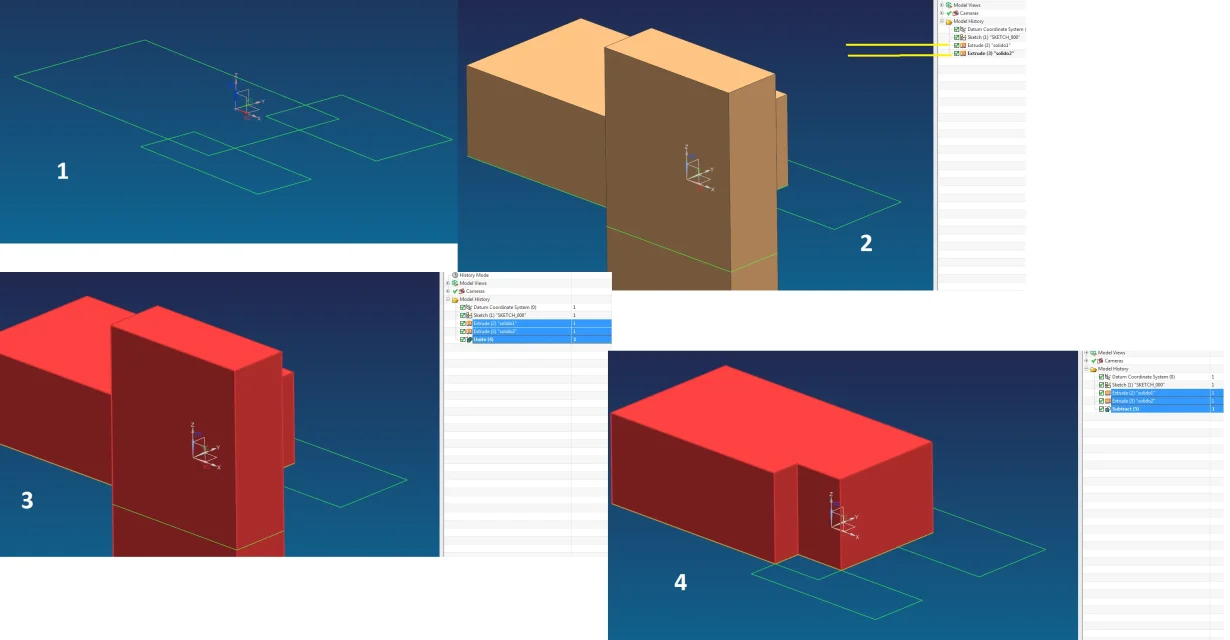
I hope to answer with the attached image:

1) sketch with n (three in this case) profiles
2) independent extrusion of two profiles (in the tree where there are yellow rows see that there are two extrusions and therefore (for nx) two solids
3) union of the two solids
4) I have changed my mind and then subtract one from the other.

Hi.
 

Attachments

  • multi.webp
    multi.webp
    114.1 KB · Views: 11
1) sketch with n (three in this case) profiles
2) independent extrusion of two profiles (in the tree where there are yellow rows see that there are two extrusions and therefore (for nx) two solids
3) union of the two solids
4) I have changed my mind and then subtract one from the other.
baskets, what described above seem to me boolean operations between solids. Is that what you mean by multi-body?
 

Forum statistics

Threads
44,997
Messages
339,767
Members
4
Latest member
ibt

Members online

No members online now.
ciao
Back
Top