• This forum is the machine-generated translation of www.cad3d.it/forum1 - the Italian design community. Several terms are not translated correctly.

problem slow design

  • Thread starter Thread starter tanticapelli
  • Start date Start date

tanticapelli

Guest
Hello, everyone.

I am working on a workstation on which the video card was just upgraded to a nvidia picture p2000.

I atagonized the slowness of the regeneration of the design reported to two axioms which worked smoothly even with the previous graphics card (nvs300).

the design consists of a single sheet formed a1 in which I inserted more views both in the plant and sections and assonometric almost all cut out.

had the design is very slow in regeneration.

the larger axieme is subdefined only because of 4 threaded bars and 8 washers that can still rotate on themselves.

how can I prevent rotation without overdoing the axieme (for example using "fix"? ).

I noticed however that the crops of the views slow down the regeneration and stress is almost exclusively at the expense of the cpu.

Please help me because this video card expense (recommended by the solidworks service center) didn't really want us.

Thank you.

so many hairs
 
for rotations there is the option blocks rotation both to the creation of concentric coupling and to the coupling already created by clicking on it.

for the rest how do you understand why a drawing is slow? there are various options to improve table management, but it also depends on how the template is handled: complex references of the model 8un pin on wheel is one thing, a shed with 50 beams c carpentry for n knots of union is another), redundant couplings (for example to put two planes coincident and parallel will not give error but will always be an extra couple to process) have their influence, modeling of the details (a motor superdettagliato with fins, wires, perforated grid has a different handle . .

you can not reduce everything to a video card (maybe even set to improve its performance) and to the couplings while remaining that they also have their weight
 
Okay massive,

In principle I understand.

But what I don't understand is why axioms work smooth and fast while the drawing board (only after cutting out the views) has become tremendously slow.
 
the table is always much slower than the modeling. does not depend on the graphics card, which in the case under examination affects x very little. I personally did not manage to read it. The only thing is, as massive as he said, to do as best as possible models. Try to see if they improve time by making this proof that it is a long time I wanted to do but that I never did... open all models and suspend functions from the model tree. then try to put in the table and see how it reacts. Let us know. .
 
the table is always much slower than the modeling. does not depend on the graphics card, which in the case under examination affects x very little. I personally did not manage to read it. The only thing is, as massive as he said, to do as best as possible models. Try to see if they improve time by making this proof that it is a long time I wanted to do but that I never did... open all models and suspend functions from the model tree. then try to put in the table and see how it reacts. Let us know. .
Okay, I'll try.

could serve something the option on the "resolved view on light weight? "
 
without the file it is difficult to help you.
If you make sections try to simplify them by hiding the parts that you don't need and using "section scope" exclude from cutting the parts that you don't need.
if the axieme is not built by simplifying the details may be that it has an excessive weight.
if you have bound parts so that the program must always recalculate the developments of gingie and various things could represent another problem.
you need a thorough analysis to understand what the reason is... but from here I see it hard............ .
 
probably the cutout requires more processing. It is true that you only see a part, but you still have all the view to rework in addition to the update of the crop, in practice a square processing.
try removing the check to update automatic views by clicking the right button on the design name at the top of the feature manager
 
probably the cutout requires more processing. It is true that you only see a part, but you still have all the view to rework in addition to the update of the crop, in practice a square processing.
try removing the check to update automatic views by clicking the right button on the design name at the top of the feature manager
Thanks massive. with your last finding seems to be better.

instead I did not understand how to adjust the scope of the section. I tried with depth but moved the section line on the plant.
 
the depth of section shows in magenta until where the view of what is selected comes. if you move the line means it is not bound.
of course if you put pictures the answers would be easier and circumstantial, but as you wonder every time I realize it is a lost battle
 
I regret this post as I also experienced obvious slowdowns in 3d modeling of a particular file and also refer to the table, also experiencing several software crashes.

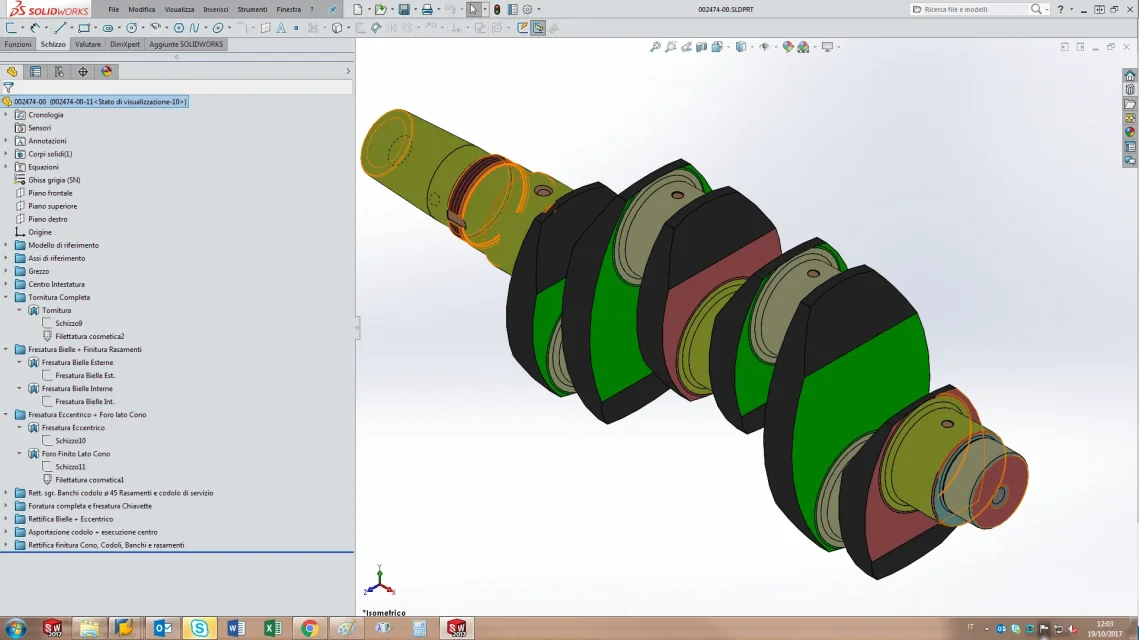
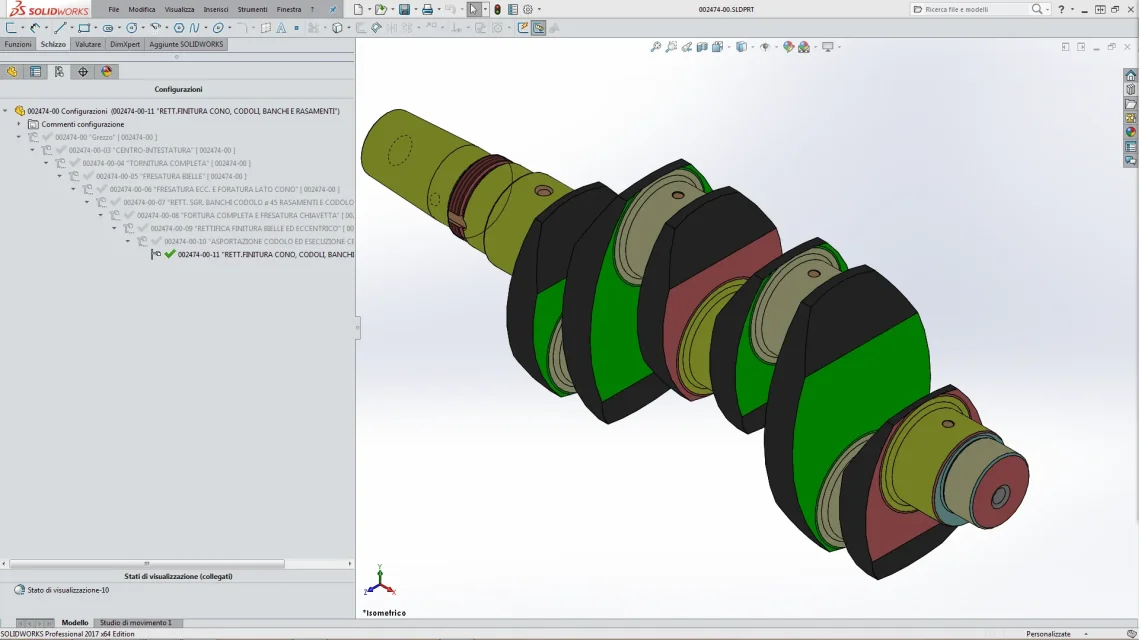
it should be said to honor the truth that this file includes 3 imported models (2 models of 2 different raw starting + 1 model of the finished) to which all the various processing of "sottration" (99% extruded cut and puncture) must be added to bring the 3d model of the crude to the state of the finished, in distinct derived configurations. the derived configurations always descend on 1 level (i.e. a processing phase) and always start from the previous one: descending from the rough to reach the finished piece

by premitting that this setting I found it on the "new" workplace (now 8 months), that the machine on which work is performing (set a 4000 picture) and that working with the same methodology I did not notice similar slowdowns, I would like to understand what can be attributable this slowdown.

Is it possible that 3d models weigh down?
excessive number of shares bound to a model?
 
spiega queste due frasi:
working with the same methodology I did not notice similar slowdowns
methodology di cosa? I did not notice similar slowdowns Dove? Eat?
Is it possible that 3d models weigh down?
without the 3d model the design opens that it is a wonder but it does not serve anything. It is obvious that it is the model to slow down the drawing (unless you did 80 details and sections of a plate with 4 holes). Why slow him down? is the geometry or quantity/quality of functions? You can only know that.
In the meantime you do a function statistics and see if something abnormal
excessive number of shares bound to a model?
hopefully you put the necessary quotas and not dozens of guided shares for sketch. as hopefully he did the simple sketches and functions logically.
If you want to know if the slowdown is due to external references interrupt them and see how the drawing behaves.
Hips can also partly depend on how options are set. as already said you can not always reduce everything to a single factor, can be various some solved and others not. sometimes the file is slow and you can't do anything
However these questions almost always require a specific analysis of the model and management of options
 
spiega queste due frasi:
methodology di cosa? I did not notice similar slowdowns Dove? Eat?
I mean with individual configurations nested in one another.
I guess I can't explain correctly, maybe tomorrow at work I realize some pictures of how all files are set.
I still try verbally: starting from the configuration , which corresponds to the starting rough, the 1 derived configuration that corresponds to the first processing to be performed in the workshop. the next derived configuration, 2, descends from 1 and so on following a pyramid scheme. multiple functions can be present in the single configuration.

when I was talking about similar slowdowns I meant in other files made in the company, using the same working logic. from which my next question arises...
without the 3d model the design opens that it is a wonder but it does not serve anything. It is obvious that it is the model to slow down the drawing (unless you did 80 details and sections of a plate with 4 holes). Why slow him down? is the geometry or quantity/quality of functions? You can only know that.
In the meantime you do a function statistics and see if something abnormal
... i.e. if the slowness of that particular file could be attributed to the number and/or quality of the 3d models (always provided by the customer, let's mean) inserted, and from which then I go to insert functions and relationships to realize the various steps of my production process

hopefully you put the necessary quotas and not dozens of guided shares for sketch. as hopefully he did the simple sketches and functions logically.
If you want to know if the slowdown is due to external references interrupt them and see how the drawing behaves.
Hips can also partly depend on how options are set. as already said you can not always reduce everything to a single factor, can be various some solved and others not. sometimes the file is slow and you can't do anything
However these questions almost always require a specific analysis of the model and management of options
In order to make machining chips for the various removal operations, through equation we impose the overmetals to be left working. so in good part the configurations contain sketches that are (extremizing) of offset of the quotas of the finished drawing, defined by quotas fixed by equation.

So as for the simple sketches I would admit that it is more a no than a yes. but I fear it is a factor that, given the complexity of the components we make, is unfortunately irreparable.
 
when I was talking about similar slowdowns I meant in other files made in the company, using the same working logic.
if another similar file has no slowdowns the problem in the modeling system should be sought.
a flanked files (a slow and no) make an evaluation of the performance to see if there is any excessively slow function, analyze equations and references (this interrupting them) to see if there is any redundancy, improveability or bottleneck; in the end accept that a model is slow because it is complicated of its and it is not possible to do otherwise
 

Forum statistics

Threads
44,997
Messages
339,767
Members
4
Latest member
ibt

Members online

No members online now.
Back
Top