• This forum is the machine-generated translation of www.cad3d.it/forum1 - the Italian design community. Several terms are not translated correctly.

tolerance of union

  • Thread starter Thread starter stefano_faye
  • Start date Start date
Hello reader,

I also sought a more neutral export. . .

the join and optimization of the surfaces are possible only in the import (and I did not even use them when I reimported the file)

in the export iges I used:
save only displayed entities: Yes.
type of curve and surface: standard
mode of representation: surface area

in export step I used:
Protocol: 214 iso

import iges I used:
no optimization
representation of the edges and faces: preserves file preferences and I also tried strength 3d representation (equal result)

import step I used:
no optimization
the step loads a solid surface, and if the disassembly echoes 2 surfaces that reflect the deformation

a colleague loaded iges and step with nx with similar results
 
Hello reader,

I also sought a more neutral export. . .

the join and optimization of the surfaces are possible only in the import (and I did not even use them when I reimported the file)

in the export iges I used:
save only displayed entities: Yes.
type of curve and surface: standard
mode of representation: surface area

in export step I used:
Protocol: 214 iso

import iges I used:
no optimization
representation of the edges and faces: preserves file preferences and I also tried strength 3d representation (equal result)

import step I used:
no optimization
the step loads a solid surface, and if the disassembly echoes 2 surfaces that reflect the deformation

a colleague loaded iges and step with nx with similar results
Uh...
I don't think it's an iges/step problem and its parameters.
I've seen the images better, and if I'm not wrong, the two faces are on the same floor.
Did you try to do the same tests with two faces on two floors of 0.05 mm ?
 
Uh...
I don't think it's an iges/step problem and its parameters.
I've seen the images better, and if I'm not wrong, the two faces are on the same floor.
Did you try to do the same tests with two faces on two floors of 0.05 mm ?
I confirm: in my analysis the two faces are on the same level. . .

I had not used faces on different planes as they immediately showed me a different result from what you said in the second post: "You find yourself with two edges attached and it looks perfect. If I intersect it with a plane, the generated curve is unique", since the edges were attached but with surfaces that are far from perfect and the curve is far from unique (see attachment), I thought I understood badly!

I'm going to do the parrot and then I'm going to do the full test with the 0.05 plans and I'm telling you


Attachments

  • Capture_000.webp
    Capture_000.webp
    102.7 KB · Views: 1
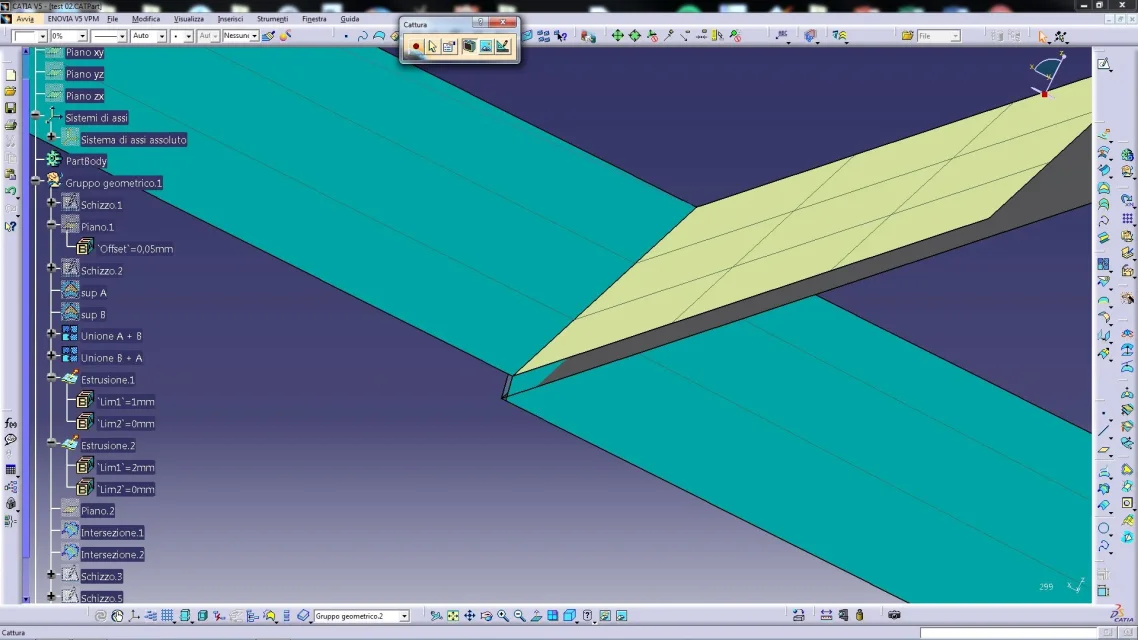
I did the test with the floors of the 2 z spaced surfaces and found that:

01) I create a+b union by selecting first sup. a and after b (b-board oscenously moved to a)
02) I create the union b+a by selecting first sup. b and after a (board of a oscenously moved to b)
03) visually the two unions differ from the inner edge that is not in common
04) in wysiwyg mode the display shows the surfaces for what are originally, i.e. detached by 0.05
05) I create extraction direction 45° from the inner edge of the a+b union
06) I create extraction direction 45° from the inner edge of the union b+a
07) surfaces are distant 0.035
08) I still confirm that the union command does not deform the original surfaces, but chooses the common edge on the basis of the selection order
09) I generate iges, and surfaces are detached and no longer deformed as in those on the same floorin the next post other test with non-planar surfaces less "exasperated"
 

Attachments

  • Capture_003.webp
    Capture_003.webp
    135 KB · Views: 0
  • Capture_004.webp
    Capture_004.webp
    156 KB · Views: 0
  • Capture_005.webp
    Capture_005.webp
    158.2 KB · Views: 0
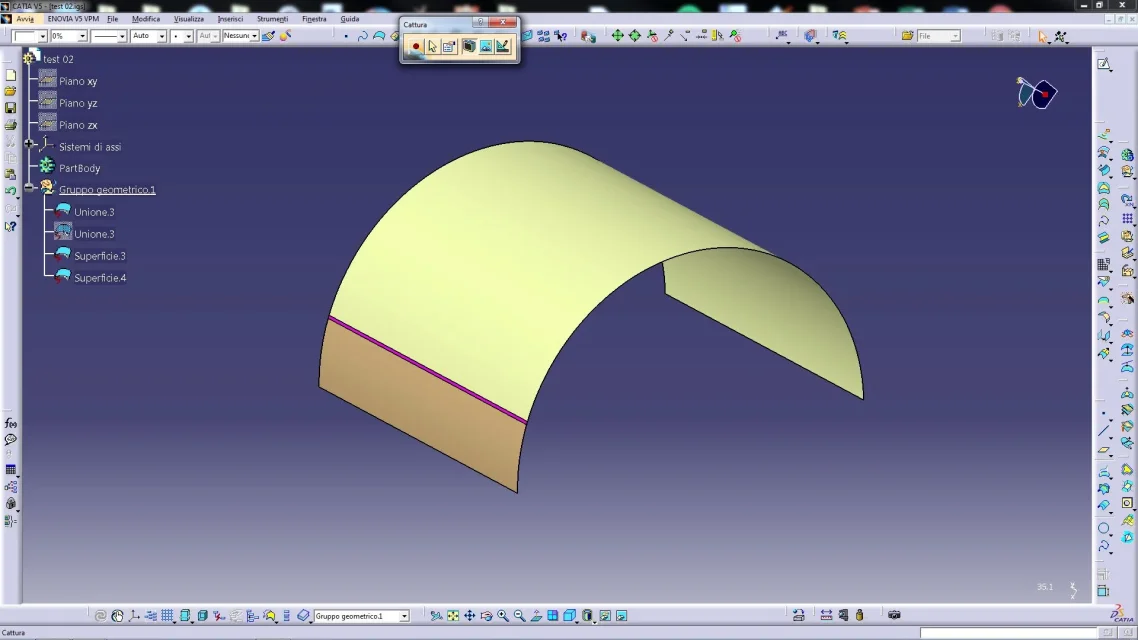
I did another test by cutting a cylindrical (separation of 0.05), and the usual unions, the behavior is the same but the iges and the step return again the superfici unite but if I disassemble have a joint surface extra magenta (messa by the system, which I did not put), then in the case of canonical surfaces, export by altering the original surfaces, while in the case of more complex surfaces (Fortunately) leaves them original. . . vabbè, it is however strange, should leave them original, almost certainly is a problem of iges and step

You should do other tests, but I don't have the knowledge and tools to go beyond a few simple tests.. .

I can't even draw any other indications useful to the initial theme (tolerance 0,001) in addition to what has already been said.

good holidays to all

years ago
 

Attachments

  • Capture_006.webp
    Capture_006.webp
    130.7 KB · Views: 0
  • Capture_007.webp
    Capture_007.webp
    130.4 KB · Views: 0
  • Capture_008.webp
    Capture_008.webp
    104.8 KB · Views: 3
Good morning.
I am new to this forum but I read about this discussion.
I also work in the field of construction molds and in our office we tested the issue tolerances.
Currently we work with a tolerance of one cent to reduce the work to be done during updates (holes, breaks, etc.)
union tolerance does not change the surfaces but tells the system that if two faces are at a lower distance of tolerance then they are united.
it is possible to "see" the surfaces without tolerance by activating the "wysiwyg mode" command present in the analyses (insert -> analysis -> wysiwyg mode )
activating it is possible to see the surfaces in their "real" position
Obviously separating the surfaces return to their original position.
for this reason the proposal to change the union tolerance "locally" to the problem and then return to a tolerance of 0.001mm seems to me a useless thing and probably also at risk of errors.
rather I would keep the default union at 0.001mm and set the surfaces.
for tests carried out in our office the increase of tolerance has brought only benefits in terms of time.
is it possible to have an example of the problems encountered using a "high" tolerance?

thanks, fabio
 
Hi.
I apologize for my absence in the question I opened.
I read your answers.
I think the answers are about two things.. one import/export data in step or igs and another general tolerance given by general options.
tomorrow, if I can respond to the written instructions in the cad guide in this regard.
I would be interested in exodus's answer about the tests carried out in the vs. office.
in any case, for what I understand, the tolerance of union does not change the faces but only the graphic representation of the faces.
If so I know that the output file can stay in the maximum tolerance of 0.02mm I should have no problem working at the maximum of that tolerance!
excuse the somewhat disconnected phrases but it was a long day
 
....
You should do other tests, but I don't have the knowledge and tools to go beyond a few simple tests.. .
I can't even draw any other indications useful to the initial theme (tolerance 0,001) in addition to what has already been said.

good holidays to all

years ago
Bye-bye.
I think, instead, that you put "on the plate" important things.

That's what I took from the evidence you did and the directions you gave.

First of all.

1) What involves altering the tolerance value of the join? as always depends .

if the join is done at the end of all the geometric construction, in order to be able to publish the geometry in a single stroke, it seems to me that the risks are limited. apart, of course, the risk of exporting solids or surfaces with holes (limited) is done to say ...) which could possibly be resolved with local patches on the geometry 3d prior to the join itself.

if (and here I take a piece of your comment )
I did the test with the floors of the 2 z spaced surfaces and found that:

.... I confirm that the union command does not deform the original surfaces, generate the iges, and the surfaces are detached and no longer deformed as in those on the same floor
instead of generating the iges, "so much for test", you again cut the join "altered" and move the highest of 2 still of 0.05 mm in z.
then join "altered" again.
then cut.
Move.
join "altered".
etc...
I did a test, and I don't know whether it's a resolution problem or anything, but it seems that it has come to have two parallel plane surfaces apart from 0.3 mm but connected, without the system highlighting the problem to video. or better. the system would if I hadn't "forced" it to "cover" the problem.
problem that reappear once again I take the iges.
certainly with two rectangular surfaces and knowing where to go to search, it is simple to recognize where the system alters the edge, towards which direction and how. but if we have a bumper mold with 1245 faces... .

So if, let's put, to every micro operation (a fillet, an imprint, a rib) I create a join, worse if altered, and then I go to join with other operations followed by other join, there is the risk of having added a series of tolerances such that, then, at the end I create serious problems to model 3d and to any igs/step/etc (because then I don't know where it is).
rather than many altered joins, better use, where possible, the classic trim/split/fillet operations.


2) About fillet, I'll take your message again
...I found that:

01) I create a+b union by selecting first sup. a and after the b (b... board moved to a)
02) I create the union b+a by selecting first sup. b and after a (board of a ... moved to b)
....
the union command ... choose the common edge on the basis of the selection order ...
important to remember that in some commands, for example in the gsd fillet between surfaces (not the one on edge) , the surface selection order is useful to activate/disable functions and geometries at will.


3) the fact that (for what I know) the join is a logical operation, probably helps in cases where faces (i.e. logical limits of surfaces) have a common or recognized surface. probably for that reason the exportation of two plot faces and joined with the "altered" join gives out a better result.

Good evening
 
hi expat reader,

I agree with what you said and well you have made it clear that each subsequent operation (downstream) adds errors that can escape control, as well as (upstream) receive a bad conversion or perform a bad import "do it yourself" from which to leave, is often the origin of the evils.

Usually the customer provides a solid (native or non-native in its system) and often performs a conversion from them. . .

Well, here are some examples of how a bugnet is converted according to the systems and protocols used (from nx, rhino, catia by performing step, iges etc. with or without optimizations) the best result is that obtained by converting from nx directly into cay.

in the whole model the number of surfaces resulting depending on the conversion (when separated in all possible cells) varied between 1200, 1400, 1728, 2257, 3059, 10769 (tenty thousand seven hundred and sixty-nine!)

Sorry to say obvious things...

Hi.
 

Attachments

  • Capture_008.webp
    Capture_008.webp
    42.8 KB · Views: 1
  • Capture_009.webp
    Capture_009.webp
    37.5 KB · Views: 0
  • Capture_010.webp
    Capture_010.webp
    81.5 KB · Views: 0
  • Capture_011.webp
    Capture_011.webp
    68.7 KB · Views: 0
  • Capture_012.webp
    Capture_012.webp
    32.1 KB · Views: 0
Good morning.
Of course, it should be considered the repetition of errors in tolerance but this is given by tolerance in emission parameters rather than by input parameters.
These are the settings we use at the moment.
General input tolerance 0.02
general emission tolerance 0.001 / 0.01

the first pilot project with only modified emission tolerance did not give negative feedback.
we are currently testing emission tolerance at 0.01mm but at the moment it is well hoped.

for information.
the option of tolerance on support gave problems in cuts and was therefore rejected
Capture.webpThank you.
fabio
 
Hi.
I'll try to test with those parameters to figure out what differences there is.
One thing. Emission parameters with a tolerance means that tolerance is no longer a graphic issue but changes the piece. Right?
 
I did another test by cutting a cylindrical (separation of 0.05), and the usual unions, the behavior is the same but the iges and the step return again the superfici unite but if I disassemble have a joint surface extra magenta (messa by the system, which I did not put), then in the case of canonical surfaces, export by altering the original surfaces, while in the case of more complex surfaces (Fortunately) leaves them original. . . vabbè, it is however strange, should leave them original, almost certainly is a problem of iges and step

You should do other tests, but I don't have the knowledge and tools to go beyond a few simple tests.. .

I can't even draw any other indications useful to the initial theme (tolerance 0,001) in addition to what has already been said.

good holidays to all

years ago
Bye-bye
I was rereading the various messages and hit your example. I had the same problem (the creation of an additional surface not present before the union) and I noticed that the setting of the export tolerance was set at 0.01mm
the face does not appear (but gives error) using a tolerance to 0.001mm.
What settings were you using? Thank you.
 
Hello stefano,

I have always left 0.001, now I am out of the house, in a few days I will make some evidence.

the online guide specifies that the tolerance of the emission parameter has effect on the following commands: project, parallel curve, sweep, multisection and smoothing of curves (as well as a parameter of insertion on a mesh, composition and extraction), so I hypothesize that even here the noun issue is referred to the within of the internal modeling of caia and not to the exported model.

export to iges or step is influenced by other parameters, and I imagine (my opinion, take it with the pliers) also by the complexity of the surfaces, which if canonical or simple, are exported with some poetic license, such as adding portions of surfaces, while when complex leaves them original.

to this is added the processing made by those who import, through the parameters of the converter or the effectiveness of the converter itself.

That's what I have to say between alcohol smokes and panettones.
 
Hi.
Thanks for the answer.
You gave me so many important details to set up tests.
We will see what will be decided within the office and you will see! then I will let you know!
in the meantime I thank you for the availability and add a good Christmas late:)
 

Forum statistics

Threads
44,997
Messages
339,767
Members
4
Latest member
ibt

Members online

No members online now.
Back
Top