
• This forum is the machine-generated translation of www.cad3d.it/forum1 - the Italian design community. Several terms are not translated correctly.

test job interview

  • Thread starter Thread starter exxon
  • Start date Start date
your test would be tolerable in a public competition for the assignment of a place for a physicist to the hyena, ...
we do not exaggerate, the exercise is trivial even if it can induce easily in error. more than for a physicist is definitely more suitable for mechanical engineer (especially if he wants to make the designer) who should be able to demonstrate to handle concepts such as pretension. The most important thing is to discuss how it was formulated, but we do not send a good discussion among colleagues, who I still have to find time to read, understand and respond to the last intervention.
 
Hello everyone!!! is discussion is taking a wrong turn...the exercise is one of those found on the books of physics 1 of the first year of mechanics and in my time there were more rognosis....certo unmeddiato (but not so much) and the answer can be corrected or not but behind there must be a reasoning that after can be corrected or confirmed by the examiner but in any case should be observed the ability to reason. yesterday in the office discussing the exxon exercise with some colleagues one of these neolaureate and cool of studies left "if they ask me a similar question I rise and leave".....I replied that if I had been the examiner I would have appreciated much more the good will of the candidate who would have tried with spirit of sportiness to the resolution.
 
I can't see it as you say.
a force that is precarious or not gets it with a weight application. ...
hi mg, I didn't respond for economics of time, but I think the matter you raised me is important and worth it anyway spend some time.

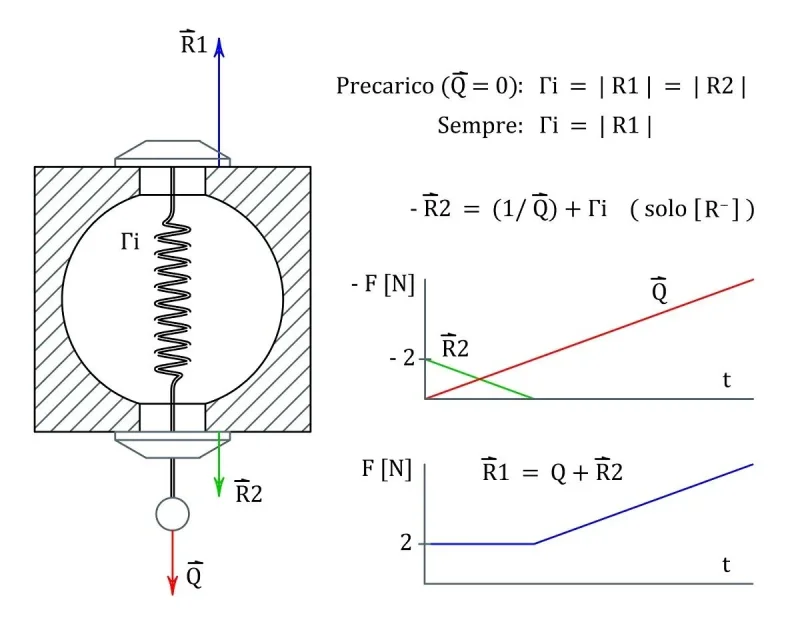
I made a box. nothing that has not already been said or schematized during this discussion. trying to make it as intuitive as possible, I put a spring in a lantern. the spring is preloaded with an initial voltage γi (gamma) fixed and extended between two plates resting on the ends of the lantern, and a lower extreme extended to which a q load can be applied. under the base of each plate the lantern responds with two reactions, r1 for the upper plate and r2 for the lower plate, such as:

γi = |r1| = |r2| (only when q = 0)
or always: γi = |r1|

While:

- r2 = (1/ q) + γi (only [R-] )

that is to say that the reaction r2 is, in the same direction of q, inversely proportional to q less than the initial preload γi. only r- is the condition of the bond that is unidirectional. reaction cannot take positive values, i.e. vector upwards.

then we have:

r1 = q = r2

and with the overlap of the effects (surveillance of the carriers) you get, as you see in the chart, that the tension of the spring is constant until r2 completely cancels, and only then begins to tend with the increase of the external load q. this is why the tension of the spring begins to add the tension of the load only after the exhaustion of the preload.
PrecaricoSmall.webpmath helps us rationalize, graphics also (always maths are), so I think so should be easier to see the solution without misunderstandings. ah, in the two charts alongside the figure I hypothesized an increase of constant q over time.

Let me know what's wrong with you.
I am always ready to admit any possible error.

p.s. I've been too big, now it'll be hard to convince everyone to assume that they're negligible.
 
@paolocolombaniI believe that there is a fundamental hypothesis to your example (I think it was subconscious): that the lantern is infinitely rigid and indeformable, in which case the performance of the forces is correctly highlighted (the spring is loaded only after the plate has separated, and indeed I "eat" the first 2 n of external load in detaching the parts without further pressing the tense element).
in case it was not (as in general the compressed parts of a real bolted connection), also the tense element would be charged since the very first application of the q external load, depending on the rigidities of the stretched parts and tablets.
in the case of the opposite limit (the lantern with very low rigidity, i.e. made "of rubber" for example, and thread absolutely inextricable) the imperceptible stretch due to the load of the tense element (x = f/k -->0, with k --> inf) subject to the application of the external load would not allow in substance the decrease of the forces transmitted between lantern and piattello (the mechanical reaction immediately
in the case of even more limit of infinite rigidity of both parts I admit candidly that at the moment I can not honestly give an answer to the flight and sure: But it is a limit of mine, which still does not allow me to get to absolute abstraction (...and I feel a bit like a dante who tries to describe God in the last song of paradise... ).
excuse the blinded comparison but a little irony does not spoil:lol:
 
@paolocolombaniI believe that there is a fundamental hypothesis to your example (I think it was subconscious): that the lantern is infinitely rigid and indeformable, ...
Yes, in fact, I did not want to weigh my (already too heavy) intervention, correctly uttering all formal hypotheses, although they are fundamental. I knew that sooner or later someone would do it:)
in the case of even more limit of infinite rigidity of both parts I admit candidly that at the moment I can not honestly give an answer to the flight and sure: But this is my limit, ...
Don't worry, I'm still evaluating the consistency of riemann's conjecture ...ehm, I mean: the conjecture of exxon, and it's not said I'll come to the end.
 
errata corrige:
Sorry, I realized I was wrong with writing r2. the correct r2:

- r2 = q + γi (only [R-] )

the kit also in the drawing:
PrecaricoSmall.webp
 
errata corrige:
Sorry, I realized I was wrong with writing r2. the correct r2:

- r2 = q + γi (only [R-] )

the kit also in the drawing:
View attachment 53219
what you explained is correct. but if the spring is unthinkable what happens? the elastic constant of the spring is worth infinite and therefore cannot undergo change of length and therefore what varies?
 
hi mg, I didn't respond for economics of time, but I think the matter you raised me is important and worth it anyway spend some time.

I made a box. nothing that has not already been said or schematized during this discussion. trying to make it as intuitive as possible, I put a spring in a lantern. the spring is preloaded with an initial voltage γi (gamma) fixed and extended between two plates resting on the ends of the lantern, and a lower extreme extended to which a q load can be applied. under the base of each plate the lantern responds with two reactions, r1 for the upper plate and r2 for the lower plate, such as:

γi = |r1| = |r2| (only when q = 0)
or always: γi = |r1|

While:

- r2 = (1/ q) + γi (only [R-] )

that is to say that the reaction r2 is, in the same direction of q, inversely proportional to q less than the initial preload γi. only r- is the condition of the bond that is unidirectional. reaction cannot take positive values, i.e. vector upwards.

then we have:

r1 = q = r2

and with the overlap of the effects (surveillance of the carriers) you get, as you see in the chart, that the tension of the spring is constant until r2 completely cancels, and only then begins to tend with the increase of the external load q. this is why the tension of the spring begins to add the tension of the load only after the exhaustion of the preload.
View attachment 53218math helps us rationalize, graphics also (always maths are), so I think so should be easier to see the solution without misunderstandings. ah, in the two charts alongside the figure I hypothesized an increase of constant q over time.

Let me know what's wrong with you.
I am always ready to admit any possible error.

p.s. I've been too big, now it'll be hard to convince everyone to assume that they're negligible.
thank you so much Paul, you have explained very clearly a concept and you have cleared the ideas to me too that I have not studied matter.
 
I'm all cine for a test like those of entry to medicine, you ask a simple question to understand the reactivity of the character, point.
then write pages and pages in the newspapers with prof., teachers, students, politicians who criticize and say that they, while supported by a great culture, would not have been able to answer such a banal question.
and now I run, before I am stoned.
 
hi mg, I didn't respond for economics of time, but I think the matter you raised me is important and worth it anyway spend some time.

I made a box. nothing that has not already been said or schematized during this discussion. trying to make it as intuitive as possible, I put a spring in a lantern. the spring is preloaded with an initial voltage γi (gamma) fixed and extended between two plates resting on the ends of the lantern, and a lower extreme extended to which a q load can be applied. under the base of each plate the lantern responds with two reactions, r1 for the upper plate and r2 for the lower plate, such as:

γi = |r1| = |r2| (only when q = 0)
or always: γi = |r1|

While:

- r2 = (1/ q) + γi (only [R-] )

that is to say that the reaction r2 is, in the same direction of q, inversely proportional to q less than the initial preload γi. only r- is the condition of the bond that is unidirectional. reaction cannot take positive values, i.e. vector upwards.

then we have:

r1 = q = r2

and with the overlap of the effects (surveillance of the carriers) you get, as you see in the chart, that the tension of the spring is constant until r2 completely cancels, and only then begins to tend with the increase of the external load q. this is why the tension of the spring begins to add the tension of the load only after the exhaustion of the preload.
View attachment 53218math helps us rationalize, graphics also (always maths are), so I think so should be easier to see the solution without misunderstandings. ah, in the two charts alongside the figure I hypothesized an increase of constant q over time.

Let me know what's wrong with you.
I am always ready to admit any possible error.

p.s. I've been too big, now it'll be hard to convince everyone to assume that they're negligible.
All perfect. I believe that now this beautiful resumption on the theory of links has removed rust even to the most rusty, but there is one though.
I continue to support the incorrectness of the initial question where the "extensible" cable was hypothesized.
which means, and gave me further confirmation of your schematic (where, however, you did the smart by replacing in the ascissa the time to move bullyon memory....) that in fact can not take the detachment (that you yourself represent as the intersection point between the two blue segments in the second graph).
Besides, the "time" variable is not included in the initial question, so your solution is not correct, to logic rigor everything should take place at zero time (to understand the segment to 2 n is infinitesimal and crushed against the order).

cherry on the cake also you shaped the whole with a nice spring, ennesima confirms that the initial flawlessness just is an incongruent condition.
 
@meccanicamg, @stevieYes, in many we have observed that it would not be correct to give a precarious to a rigid body, but exxon (which however recognized the indeterminate behavior of the infinitely rigid body) invoked the ideal case with an arbitrarily determined precarious value. I observed that it would be like to assign a constant to the tension of the tie, and therefore also to the reaction of the plate. its response is that however “the reaction is given by the tension minus the force applied externally”, i.e.: r = t-q, which is equal to that of my scheme: -r2 = q+γi where however r2 and q are both negative implied.
Now, it is a matter of showing whether such an equation necessarily requires that the body to which the load is applied is elastic rather than rigid. I can't do it for now, and it's not even said it's possible. eye that you enter purely theoretical field.

In my humble opinion (humanly unsuccessful), to say that the tie is inextensible is to introduce a non-necessary hypothesis to the problem, as well as to be in a certain controversial sense. I mean, for the purposes of understanding and solving the problem, to say that the thread is inextricable is really necessary?
or may it serve to exclude any other possibility, for example to exclude that the thread may be viscoplastic?
which means, and gave me further confirmation of your schematic (where, however, you did the smart by replacing in the ascissa time to move bullyon memory.... )
Yes, I used the time as an escamotage to represent the behavior of the system to a constant increase of the load, disconnecting the problem from the movements.
cherry on the cake also you shaped everything with a nice spring, ennesima confirms that the initial flaunt is an incongruent condition.
I wanted to make it more intuitive and free the field from open issues on hypothetically indeterminate cases. with the elastic body we are sure that everything works.
 
...but exxon (which also recognized the infinitely rigid indeterminate behaviour of the body). .
I don't think I did.

I have defined indefinite the result of an equation, which is a very different thing (also because "indeterminate" in mathematics does not assume the negative connotation that the same term has in mechanics).

the behavior of the rigid body is absolutely deterministic, as is that of all systems analyzed at that level of abstraction.
 
I don't think I did.

I have defined indefinite the result of an equation, which is a very different thing (also because "indeterminate" in mathematics does not assume the negative connotation that the same term has in mechanics).
Of course, I for "undetermined" thought precisely to the mathematical meaning, and for "behaviour" I implicitly allused (by brevity) to the behavior of the rigid body in the elastic field, which is given by the equation of hook, that you had used to show an indefinite result.
I did not mean that you had given the rigid body a generally indefinite behavior. ohi, it could also be, if we reduce it on a subatomic scale.
 
to the sole purpose of lightening a discussion, however very interesting, I tell what happened to me with simple questions that I proposed to candidates . one of these was a problem solved with a little trigonometry and some basic knowledge of cinematics, enunciated with a figure. a fundamental passage was the definition of the angle between two elements.

a young engineer began with “ since the angle is 56°...” . I remain basic and doubtful, I interrupt and go to consult with a very prepared colleague engineer, questioning the very formulation of my question. perhaps the value of the corner, which was not at all 56°, was so obvious that no calculation was required? The colleague comforts me by saying that absolutely no, it took a good equation. I come back from the young man and humbly ask” Excuse engineer, but did you define the angle as cz? ”. “ with the goniometer, of course, there's the figure... ”exxon, what would you do with your rocker hands? :):
 
to the sole purpose of lightening a discussion, however very interesting, I tell what happened to me with simple questions that I proposed to candidates . one of these was a problem solved with a little trigonometry and some basic knowledge of cinematics, enunciated with a figure. a fundamental passage was the definition of the angle between two elements.

a young engineer began with “ since the angle is 56°...” . I remain basic and doubtful, I interrupt and go to consult with a very prepared colleague engineer, questioning the very formulation of my question. perhaps the value of the corner, which was not at all 56°, was so obvious that no calculation was required? The colleague comforts me by saying that absolutely no, it took a good equation. I come back from the young man and humbly ask” Excuse engineer, but did you define the angle as cz? ”. “ with the goniometer, of course, there's the figure... ”exxon, what would you do with your rocker hands? :):
:eek: :eek: :eek: :eek: :eek:figura di:poop:
 
to the sole purpose of lightening a discussion, however very interesting, I tell what happened to me with simple questions that I proposed to candidates . one of these was a problem solved with a little trigonometry and some basic knowledge of cinematics, enunciated with a figure. a fundamental passage was the definition of the angle between two elements.

a young engineer began with “ since the angle is 56°...” . I remain basic and doubtful, I interrupt and go to consult with a very prepared colleague engineer, questioning the very formulation of my question. perhaps the value of the corner, which was not at all 56°, was so obvious that no calculation was required? The colleague comforts me by saying that absolutely no, it took a good equation. I come back from the young man and humbly ask” Excuse engineer, but did you define the angle as cz? ”. “ with the goniometer, of course, there's the figure... ”exxon, what would you do with your rocker hands? :):
What is important is the solution and not the method?
 
exxon, what would you do with your rocker hands? :):
nothing funny or tricky, maybe even banal. when I'm sure the candidate doesn't have the characteristics to cover the role we both used our time... I'll tell you openly.

I avoid the circumstance phrases like "we'll let you know", which are a real joke. If the proven inability is particularly evident (as in the case you have described), I am allowed to point out to him to avoid being repeatedly in the same situation.

some appreciate, others insult me; most only with eyes, one also openly. . .
 
I'm just wondering how they get to think about it. I asked a client to send me the cad model. attached I found the photograph of the PC screen.
Sometimes maybe it's just a hero of understanding the question, that maybe it wasn't well stated. It could be enough to reform the question more explicitly to see that the interlocutor adjusts the shot.

I sincerely remain grounded, to use a word already appeared in this discussion, in this attitude of "schadenfreude" so widespread. Are we so sure we're the only smart ones in the stupid valley?
 
Yes, I share your observation. I am the first to admit to being prone to error and distraction (I had written 1/q!). But we must recognize that certain answers show unexpected creativity.

But then, during all this discussion I forgot to ask exxon something. was asked to answer simply yes or no, or were they asked to justify their answer?
 

Forum statistics

Threads
44,997
Messages
339,767
Members
4
Latest member
ibt

Members online

No members online now.
Back
Top