
• This forum is the machine-generated translation of www.cad3d.it/forum1 - the Italian design community. Several terms are not translated correctly.

test job interview

  • Thread starter Thread starter exxon
  • Start date Start date
there was an initial definition error between those who spoke of tension (forces per unit of surface) when it meant the effort (a total value applied to the element intended in its interest). then the rest made it the definition of "unextensible" that makes the problem unreal. I would never submit a candidate to a trick test like this. I miss that quality should come out, if the ability to reason, to tell the boss that he said nonsense, to find a solution to an unresolvable problem, boh?
I don't know, I'm always on the classic, a little static, a sizing (a motor driver, a screw-modrevite group etc) , a nice chatter on the resistance criteria (statics), I try to test some knowledge about fatigue even if I realize it's a hostical argument also for the professionals, the interpretation of a constructive and fine design.
to make such a question I find it unimportant sincerely, indeed you risk having a false negative, a prepared person is discarded because he has not answered.
 
Mah... I'm more and more basic.

we have a number of users who say things like that
a screw mounted with no preload can withstand a traction force due to the external load higher than the screw preloaded to 80% of the yield.
with others who give him reason. What to say: go get a university text on the subject and... study. These statements are part of the "revisionism" on which there is no point discussing beyond.


others who claim that an infinitely rigid element cannot apply precarious. This is a more philosophical-mathematic subject and deserves a deepening.

as I have already written, strength and shift are two completely independent state variables; are connected by laws concerning specific conditions (e.g. elastic elements).

I repeat again, remembering that the logical abstraction that leads to consider the bodies as rigid or even as condensed at a point of zero size, is not a "mental patch", but one of the key concepts that led to the development of the current scientific knowledge. the greater the abstraction that you can apply to a model and the greater the possibility to establish in a verifiable way the laws that regulate its behavior.

Specifically, it must be clear that binding reactions are determined by the applied force and totally independent from the movements of the interested parties. example: on an infinitely rigid horizontal plane an object is also infinitely rigid; the binding reaction of the plan is equal to the force-weight of the object; if I apply to that object a vertical force upwards, equal to half of its weight, the object does not move and does not deform, but the binding reaction of the plane halves.

on the possibility that an inextensible thread with fixed points at the ends can be the seat of a tension (understood as force) inside, we come to help mathematics:

we initially consider the thread as elastic and stretched between the two fixed points; voltage is given by equation
τ = k
where τ is the voltage n, k the elastic coefficient of the spring in n/m and s the stretch imposed in m. if k and s are finished and different from zero, the equation returns a finite and different value from zero. on this (I think, but I don't swear...) we all agree.

What happens if the thread is inextensible and how such is not stretched? How much is the tension of the same? of course the same equation applies, which takes the form
τ = k = ∞ · 0
How much is it worth ∞ · 0? any value. attention, this does not mean that it does not exist, or that can change without reason or any other imaginative interpretation. means that τ has one and only one specific value that can be any. is indefinite and, as such, must be defined externally to make the model valid.

in #1 it has been specified that the wire is inextensible and seat of the indicated voltage, respecting all the physical-material impositions necessary to describe a model in its validity. the following specific evaluations on the exercise.
I don't know if the candidate who responded that the case is undetermined, had taken this consideration.
No, unfortunately. his considerations were much lower. If he had raised an exception of this kind, however wrong he could be, he would have played all in his favor. . .
 
we have a number of users who say things like that


with others who give him reason. What to say: go get a university text on the subject and... study. These statements are part of the "revisionism" on which there is no point discussing beyond.
This statistically should give you a "warning"
others who claim that an infinitely rigid element cannot apply precarious. This is a more philosophical-mathematic subject and deserves a deepening.
But no, of course he can't for practical reasons: If you have a grain of dust between the flange and the wire splits everything, if the rectifier has removed 0,000001 of extra material it does not charge anything.


on the possibility that an inextensible thread with fixed points at the ends can be the seat of a tension (understood as force) inside, we come to help mathematics:
But could we not call tension what is a tension and force what is a force? We'll get some useless fog back.
What happens if the thread is inextensible and how such is not stretched? How much is the tension of the same? of course the same equation applies, which takes the form
τ = k = ∞ · 0
How much is it worth ∞ · 0? any value. attention, this does not mean that it does not exist, or that can change without reason or any other imaginative interpretation. means that τ has one and only one specific value that can be any. is indefinite and, as such, must be defined externally to make the model valid.
I let go of the engineering domain where 9.8 and 9.81 are the same thing to get into fields where I have no interest in measuring the length of my cognitive atrimony.
 
This statistically should give you a "warning"
"statistically"?

anyway, if someone, whoever it is claims
a screw mounted with no preload can withstand a traction force due to the external load higher than the screw preloaded to 80% of the yield.
è revisionism.

These are not opinions of a guy or caio: that reality is opposite is part of the scientific heritage acquired and that does not admit revisionism. leave without immediate and clear casket statements of this level is a damage that makes itself responsible for every reader arrives on these pages.

I don't want to make myself responsible for a student reading such a statement and not seeing my clear opposite stance, I can only imagine what tomorrow might cause him problems in his career.

Why don't you try to check in person instead of commenting on my comment? Maybe you could be more useful than you think.
 
seeing the whole thing from the outside, not having the knowledge to evaluate it thoroughly, the consideration that I can do is that the question was totally unsuitable to the function that it had to perform, and that is to evaluate the knowledge during the interview of a designer for more junior.
In the absence of any other considerations that would trigger just unnecessary controversy, what is the point?
 
... what for all this?
because we examiners are sad and enjoy proposing completely unsuitable questions to waste time on candidates, lose our time, that of the company, and throw in the basket the money of all.

or perhaps because after tens of years of experience, hundreds of interviews behind us, and a clear idea of how a candidate should confront a certain type of question, we have developed that sensitivity that allows us not to discard the best elements, but to highlight them in the mass of those who are convinced that a predetermined life is less than one without pretension.

choose you.
 
I find 'exercise' of exxon stimulant from many points of view, so that there are four pages of interventions.
I wouldn't argue so much about the difference between strength and tension because I think everyone understood the problem.
 
I find 'exercise' of exxon stimulant from many points of view, so that there are four pages of interventions.
I wouldn't argue so much about the difference between strength and tension because I think everyone understood the problem.
beyond that the exercise is stimulating, if we consider that 4 pages of interventions with opinions do not agree also between engineers with a solid work experience, we think of a candidate for a place of junior designer how he can address the issue.
We will already be thrilled by the fact that we feel examined, the little time to examine the question, the impossibility to ask questions because the situation does not allow it and everything that goes behind us.
and all this to select, I repeat, a junior designer.
 
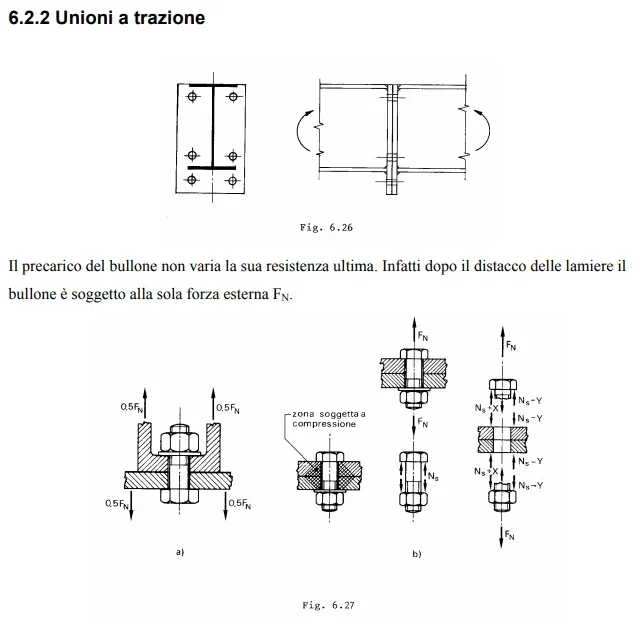
in order to invoke students (or maybe even some post-students...) to very critically evaluate certain statements on the hold of bolted joints, and verify them not on the basis of my opposite statements, but on the basis of the literature established at international level and the content of university courses on the topic, I attach an extract from the technical lessons of the constructions of prof. piero ghelfi of the university of Brescia (recuperablescia).
PR1.webpI only reported the part containing the key statement
"the preload of the bolt does not vary its ultimate resistance"but in the document from which it is extracted there is also the formal and analytical treatment of the topic.

because little intuitive, this topic is often the subject of my questions: Unfortunately, in courses it is not given the necessary weight to this particular that can affect (and a lot) the ability to design a machine correctly. we read before there are designers convinced that the precarious reduces the ability of the assembly to hold the traction, when instead it is precisely the precarious maximum that makes the system more resistant.

I hope that among those who read us, there are also any next candidates I could meet tomorrow: a correct answer would be happy both.
 
But excuse me if I insist, if your goal was to evaluate the knowledge of precarious and to test the knowledge of the counter-intuitiveness according to which a preloaded screw or joint is not affected by the precarious as a sustainable load because you have started defining the inextricable cable?
If it concerns you for a moment the processing on the joints and threaded links (which I recommend to you to do), you will see that it is all completely based on the stiffness and elasticity of the bolt and the clamped element.
the different rigidity of the two elements and the different behavior following the external load give rise to the famous "sealing triangle".
once the outer load has exceeded the initial preload (situation to avoid) the load is completely absorbed by the bolt and the lock element is free, basically our joint is useless. .

your question is wrong from the beginning, as you have defined the unexpectable cable!
to understand us in a hypothetical triangle of tightening your imaginary tie has infinite rigidity so it is vertical! will never intersect with the segment identified by the tightened elements.
You started defining a rigid system and then want to apply the theory of elasticity.
 
I repeat again, remembering that the logical abstraction that leads to consider the bodies as rigid or even as condensed at a point of zero size, is not a "mental patch", but one of the key concepts that led to the development of the current scientific knowledge.
I am absolutely persuaded of what you just wrote, it should not even be necessary to reiterate it. the introduction of ideal hypotheses is fundamental for the simplification and rationalization of a system, as a system of forces. This serves to remove from the field any unnecessary (or negligible) complication for the rationalization of the problem.

What happens if the thread is inextensible and how such is not stretched? How much is the tension of the same? of course the same equation applies, which takes the form

τ = k = ∞ · 0

how much ∞ · 0 ? any value. attention, this does not mean that it does not exist, or that can change without reason or any other imaginative interpretation. means that τ has one and only one specific value that can be any. is indefinite and, as such, must be defined externally to make the model valid.
Yes, it is a hypothesis that you can do, as well as many other "ideal" hypotheses apply.
However, in this way, the value of the tension of the constant wire (the one chosen) becomes constant the reaction caused by the plate resting on the fixed support.
Thus, how do you justify the behaviour of the system, which is based on proportionality (for example, the annulment of that reaction or stack of the plate in order to understand us), when the load is added?
 
... why did you start by defining the cable?
just to remove any other side factor and leave only the verification of that behavior that you need know and not guess. I didn't care to know anything about the locking triangle, but I wanted to see if the candidates would sum up those forces (what not to do) and that they punctually did all (and someone even on these pages).

the best answer gave you anyway paolo colombani in his first paragraph: remove what is around us to focus on the point you want to check.

Therefore, the problem is not bad, indeed.
However thus making imposed the value of the constant wire tension (the choice)
true (but only until the external force exceeds it).
and with it also becomes constant the reaction provoked by the bat resting on the fixed support.
Here is the difference: reaction is given by tension minus force applied externally.
for a more detailed discussion read #31.

p.s. the bat never breaks, always stays in touch. what varies is the reaction of the fixed support to the plate.
 
if at the mathematical level the problem is indefinite (infinite for zero) it is wrong to say that the tension is set constant because tau will be a function that tends to 2 per temperature, load and other values that affect k and s that tend to a certain value (such? ).
 
perched May dovrebbe tenders a 2?and due.However, "unextensible and negligible mass wire" is an ideal model of something that does not suffer from temperature, magnetic fields, neutrinos or other. It is a means that flexiblely transports the point of application of one force into another.

no one did exercises in physics 1?
 
perched May dovrebbe tenders a 2?and due.However, "unextensible and negligible mass wire" is an ideal model of something that does not suffer from temperature, magnetic fields, neutrinos or other. It is a means that flexiblely transports the point of application of one force into another.

no one did exercises in physics 1?
exxon, in my opinion, makes no sense to undo a mathematical justification if you do not want to deepen it and/or argue it. a question without offense of course, do you have in mind the concept of limit of a function and more of indeterminate forms mentioned by you?
 
ale, I'm sorry you didn't understand, and I try to be clearer:

τ is not a function, it is a number. How can it be a function? what are the starting and arrival sets? what would be the independent variable? in analysis 1 explain that equations and functions are two distinct mathematical entities. that the functions are represented with equations is incidental, does not mean that every equation assumes the function hat right. if I write "a = 1 + 2", I wrote an equation, not a function; "a" is a number (it should be 3 if I'm not mistaken...) and it's not a function of anything and does not tend to anything: That's 3.

then, when I write "τ = 2 · 3", I define a Number (τ) which is defined and is worth 6. if I write "τ = ∞ · 0", I always define the same number that can take any extended real value. since it can take any value, I choose it myself and decide that τ = 2.

a small engraved: when (at his time) I studied analysis 1 and later, for me, as for all my colleagues, the only goal was to pass the exam. once there was more to think about. at a distance of many years, I took that matter in hand and I restudied it from the top (following the courses of prof gobbino of the normal of pisa). It was one of the most useful things I've done in many years: understand math is very different from studying it to pass an exam. is to buy a tool that allows to face "strange" situations with a rigour that does not allow deviations and certifies the correctness of certain choices made in every branch of science. This is a small example. If you can cut out a corner of time to devote, it will certainly be time well spent.
 
apart from this I rectify my answer. I had read the problem very badly and I had given my answer considering s and the "appesi" piattello to the rope and therefore generated an initial tension to be added to the weight subsequently applied. I hope not to say a chestnut but you could pretensify the cable even at 98n and you would still have the estate: the 98,1n will first go to download the pretension and then go to download on the rope without adding up obviously to the initial voltage.
returning to the mathematical speech and addressing me in particular to exxon, perhaps I was miserable. I meant that tau is two at the beginning and tends to other values when the system is loaded.
 
then, when I write "τ = 2 · 3", I define a Number (τ) which is defined and is worth 6. if I write "τ = ∞ · 0", I always define the same number that can take any extended real value. since it can take any value, I choose it myself and decide that τ = 2.
I don't understand this concept. You've been very clear, but I have to metabolize it and understand what's wrong with me and why I'm convinced of something else.
a small engraved: when (at his time) I studied analysis 1 and later, for me, as for all my colleagues, the only goal was to pass the examination
I've been running out of college for a year, and I'm totally right. between studying to pass the exam and studying to understand what you are studying, sometimes, not always, we pass
 
Good wing!

with the hypothesis of pretensioning the cable to 98 n proves to have grasped the concept. the answer is yes: you can tension it to the limit, so much the tension will not increase until the added weight will not reach the same intensity.

p.s.1 my choice in the exercise of preloading to 2 n is intended to put the two neighboring values and riding the seal limit. Thus it happens that by using the numerical value 9.8 you get a result, while with the numerical value 9.81 you get the opposite one. It is not really a trick, but I was hoping to get a different result from the candidates and I had inserted this little further difficulty.

p.s.2 fast reading the text of an exercise is the best way to "feel" (especially for students...). It is essential to dwell on every word and ask what its weight is in the description of the system. for the older ones (like me...) the same applies to contracts and technical specifications!
 
............no one did exercises to physics 1?
Here we go
your test would be tolerable in a public competition for the assignment of a place for a physicist to theenea, it is not tolerable for the selection of a junior mechanical designer to be included in a private company more with admission to the selection of graduates, I find a retrogusto .....puntini puntini
p.
Can you write tolerable?? we will see
seems someone posted it on a foreign site
 

Forum statistics

Threads
44,997
Messages
339,767
Members
4
Latest member
ibt

Members online

No members online now.
Back
Top