
• This forum is the machine-generated translation of www.cad3d.it/forum1 - the Italian design community. Several terms are not translated correctly.

which software is recommended to make such a model?

  • Thread starter Thread starter Jovanz
  • Start date Start date

Jovanz

Guest
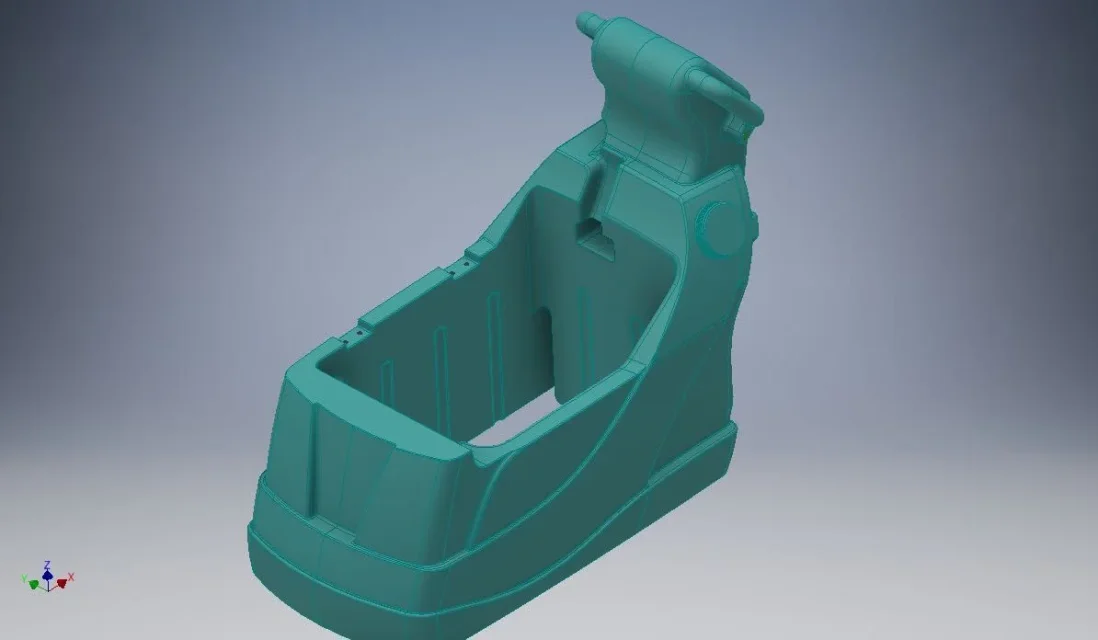
I was asked if I could draw in 3d a coating model of a washing-dry machine as in figure. I honestly don't even know where to start and which software would be more appropriate. my question is then, who realizes these particular industrial plastics how does it take the actual measures of such a complicated model and then reproduce it correctly in 3d? what should he leave?
 

Attachments

  • IMG-20171205-WA0015.webp
    IMG-20171205-WA0015.webp
    29.1 KB · Views: 76
I mean, they give you the 3d of the machine and you have to do the coating? All right, any solid modeler
my question is then, who realizes these particular industrial plastics how does it take the actual measures of such a complicated model and then reproduce it correctly in 3d? what should he leave?
You have to understand what you mean by realizing.
if you mean materially the product follows the directions of the designer
If you mean industrialization, it defines the measurements according to the project and I imagine it interfaces with a designer for the aesthetic aspect.
 
I've been asked if I can do it in 3d, because the study they've been leaning on to make the model makes the professionalism pay frankly. sincerely even with the images of the three projections on the main planes I see it very complicated the thing... although perhaps it is the only way that of the surfaces. I still see a complicated job.
 
They asked me if I can do it in 3d, as the studio they leaned on to make the model makes the professionalism pay frankly.
if you have to make yourself the model of the figure you are not enough pictures; you could try converting them to dxf to use as a layout, but I doubt it is a practical and reliable system.
serve drawings or in extrema ratio the real object to be detected by hand.
or contact the manufacturer of the tub and find a deal and send the step... someone that solid image 3d has already done it
 
in the first post the word "how" puts me a doubt.
must that be exactly the figure? If so perhaps it is easier to make a relief with 3d scanner.
(but I've heard about it well, even though I don't know what the cost is for this size. )
if you mean something similar to that of the image, you start from below: you sketch a shape similar to the suggested one that covers your mechanical structure (which you already have because it is yours, if I understood correctly) and you do the adaptations of the case. will not be the same, but it will be functionally adapted. and no one can accuse you of replicating a project of others.
 
it is not clear to me if you have to replicate the object of the image to the first post or if you have to do a particular that you will fit with this.
In the first case you have to reverse engineering, the best thing is to start from a 3d scan of the object and model with any solid modeler, type solidworks, inventor,cree, solidedge etc.
from what I see are quite simple forms, you should do it with any of these software.
if instead you have to create an object that fits this you have to follow the suggestion of massivonweizen, hear from the manufacturer if you pass a step and then create the object based on that.
If you have to make "exthetical" forms with complex superphiles may not be enough one of the above-mentioned software and you should use something more specific, type catia.
 
I've been asked if I can do it in 3d, ....... sincerely even with the images of the three projections on the main planes I see it very complicated the thing... although maybe it's the only way that the surfaces are. I still see a complicated job.
and you risk hurting yourself like I said, that is, failing to complete your work in the ways and times required.
as the study to which they have leaned to make the model is made to pay fragrantly professionalism.
It seems to me the least to get paid for professionalism, they probably know how to do... :-)
 
hello, even powershape is indicated for such a thing.

the top would be, as they have already told you, to start from the mathematicians that you have to "dress" ( fairly easy and cmq feasible for those who know how to do it, if you have the mathematicians at your disposal).

Otherwise, if you have to reverse, it is "complicated" also for those who know how to do it, and it does it in business.

the costs of the two works are different just as order of magnitude;)
 
is the usual question of the difference between the "know to do" and the "know to use a sw".

today as today it seems that the two things are superimposed, or rather, that the ability to use the "right sw" can replace the necessary knowledge to carry out a job.

in the case of species, the op asks which is the best sw, not what are the factors to consider in the project (thickness, deformity, stiffening, retreats, vents, etc.). the possibilities are two: or you know these factors well and then it is sufficient to indicate the brand and model of the most indicated package, or you have not placed the problem because you think (or hope) that the "sw" can satisfy these necessary knowledge of designer.

we expect to have more information about it, then we can give more answers centered.

I associate myself with a question already made: is this the first work of this type? the question is not rhetoric: normally also of designing a small parallelepipeda box, the first project commits an avalanche of errors.

starting with an object of that size and complexity and how to climb the vintage having only the escaped outside the door.
 
replicating the model in figure is not difficult, it is only a matter of time (i.e. $$). Looking at it well, I would say that with a traditional solid modeler it is possible to complete it to 99% with good executive precision. It would be interesting to have the step available to see it more in detail, after removing all the fittings the figure certainly appears more schematic in order to be able to hypothesize a valid 3d modeling path. I would not throw myself on the surfaces in this case, but on a good number of boolean. If you have to make the coating, then there is no doubt, you should start from a copy of the affected surfaces, then the classic size and sew as the tailors do. So, in the first case it's okay a bit 'of everything (swx is more than enough, I have seen more complex models with this program), while in the latter case I would be comfortable with a zw3d, which gives you full control of solid/supf geometry as hybrid. In any other case, since I used a good number of cads for various uses, I would feel a little bit in "cloths".
 

Forum statistics

Threads
44,997
Messages
339,767
Members
4
Latest member
ibt

Members online

No members online now.
ciao
Back
Top