• This forum is the machine-generated translation of www.cad3d.it/forum1 - the Italian design community. Several terms are not translated correctly.

problem: union separate parts of a single volume (stl file)

  • Thread starter Thread starter Gallup
  • Start date Start date

Gallup

Guest
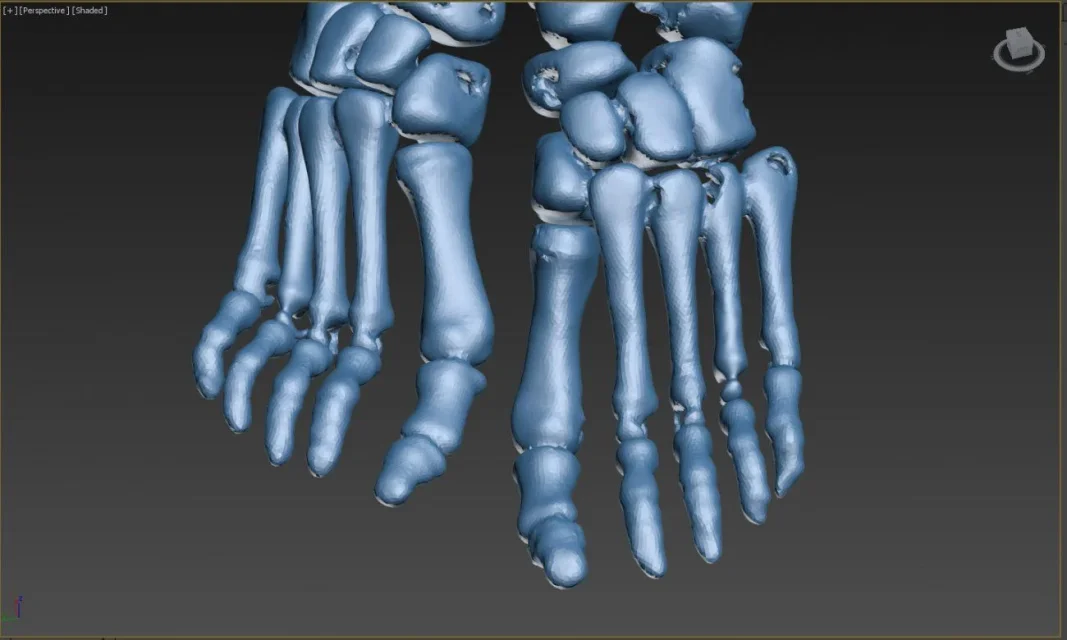
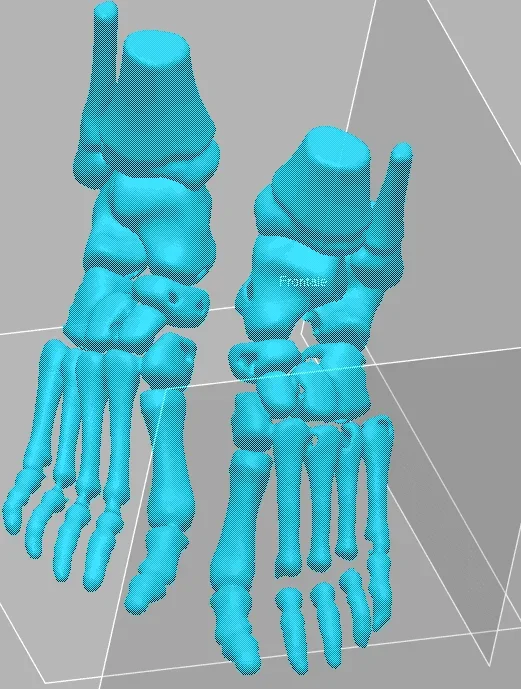
hi to all, I would need a hand I'm doing thesis and I'm stuck, I have a stl file of the bones of a foot, but the phalanges are separated from each other, I need to join the separate parts and create a unique volume, I have attached a photo.
as software available I have rhyno, geomagic, freecad and blender.
Thank you for your help
 

Attachments

  • Cattura.webp
    Cattura.webp
    67.1 KB · Views: 11
You should work with polygonals by rebuilding the missing parts and joining them with the adjacent ones. from the photo it would be said that 3 phalanges are missing.

or you can simply group them. in autocad with the "group" command, with other software I don't know. is it possible to have the stl file?
 
You should work with polygonals by rebuilding the missing parts and joining them with the adjacent ones. from the photo it would be said that 3 phalanges are missing.

or you can simply group them. in autocad with the "group" command, with other software I don't know. is it possible to have the stl file?
I don't have autocad, is it free? the fact is that he sees it as a unique object, not as various parts.
Yes, the file I attach.
 

Attachments

I don't have autocad, is it free?
No, but there's a possibility to download the student version.
Do you have to work on that file, which is clearly created by scanning with all its approximations (see the bones joined together) or what you need is more simply any 3d pattern of the foot bones? because on the net you can find the bone pattern of the foot without the approximations of that stl file. even in low poly, so manageable with more ease. so you'd have the chance to laure bone to bone accurately.

Anyway, I separated what was possible to separate easily. before correcting the scan result approximations I thought I asked you the question I asked you before, because those 3d objects are a mountain of polygons. the only dxf exceeds 200 mb. I saved the file in obj format
file piede obj
 

Attachments

  • 1bis.webp
    1bis.webp
    46 KB · Views: 11
  • 2bis.webp
    2bis.webp
    45.8 KB · Views: 11
Last edited:
No, but there's a possibility to download the student version.
Do you have to work on that file, which is clearly created by scanning with all its approximations (see the bones joined together) or what you need is more simply any 3d pattern of the foot bones? because on the net you can find the bone pattern of the foot without the approximations of that stl file. even in low poly, so manageable with more ease. so you'd have the chance to laure bone to bone accurately.

Anyway, I separated what was possible to separate easily. before correcting the scan result approximations I thought I asked you the question I asked you before, because those 3d objects are a mountain of polygons. the only dxf exceeds 200 mb. I saved the file in obj format
file piede obj
Thank you for your readiness, but I want to join separate phalanges, don't separate them! :d you have to work on that file, I want to get a 3d file of closed and compact bones not separated in an openable format in abaqus (step) on which then I have to perform the processing.
 
bone separation is only the first approach, to eliminate those parts that are extra because of the approximation due to scanning. once separated one by one and rebuilt in the parts where the polygons are lacking, the bones reassemble to form a single set. This was the approach I meant when I talked about separation.
For example, in Figure 1bis, the four metatarsal bones and wedgeforms cemented together form a unique mass. are those indicated by the arrow and colored in dark grey. beyond those there are other "certain" with others. It is clear that these approximations are due to scanning, so I imagined it was better to separate each bone, rebuild it in the missing parts and then form one group with all the other bones.

But if the problem is just joining those three phalanges to metatarsals, then it's all easier. means having to rebuild the missing parts. I see what you can do. which file format is importable from abaqus?

regarding the other bones, the fact that some are cemented to others could distort the result of processing? That was the scruple I put on.
 
hi to all, I would need a hand I'm doing thesis and I'm stuck, I have a stl file of the bones of a foot, but the phalanges are separated from each other, I need to join the separate parts and create a unique volume, I have attached a photo.
as software available I have rhyno, geomagic, freecad and blender.
Thank you for your help
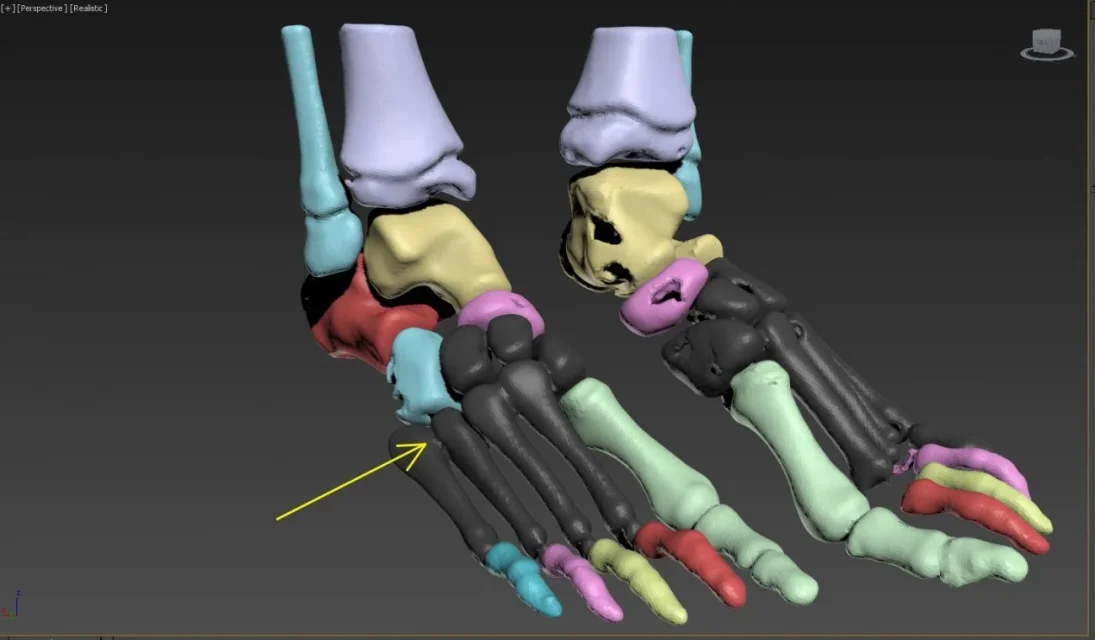
you can do it by yourself with blender and with so much holy patience is a mesh full of holes and spaces between one bone and the other
fast example:vix4Immagine.webp
 
If I hadn't separated the bones, I would have had a big problem of accessibility to the sewing parts. You always learn to work by facilitating things so you save more time and less worries. It was in fact a matter of going to work between finger and finger, so to do a precise job you had to separate the bones and hide from time to time those that bothered the sight.

So, the missing parts I cloned them from the other foot. only the final heads of the bone and sewn on the other bone of the reverse foot. .
I tried to create an obj containing all the bones contained in a single set, but 3ds max has problems in creating it. So I created the obj leaving the bones separate, where I operated in separations. You should group them manually with the program you're doing.
Look if the file is okay

this the file objcorrect foot obj
 

Attachments

  • 3.webp
    3.webp
    40.5 KB · Views: 9
  • 4.webp
    4.webp
    53.3 KB · Views: 10
is a mesh full of holes and spaces between one bone and the other
In fact, recreating mesh is an arduous enterprise. that is to correct the solids and clean the 3d from the typical excesses of the 3d born from scanning
 
the original 3d is the result of some scan, probably a tac or something like that. inevitably these scans produce an imperfect result. There are software that manage these scans (like geomatics) but they are real modeling software, so if one does not have modeling bases they are practically useless.
 
hello, unfortunately in these days I have no time, if you do not solve before I try Thursday or Friday
 
are 419 vertices and 451 edges and 23 non manifold faces
It is possible that he did not weld among themselves the leaders concerned by separations. in fact known that blender highlights them right in correspondence of those separations. Some other part lacks some small polygonal. I see what you can do
 
il
It is possible that he did not weld among themselves the leaders concerned by separations. in fact known that blender highlights them right in correspondence of those separations. Some other part lacks some small polygonal. I see what you can do
My heart was not a reproach:)
you don’t have to do more too much you have already done,considering also that the little is gone
 
the

My heart was not a reproach:)
I know, I just want to hang with 3ds max, and that file to correct seemed interesting to me as an exercise. if then a gallup comes useful is always in time to return and download it, if you want.

I have provided to weld (the welding) of the vertices where I operated the separations to see if it depended on that. I also improved the mesh a bit near the welds.
rather I was interested in the speech on the non manifold vertices. on 3ds I did not find the option that allows to do that control.
Could you check the file with the blender? If yes, tomorrow place the obj file.
 

Attachments

  • 5.webp
    5.webp
    31 KB · Views: 9
  • 6.webp
    6.webp
    54 KB · Views: 10
I know, I just want to hang with 3ds max, and that file to correct seemed interesting to me as an exercise. if then a gallup comes useful is always in time to return and download it, if you want.

I have provided to weld (the welding) of the vertices where I operated the separations to see if it depended on that. I also improved the mesh a bit near the welds.
rather I was interested in the speech on the non manifold vertices. on 3ds I did not find the option that allows to do that control.
Could you check the file with the blender? If yes, tomorrow place the obj file.
Okay.
 
to export obj finished 3ds warns me that there are small errors. But I've sold out every summit that was previously dissaldated. It's right to see if it depended on that fact, thank you.

file objcorrect foot 2
 

Forum statistics

Threads
44,997
Messages
339,767
Members
4
Latest member
ibt

Members online

No members online now.
Back
Top