• This forum is the machine-generated translation of www.cad3d.it/forum1 - the Italian design community. Several terms are not translated correctly.

design trolley on tracks

  • Thread starter Thread starter leonardo000333
  • Start date Start date
Then I explain better, the cart must move a few meters a day, when it serves, sometimes even 300mm if I lower the speed then also deceleration happens in less time, one thing at the limit would be to turn the engine in another sense or a mechanical brake of some kind? the budget is about 7000 euros but already 3000 it year iin material and other, with 4000 I have to make me retadented motor rack and rails
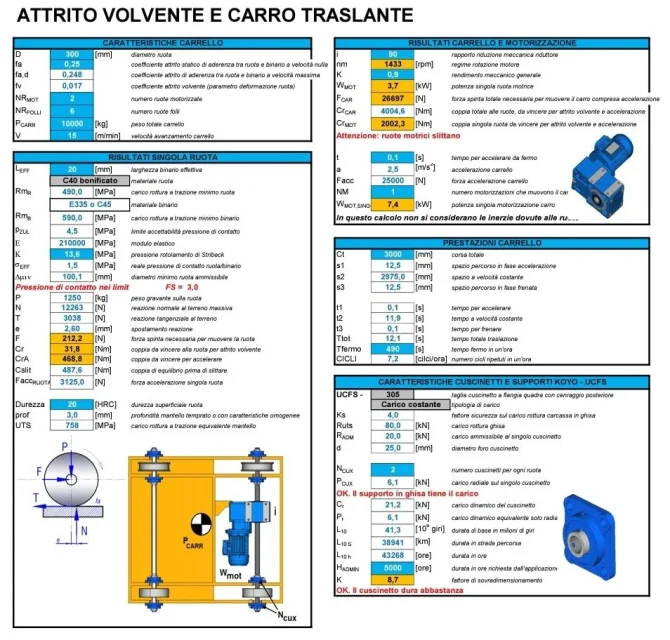
 
a speed of 0.25m/s. a 'brain' that comes to mind is to make a joke with a spring that absorbs deceleration and then brings the cart back. . .
 
realize that in a month the engine will remain on for even 2 hours with the sum of all the translations
 
or since the translation quotas are different but about a 20in in total with photocell type sensors or other I trigger the stop interrupter to the motor automatically a bit earlier based on field trials
 
with regard to the photocells, thinking about something more evolved and expensive than an inductive or capacitive proximity, if you have to put more than four you want an absolute encoder. Keep in mind that even simple proxies with 4 have the cost of an encoder... made the account several times.

Keep in mind that the spring alone takes the energy and returns it almost completely, so it is not a dampener or decelerator and therefore it is not okay.

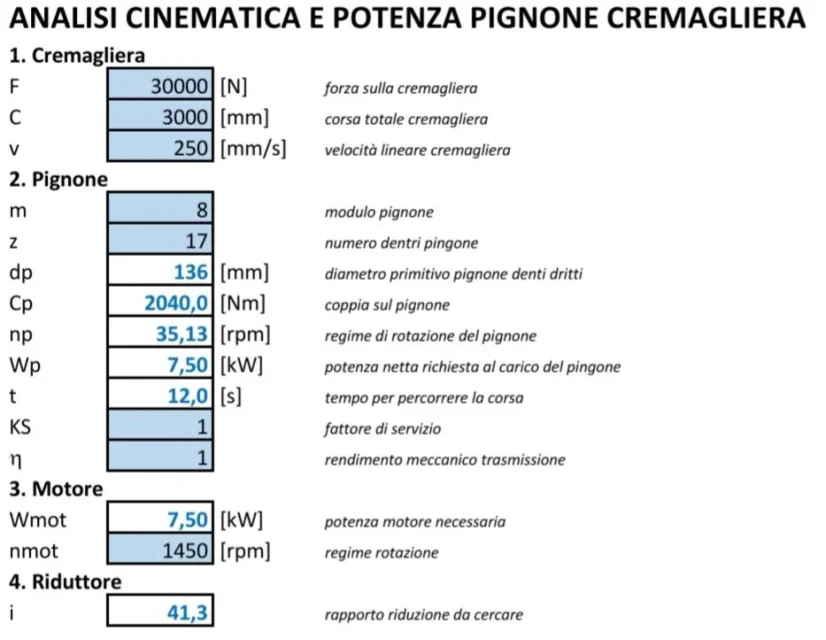
going to 15m/not i.e. 0.25m/s it is already more reasonable the thing because to make decelerations from maximum speed to zero, in 100 milliseconds you are enough 7,5kw.Screenshot_20200425_081604.webpof course in your case, from the card above you don't have to consider the reduction ratio and the slip notice because your motorization will be rack, but it can give you the idea for the wheels on track drawn, the koyo supports to support the wheels, etc.

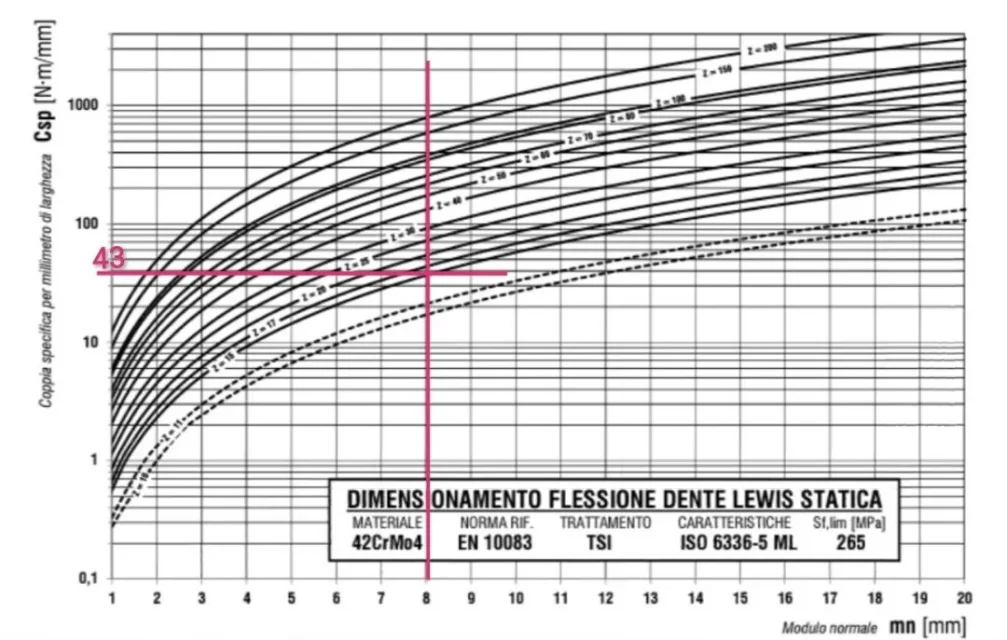
fast lazy system and rack can be so evaluated:Screenshot_20200425_092443.webpthen we verify that the 80 mm wide module 8 pinion for standard rack, in induction hardened rectified material is able to carry the load.IMG_20200425_092717.webptherefore 43nm/mm for 80 mm makes 3440nm that are less than 2040nm required and therefore okay.

then going to look at the red catalogue gearboxes you could mount this:Screenshot_20200425_100710.webpand use a hbf engine braked from 7.5kw to 4 poles.Screenshot_20200425_101020.webpwhere you have a parking brake to stand still when you are in position.Screenshot_20200425_101037.webp
 
Thank you very much, just one thing, how did you find the f force on the rack that I am not? that you considered the total weight multiplied by the factor of friction of the wheels? I mean the 30000n force from where it comes out?
 
Thank you very much, just one thing, how did you find the f force on the rack that I am not? that you considered the total weight multiplied by the factor of friction of the wheels? I mean the 30000n force from where it comes out?
Turns out I needed 7.5kw on the cart spreadsheet, so I still got 7.5kw, that's the number.

all the theoretical calculation of the carriages find it in the various posts equal to this... .
all is rated in acceleration/deceleration.

It is clearly a point for you to reason and post your proceedings.
 
I understand, a last question, I do not understand a formula in a shared image on another forum, I attach it to you.
The length of the rack does not understand why it is linked to that formula, for me the rack can be as long as you want or not? because it has to depend on other things, I just can't get there and on racks even in engineering books and manuals very little, without talking about the internet.pyma6a7u.webp
 
I understand, a last question, I do not understand a formula in a shared image on another forum, I attach it to you.
The length of the rack does not understand why it is linked to that formula, for me the rack can be as long as you want or not? because it has to depend on other things, I just can't get there and on racks even in engineering books and manuals very little, without talking about the internet.View attachment 57418
This is one of my manuscripts....if the wheel has to make a round, i.e. two lazy.... its development of primitive circumference will be the minimum length of the rack.
depending on the application, when you relate the angle of rotation of the pinion with its linear effect it is necessary to know....it is the case of self-centering pliers with a pinion and two racks.....can not be long "what you want" but how much you need.
accoppiamento%203.jpg
 
but in my case it does not matter the relationship between rack length and sprocket development since I don't care how many turns or what angle of rotation makes the pinion, I only care and exclusively linear shift, to understand:
if the rack for a 1 meter shift requires 2 lazy turns or 2000 (invented number without any practical connotation) to me nothing changes
 
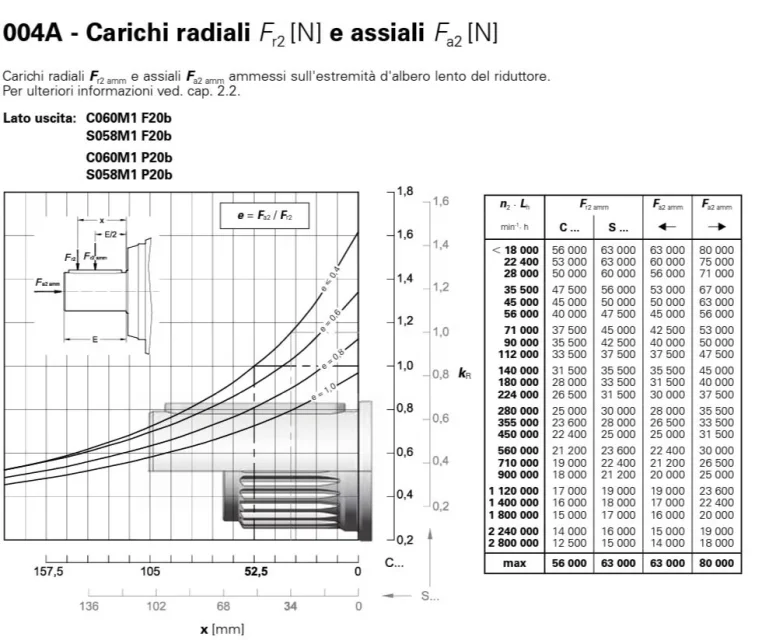
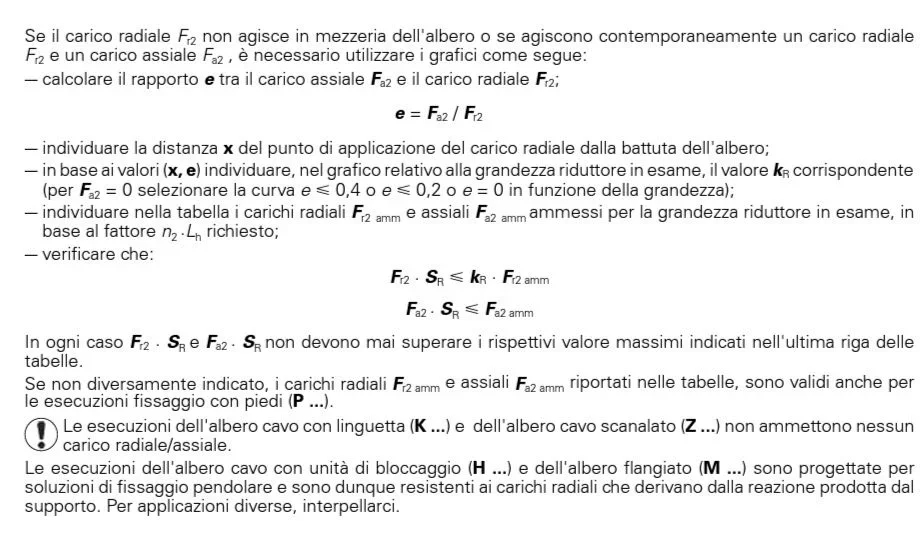
just as a reminder, there is to consider the equivalent radial load in case the pinion is cast directly on the slow shaft.
the radial force and the tangential will be composed with pitagoras and evaluated on the limit value.
I attach a piece of catalog ... to better understand you need to read also the special section.
Screenshot_20200425_135203.webpScreenshot_20200425_140025.webpScreenshot_20200425_140052.webpIf it wasn't checked, you'd ruin the head bearing and soon you'd have the broken reducer. it may be necessary, if not verified, to add a bearing at the end of the pinion.
 
but in my case it does not matter the relationship between rack length and sprocket development since I don't care how many turns or what angle of rotation makes the pinion, I only care and exclusively linear shift, to understand:
if the rack for a 1 meter shift requires 2 lazy turns or 2000 (invented number without any practical connotation) to me nothing changes
in your case no.... but for the calculation of the pinion wear you... depends on how detailed you will make the calculation.
 
I stopped at first page.
It is true that the friction force you have to win it, but it will be much larger the horizontal force of inertia, given by expensive mass for horizontal acceleration....that will be so much more since you want instant stop.

No, I'm going ahead.
second page, the trade pins have the band width of 10 times the module.

m=5....b=50mm
m=8.

in what material is the pinion made to have such a low admissible sigma?
page three...

the calculation of total yield has problems:
- engine performance I don't have to calculate it because the declared kw are net guaranteed to the shaft....if ever it will consume more power from the power grid but nobody sees it...so engine performance = 1
- reducer yield 0.4 means that it is an endless screw of bad quality and is not realistic if you use gearboxes cylindrical or conical or endless screws of new generation (10 years to this large series commercial part)

engines with poles greater than 4 are not functional at the electrical level because they consume more than hello they give. it is always better to use a 4 pole.

what makes your skin happen is that you eventually have a big engine almost like mine but only to win friction. you have a fear oversized in each formula. if you also consider the acceleration what you do? Are we going to 100kw?

keep in mind that the ball recirculation guides, even in dirt conditions, will not arrive at such a high friction coefficient...0,1.

Remember that 10 ton on ball recirculation skates turn by hand ....so 30÷50kg.

but if you have such a big structure, do you do it all where you have skates and guides? Do you also have a ground floor braided? how do you align three ball recirculation guides at those distances? What about skates? which blocks and what do you let align and close after?

Remember that the dealer can be anyone but the products are of the manufacturer....so guide hiwin....with the peace of fait group rather than world.... rather than soups or I will be... .

I am accustomed to choosing the manufacturer and possibly avoiding the dealer, at least for the technical part ....I want to talk to who really knows about the product.

reliable gearboxes and motors and competitive prices made in italy I prefer red for strong things and bonfiglioli for smarter things... large series, tested, revived in recent years, available worldwide.
 
when you say that 10 tons on ball recirculation skates turn by hand you're serious?
 
Sorry for mistakes is my first project, I'm 20 years old haha, thank you to tell me how many bullshit I do well, oversized a lot because at itis the prof always oversized everything, so nothing had a practical twist, remained on paper and stop.
 
when you say that 10 tons on ball recirculation skates turn by hand you're serious?
number 4 hiwin guides size 55 ....travel to two guides .....5 meters total with above a wagon 3 meters long.....sopra we go from 7 to 12 tons....and if you lean and push....after some fraction of a second start to move the wagon.
 
Sorry for mistakes is my first project, I'm 20 years old haha, thank you to tell me how many bullshit I do well, oversized a lot because at itis the prof always oversized everything, so nothing had a practical twist, remained on paper and stop.
here if you have to manufacture are acidic cabbage if you are wrong or if you throw money....
I unfortunately am brought to calculate to the bone.... because everything costs, because you have to be competitive... and sometimes something remains in your hands unfortunately even if not very often.
 
However, I can't calculate the eye-catching and deceleration of the cart
starting from the fact that the wagon has its good mass m and that at regime travels at speed v.....if you have to stop it you will have the final speed will be zero.
therefore the acceleration will be:
♪[ a=\frac{\Delta V}{\Delta t}=\frac{v-v_0}{t} \]the horizontal inertia force will be given by:
♪[ F_{inerzia}=m•a=m•\frac{v-v_0}{t}\]so horizontally you will have to win both inertia and acceleration force but....
If you brake you will have the strength of inertia minus the force of friction....if you go to handcuff you will have to win force of inertia and force of friction.
according to these things that act do the sizing.

just that we are about to punctuate....the engines should be chosen in an optimized way i.e.:
- nominal power for power consumption at regime
- peak power only for acceleration and deceleration ramps

However, since they all struggle to understand that they have to take an inverter heavy duty and not normal duty and the powers at stake are not exaggerated. . ..it should be ignored that the engines have the torque available for a few seconds more than twice the nominal.
Moreover it is recommended to have a physical encoder on the motor and one on the axis wheels so as to make the closed ring of retroaction and then manage through inverter also maximum torque at speed nothing.... otherwise the system will adapt to the system inertia and will do what it can.
 

Forum statistics

Threads
44,997
Messages
339,767
Members
4
Latest member
ibt

Members online

No members online now.
ciao
Back
Top