• This forum is the machine-generated translation of www.cad3d.it/forum1 - the Italian design community. Several terms are not translated correctly.

design trolley on tracks

  • Thread starter Thread starter leonardo000333
  • Start date Start date
the client is the same company I already work for, we say I am doing a project for the workshop where I work so the atrezzatura then I go to use it, and surely it will be less dangerous than the one currently used with which I have done 3 days of hospital... so I am aware of it
And maybe you paid insurance for an accident with a gear?
responsibility.
 
I'm kind of informing myself about electronics, inverters and engines in general to start understanding how they work.
from what I understood with an inverter I can control the frequency of my good electric motor, setting the maximum and the minimum. Moreover with a potentiometer I can go to vary the number of turns. Also wanting to connect us a plc really the ramps would be infinite and not predictable all since the load does not go to step (eg: first I have 20 quintals then 50 etc) but it is a variable and completely random load over time.
So I am forced to reason in another way, these are my considerations:
being the variable load the control of the movement must be manual (in the sense that I am to operate and turn off the engine)
Since the switching off is the famous deceleration I could connect the inverter to the engine so as to go to use the potentiometer for movements, when they are near the correct position I go to decrease the number of turns.
I also see myself forced to increase the uncertainty space of the position from 10 to 20 mm.
(if you don't want to answer me don't make anyone oblige anyone, I just ask to avoid unconstructive comments, it's my first approach to design I don't think no nasca learned)
the potentiometer is not a salami to attack with the spake.
I write it for the last time and I hope you can understand:
- parts with fixed acceleration ramp....you arrive at speed well will be trapeze curve... You don't get it, you'll be triangular. ...pace.
- take a long way to 15m/min
- get to the deceleration photocell
- the inverter adjusts the speed to 5m/min for a race of about 500mm so you can make immediate stop with tolerance +/-10mm because the acceleration of braking will be almost nothing
- Get to the crash photocell, pair the engine to stop
- current to the negative brake so it blocks
- current engine towels
- safety work
 
Yes everything ok only that I have to be able to make even movements of only 200mm
 
in fact if I can say mine, to make a position check it takes you something on the car: an encoder on the pinion or in the wheel hub, or a wire potentiometer, but I don't know how long they make them. fact is that you have to have direct control over the position of the cart, do not check its passage to certain steps, as if they were “traguards” ... otherwise, as you rightly say, if my distance to travel changes I have to move the instrumentation to the ground.
 
Exactly, if I put an encoder this does not take into account the change of the mass and therefore the variable inertia right? another problem is the brake of the motor: I've seen the brakes of the engine operate right from the engine itself and so I don't know if there's a way to drive away
 
Exactly, if I put an encoder this does not take into account the change of the mass and therefore the variable inertia right? another problem is the brake of the motor: I've seen the brakes of the engine operate right from the engine itself and so I don't know if there's a way to drive away
the motors have the electric brake that can almost always be separately controlled.
 
in fact if I can say mine, to make a position check it takes you something on the car: an encoder on the pinion or in the wheel hub, or a wire potentiometer, but I don't know how long they make them. fact is that you have to have direct control over the position of the cart, do not check its passage to certain steps, as if they were “traguards” ... otherwise, as you rightly say, if my distance to travel changes I have to move the instrumentation to the ground.
wire encoder.... the last one I saw in the yard ran 5 meters
 
Sorry, but I'd like to get out of curiosity.
If you need to stop the wagon at any point, move it any distance, can't you use a system like that of the chariot with pulse pushbutton or with potentiometer that allows you to adjust the speed up to the desired stop?
Maybe I lost some data in the discussion, which I followed more by curiosity than real interest, so apologize if I said a crook
 
I have not understood why you fear the slipping of the wheels.
I didn't understand why the crank sucks. It also prevents the object from confiscating a machine within the meaning of the directive. The speed you choose with the dice...
even the wall-attacks were a great idea. The 20mm are guaranteed by hand.
 
I have not understood why you fear the slipping of the wheels.
I didn't understand why the crank sucks. It also prevents the object from confiscating a machine within the meaning of the directive. The speed you choose with the dice...
even the wall-attacks were a great idea. The 20mm are guaranteed by hand.
fears the slip of the wheels because at full load weighs 10t while at vacuum weighs 1t. If the accelerations were high, if from vacuum torque as full load you have to win a pair due to the eccentricity of the force (due to the coefficient of volving friction) much smaller and then do the deflating. but this only if the wheels on the ground were moving. instead there is a rack pulling.... and the wheels all crazy.
probably in what he already feels squeeze a little due to the fact that it will not be perfectly aligned everything....so a little verse the wheel on the track does it.
 
I have not understood why you fear the slipping of the wheels.
I didn't understand why the crank sucks. It also prevents the object from confiscating a machine within the meaning of the directive. The speed you choose with the dice...
even the wall-attacks were a great idea. The 20mm are guaranteed by hand.
because by hand I can turn a handle at maximum 80 g/min while a motor makes many more so the translation of the handcar has a very low speed
 
Sorry, but I'd like to get out of curiosity.
If you need to stop the wagon at any point, move it any distance, can't you use a system like that of the chariot with pulse pushbutton or with potentiometer that allows you to adjust the speed up to the desired stop?
Maybe I lost some data in the discussion, which I followed more by curiosity than real interest, so apologize if I said a crook
the problem is that from the beginning there is nothing clear
 
Sorry, but I'd like to get out of curiosity.
If you need to stop the wagon at any point, move it any distance, can't you use a system like that of the chariot with pulse pushbutton or with potentiometer that allows you to adjust the speed up to the desired stop?
Maybe I lost some data in the discussion, which I followed more by curiosity than real interest, so apologize if I said a crook
this observation is very interesting, however in two hours place of calculations much more rigorous than the previous ones to make clear on many aspects
 
because by hand I can turn a handle at maximum 80 g/min while a motor makes many more so the translation of the handcar has a very low speed
Did you try to make two accounts between the couple you can do and the speed you reach turning to 80 rpm?
 
today afternoon place calculations I hope accurate and exhausting but maintaining the hypothesis of use motor and inverter
 
Then,
find the calculations. Unfortunately for having a 7,5 kw engine I had to reduce the maximum range from 10 tons to 8,5 and the speed from 0.1 to 0.08, you can not have full barrel and the wife unfortunately drunk.
as you can see on page 4 I describe the 3 engine options.
any of them I go to decide I intend to connect an inverter in which I program the acceleration ramp and that of deceleration but anyway I will use a potentiometer to reduce the n of turns before the shutdown.(I can set a deceleration ramp even less than a second? ).
so I would avoid the use of plc because even if it is unprogrammed I have an infinite number of translations as I do?
I would like to know your opinion on page 3 option 4 in which I propose the use of a 4 pole motor with fixed frequency reduction to 25hz to turn it into a '8 pole' so as to say but with the same performance... is a caga??? this because the 4 pole costs less.
Please note that the application will work 4/5 hours a month with the sum of the various translation.
Thanks for the help I begin to understand more I hope, the calculations should be right, perhaps I was too good with the yields?
thanks to patience but I really care about this project.
 

Attachments

le Home acceleration/decelection can also be done theoretically with some milliseconds.

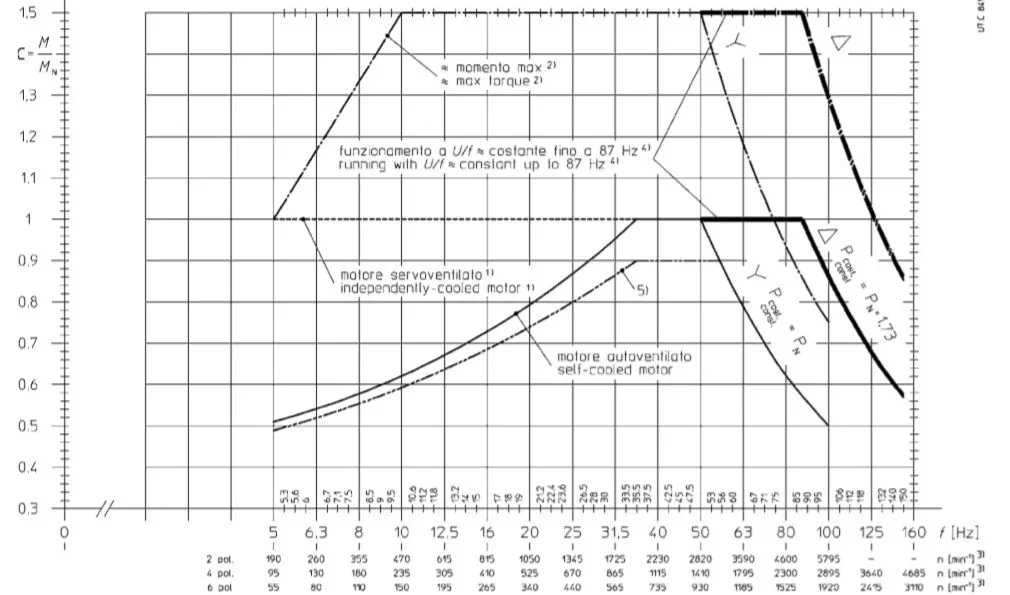
a engine 4 poles remain such. if you put an encoder behind it and make the ring regulation closed and you put the servoventola on it then you can give the maximum torque (also the nominal but constant to vary the turns) to 25hz..... otherwise you are making the mistake that make all those who use the inverter as a potentiometer.... vary only the frequency and so they cut the torque and the motor does not drive....for this reason you need an electronic softwerista who knows how to record serious drives.
to make you understand I attach the chart that is on the catalogs of red engines so you can see regarding the nominal torque what you have and with what.
Screenshot_20200428_183639.jpgFinally now we see that it is a 3x6meter platform....and it translates on the short side. This means that both you put the wheels, but even worse if you rollers, you will move diagonally. above all you can not put a tow pin but they want it due with a beautiful Parallelism bar which does not find (especially).

coefficient of friction between wheel and track will never be 0.57..... if you arrive at 0,25 It is so much because wet, oil, traces of anything.

calculation completely wrong friction force. You calculated a piece of iron to drag and it's not like that. in this regard I attach you a small pdf but I highly recommend you to deepen because confuse phenomena is a big mess then in reality.

a pinion with 13 teeth need to have rectification of the spinal profile to function properly and you have a reach to the foot of the sufficient tooth. the undercut weakens the foot of the tooth.
look at a pinion with z=12 without and with positive profile shift.Screenshot_20200428_181400.jpgin the second case the base is wider and therefore does not break the tooth and increases the load capacity. for this reason if possible, you choose greater teeth number.

Maybe I struggle to explain myself and I already told you that commercial racket lazy have the width 10 times the module. If you have module 6 you will have a square section rack 60x60mm... and the pinion has width 60mm. Then see you... if you can make the pinions at zero cost, since you want to be in the economy is not the right way. I attach the catalogue clearance So you see what I'm talking about.

math prodigy on the product.... any number multiplied by one does not increase the result....mt rains from the sky?

but what formula is that you copied from the hoepli manual? Let's take it for good.. .

that poor quality reducer would be what you chose with such low performance? brand and model... .

There's a lot to see again.
 

Attachments

Forum statistics

Threads
44,997
Messages
339,767
Members
4
Latest member
ibt

Members online

No members online now.
Back
Top