
• This forum is the machine-generated translation of www.cad3d.it/forum1 - the Italian design community. Several terms are not translated correctly.

free surface modeling controls

  • Thread starter Thread starter Kaji
  • Start date Start date

Kaji

Guest
Hello not having it now under hand, I asked if someone can tell me what are the free surface modeling commands (i.e. without the paid surfacing module of modeling 20 or 19, I remember that compared to the previous versions they had added the suspicious commands and extruded edges, added others that before was only available in the paid form?
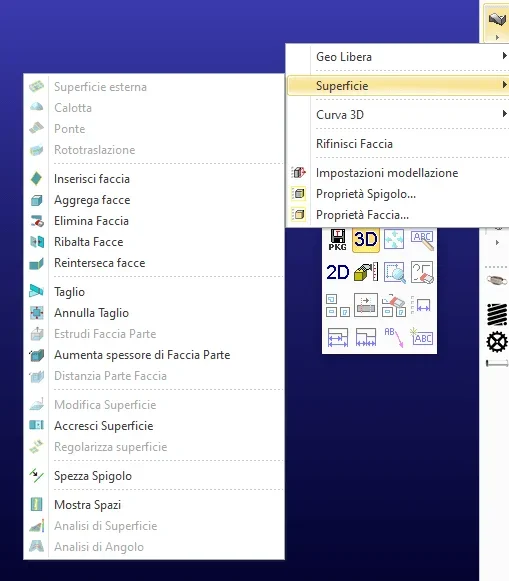
 
Hello not having it now under hand, I asked if someone can tell me what are the free surface modeling commands (i.e. without the paid surfacing module of modeling 20 or 19, I remember that compared to the previous versions they had added the suspicious commands and extruded edges, added others that before was only available in the paid form?
I did this screen capture, I don't know if it could help you.
1600520490572.webp
 
Yes thank you, I have seen that the most advanced commands such as cap and surface modification are not available, I would have been useful to make a type form, however if I don't remember badly free (at least in 20) there are also the foreign commands edge and moves edge, sometimes useful, that in the list of surface commands do not appear1716678400_morion_helm_helmet_mittelalter.jpg
 
Last edited by a moderator:
Yes thank you, I have seen that the most advanced commands such as cap and surface modification are not available, I would have been useful to make a type form
Good afternoon,
you can do even without advanced tools. the helmet's cap is actually ogival. you can get it from solid revolution, cut it a little less than halfway and then rejoin the two half so as to highlight the edge of junction. then put a plan on the joints and cut the lower magine of the two half with an arcuate sector. the protective edge is obtained with a rototranslation having as director the last cut.
the only fault of this method is that the tip of the helmet will be a little less acute, but also reflecting the blacksmith of 500 would follow the same sequence of operations.
 
thanks for the suggestions, in fact the part of the helmet that "interests me" is the layer because I have to draw a edge that drains the condensate only in transversal and non-axial direction, a little the same function that had these helmets that flowed the rain on the sides and not on the face so as to let the view more free.
to realize the semi-fall that I then mirrored I made a 3d spline in the form of semicircle, then I deformed it by moving the central point down and from there I got first the surface and then the solid.

the problem is that with this process of modeling and also with rototranslation in general, you get a solid "difficultly" ironable, so the only possibility of rapid change of form is the anisotropic scale, while with the advanced commands of surface deformation, crushing and stretching non-canons forms becomes simpler, in practice you take a point you move and he pulls behind the surface.
said this the most "delicate" part will get the solid to machine tools, because while the Spanish helmet is obtained with deformation I think hot of sheeting, my nozzle that drains condensate will be made for removal of material.
 
thanks for the suggestions, in fact the part of the helmet that "interests me" is the layer because I have to draw a edge that drains the condensate only in transversal and non-axial direction, a little the same function that had these helmets that flowed the rain on the sides and not on the face so as to let the view more free.
I saw after the other post...
in reality the primary function of the ground was to deviate the legumes directed to the head :)
the problem is that with this process of modeling and also with rototranslation in general, you get a solid "difficultly" ironable, so the only possibility of rapid change of form is the anisotropic scale, while with the advanced commands of surface deformation, crushing and stretching non-canons forms becomes simpler, in practice you take a point you move and he pulls behind the surface.
mm, with these tools you do little.
are not far comparable to t-splines for example of fusion 360 or the freestyle module of creo parametric itself, and however all these tools produce a good effect but are hardly controllable. to counter with modeling if you can find a way to solve with standard tools you can get a very high precision.
However ptc's fault that keeps his feet in two shoes did not evolve the product.
 

Forum statistics

Threads
44,997
Messages
339,767
Members
4
Latest member
ibt

Members online

No members online now.
Back
Top