• This forum is the machine-generated translation of www.cad3d.it/forum1 - the Italian design community. Several terms are not translated correctly.

motorized sizing on cart and translation mechanism

  • Thread starter Thread starter loscienziatopazzo
  • Start date Start date
You're right, I'm sorry, but I'm working and I'm risking doing two things wrong, I'll be happy to give you a hand.However you just do,consider that 0.7 is not very conservative and just a little dirt oil etc. to lower the parameter suddenly.
However if the colleague @meccanicamg He said that it was already treated as an argument I recommend to give us an eye.
Bye.
p.s.:leave the tables,take note:
1bar = 100000 pascal
1atm=101325 pascal
these measuring units you will be confronted with more often
1psi=I don't remember looking for google

performance 0.9 conventional
psi are the pounds on square thumb
 
with the data you have placed, and with some correction taking the values from nienann, we have a volving friction coefficient ranging from 0.03 to 0.057 and therefore we keep the worsening.

we take as a coefficient of friction not perfectly clean and therefore we impose not to fall below 0.1 otherwise we will definitely go to slip with the accelerations we have on one wheel.

the normal reaction to the ground of each wheel will be 3139n theoretically and therefore if you press more lift the wheels from the ground leading to an imbalance the cart and if you press little you can not transmit to couple because the wheel does not deform and therefore does not offer useful arm to the advancement of the bike.

160mm rotary wheel, i=40 gear and 4poli motor from 0.18kw minimum with reducer with 90% performance.
 
Why 1800n?
the fpeso, if a cylinder ø50 can be ~1060n (106kg to 6bar)
1060x0,7= 742n

Cmax=80nm
f= cmax/r= 80/0,08=1000n

If correct, I would already be out and therefore would be able to use a piston ø63 at least 6bar (I think it is appropriate to raise the pressure for greater safety)


for 105w
(1600kg*9,81) x 0.02 x 0.3m/s x 1/returner = ~104w
(ii) a system and plan, with the exception of
Please note that in industrial plants the famous 6bar nominal you have it if you have 8-9bar to the compressor, so normally the user can find only 4-5. Put a big axle and put a pressure regulator.
 
good morning and good Easter to all:)
@meccanicamgI tried to recreate your tab. excel is to have it available and to be able to make a direct and fast comparison.
with the data I had entered last night I got:tab_dimensionamento_Rev.0.webpcomparing the excel to your (presed by forum of 2018/2019) I have doubts regarding the calculation of power (red writings)

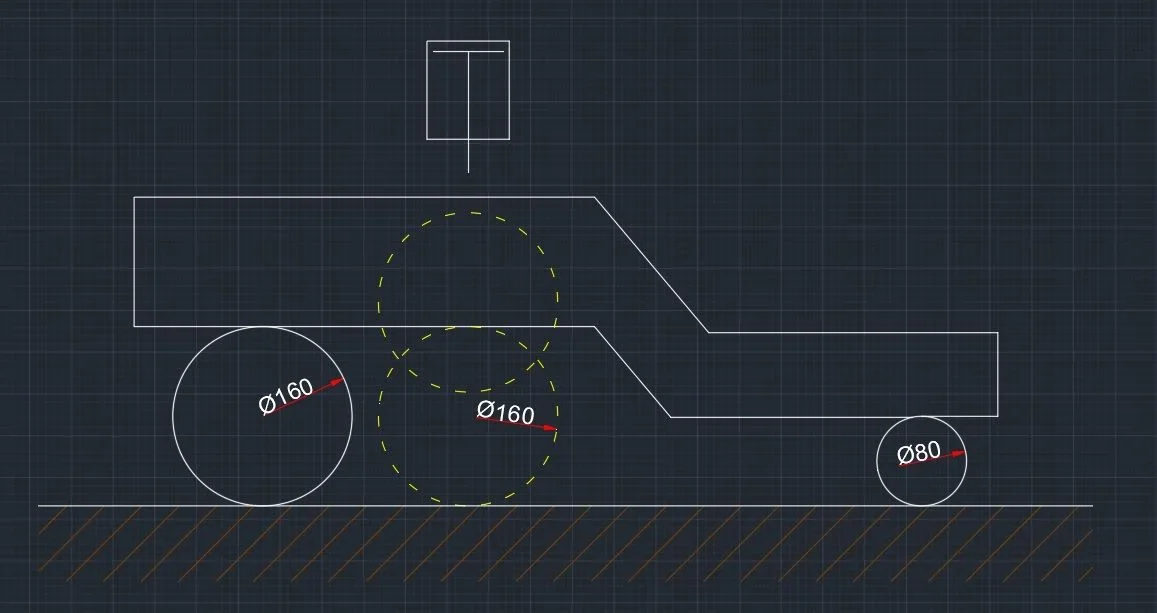
the schematic but real model will follow this configuration
carro_semplificato.webpin the morning I will update it regarding fa and fv

the max load is estimated in 1600kg ..... not perfectly centered in the half-carry but almost certainly could be moved more towards the front wheels.
in the real case the front wheels have a d=80mm and the rear ones d=160
in the model I had inserted only ø160 because I considered it worsening for the work that will have to perform (about 1m advancement and just)


yes for the cylinder I will pass directly to a ø100 that in push will give me about 420dan to 6bar (but I will have to reduce it therefore I should be ok)
solid piston at the bottom of the cart

So much so that we do not miss anything, the total load could even undergo variations, orientally 1100-1600kg .... and this puts me other doubts regarding the p and the reactions exerted on the single wheel.
if I have well reasoned, with ø100, exercising 420dan are in place both for load max and for load min as I do not add any force p to the cart but allow the same to download the p_tot / nruote.


I will try to make the proposed amendments. later, thank you
 
good morning and good Easter to all:)
@meccanicamgI tried to recreate your tab. excel is to have it available and to be able to make a direct and fast comparison.
with the data I had entered last night I got:View attachment 61551comparing the excel to your (presed by forum of 2018/2019) I have doubts regarding the calculation of power (red writings)

the schematic but real model will follow this configuration
View attachment 61552in the morning I will update it regarding fa and fv

the max load is estimated in 1600kg ..... not perfectly centered in the half-carry but almost certainly could be moved more towards the front wheels.
in the real case the front wheels have a d=80mm and the rear ones d=160
in the model I had inserted only ø160 because I considered it worsening for the work that will have to perform (about 1m advancement and just)


yes for the cylinder I will pass directly to a ø100 that in push will give me about 420dan to 6bar (but I will have to reduce it therefore I should be ok)
solid piston at the bottom of the cart

So much so that we do not miss anything, the total load could even undergo variations, orientally 1100-1600kg .... and this puts me other doubts regarding the p and the reactions exerted on the single wheel.
if I have well reasoned, with ø100, exercising 420dan are in place both for load max and for load min as I do not add any force p to the cart but allow the same to download the p_tot / nruote.


I will try to make the proposed amendments. later, thank you
to me comes about 117w ....you are not far. There is to say that I have 0.047 and not 0.04 of voluntari friction coefficient....so we are there.
 
Good morning.
I would like to understand how you can determine the value of fa and fv. among others I noticed in other discussions that there are different formulas, empirical immagin, to calculate the scaffolding and.
Perhaps I have not read the other discussions well, but I would like to know who the authors of these formulas are.
I will have to solve a similar problem.treatment of a car on four wheels ø200 bombed in c45, if I do not remember badly(now I am not in the office obviously)hardness maybe hrc60 that roll on burback.weight of the machine about 3000 kg max.
I don't want you to compute me anything, but I would like to delucidate on friction coefficients and consequently on the determination of shift and.
I address myself above all to @meccanicamg that would seem irony on the subject.
Thank you in advance.
 
Good morning.
I would like to understand how you can determine the value of fa and fv. among others I noticed in other discussions that there are different formulas, empirical immagin, to calculate the scaffolding and.
Perhaps I have not read the other discussions well, but I would like to know who the authors of these formulas are.
I will have to solve a similar problem.treatment of a car on four wheels ø200 bombed in c45, if I do not remember badly(now I am not in the office obviously)hardness maybe hrc60 that roll on burback.weight of the machine about 3000 kg max.
I don't want you to compute me anything, but I would like to delucidate on friction coefficients and consequently on the determination of shift and.
I address myself above all to @meccanicamg that would seem irony on the subject.
Thank you in advance.
as said several times we have the nienann that in its three volumes has been school for decades and is used as a source of indisputable information.
As regards the coefficient of friction, it should actually be:
- do lab tests.
- ask the companies that have sampled
- depends on materials and their hardness
- depends on speed
- companies that make wagon in a serious way could have the values calculated with sample wheels and measuring the horizontal towing force applied according to weight and speed ....idem who makes semoventi
- sector act which can provide at the request of statistical data are the Italian railways of trains that have a collection of values of resistance to rolling

As reported in my speech, there are indications about the various evaluations.

a small consideration of the contact zone wheel/binary. If you take a wheel in 42crmo4 and the recuocium, then soft mechanical characteristics, and nitride only the first 0.13/0,3mm I get a wheel that would seem to reflect the classic hard wheel in c45 tempered 54/56hrc but not so. not having a properly reclaimed layer, we have a very thin crust that struggles and in a short time breaks by working the underlying layer soft.... and so the coefficient of friction will increase.

therefore attention to the indications of manufacture of wheels and treatments.

in This is site there is a summary of all issues.

the methods of determining the rolling resistance is indicated in the iso 18164: 2005.

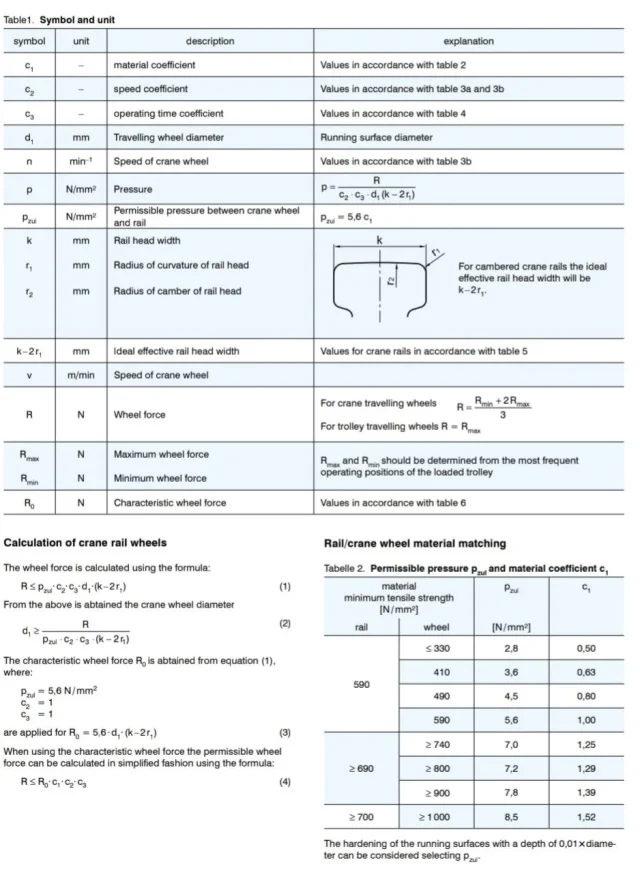
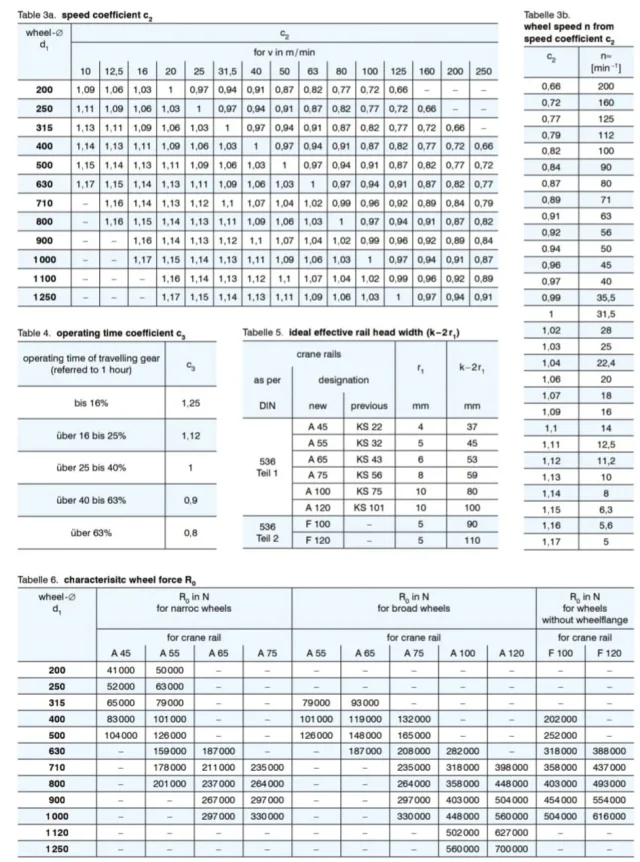
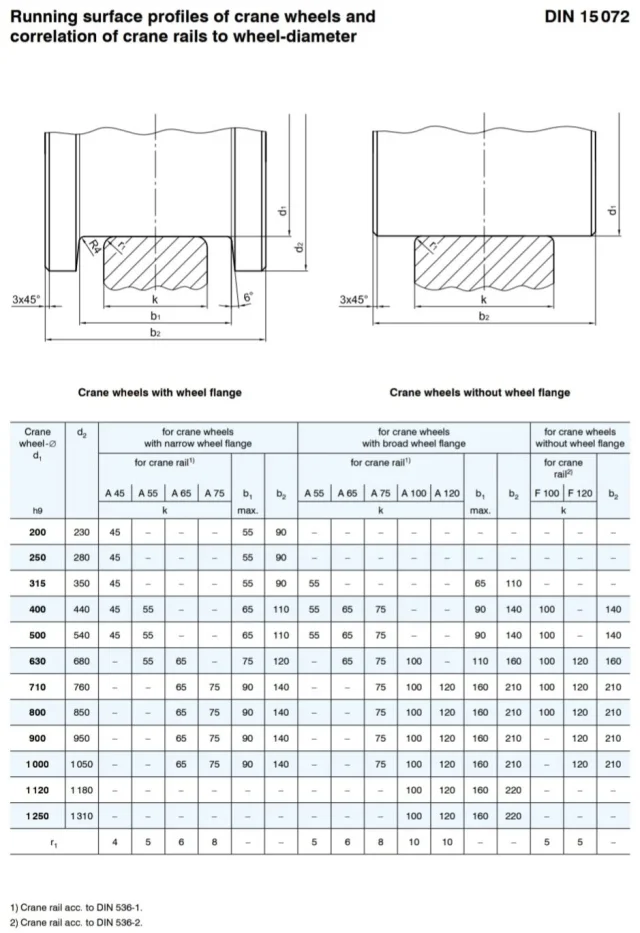
with regard to wheels in accordance with din 15070 I attach to the catalogue as follows:Screenshot_20210404_200552.jpgScreenshot_20210404_200610.jpgScreenshot_20210404_200627.jpgScreenshot_20210404_200643.jpgThese notes are from manufacturer more important German... .
 
I think it's interesting to start with the followinghttps://www.encoper.org/valutazione-della-scivolosita-di-pavimenti-in-cemento-o-in-resina/anti-slip legislation | dm 236 | 81/2008 | bcra (antiscivolo-piastrelle-pavimenti.it)a breve video of the tortus digital tribometer
I believe that for a real parameter the opinion of colleagues and experts in the sector is very useful (even of the suppliers) because I can certainly not go to the company and do empirical tests on the industrial floor (almost less for modest-scale orders).
in my case between 0.2 and 0.1 the difference is very net: the system works or does not work clamorously.
In this case, I admit my ignorance but... you know. I entrust myself to some pious soul!for the FS, you can see the dispenses available from @meccanicamghttps://www.cad3d.it/forum1/threads/carrello-su-binari.52186/in my case the motorized wheel supplier gave me fv=0,02 asserting that it is the typical value for use(of its product) on industrial floors.
It should be said, however, for completeness, that the other wheels are not identical as diameters or as mixture (the front ones are low/larger/small rubberized coating). help: eek:

looking on the net I found on the tellure catalog, the push/traction tables for wheels in polyurethane 95sh a and tab https://www.tellurerota.com/tellure...f/$file/tellurerota_catalogo2018_italiano.pdf300kg wheel from ø160x50 = 5dan
then a fv 0.016 (declared for v=cost / 4km/h)
 
I think it's interesting to start with the followinghttps://www.encoper.org/valutazione-della-scivolosita-di-pavimenti-in-cemento-o-in-resina/anti-slip legislation | dm 236 | 81/2008 | bcra (antiscivolo-piastrelle-pavimenti.it)a breve video of the tortus digital tribometer
I believe that for a real parameter the opinion of colleagues and experts in the sector is very useful (even of the suppliers) because I can certainly not go to the company and do empirical tests on the industrial floor (almost less for modest-scale orders).
in my case between 0.2 and 0.1 the difference is very net: the system works or does not work clamorously.
In this case, I admit my ignorance but... you know. I entrust myself to some pious soul!for the FS, you can see the dispenses available from @meccanicamghttps://www.cad3d.it/forum1/threads/carrello-su-binari.52186/in my case the motorized wheel supplier gave me fv=0,02 asserting that it is the typical value for use(of its product) on industrial floors.
It should be said, however, for completeness, that the other wheels are not identical as diameters or as mixture (the front ones are low/larger/small rubberized coating). help: eek:

looking on the net I found on the tellure catalog, the push/traction tables for wheels in polyurethane 95sh a and tab https://www.tellurerota.com/tellure...f/$file/tellurerota_catalogo2018_italiano.pdf300kg wheel from ø160x50 = 5dan
then a fv 0.016 (declared for v=cost / 4km/h)
In my opinion, it would be worth analysing the case of species.
the smaller the diameter of the wheel is the required force.Also as already mentioned by @meccanicamg counts the hardness of the material,as inversely proportional to the friction coefficient.if the load is not uniformly distributed you should calculate where we have greater reaction, on the wheels with greater diameter or those with smaller diameter?
fv 0.016 is however low,consider that 4km/h are about 1m/s,we have 0.3m/s of v.
I also think that you should consider fv in static conditions (securely greater than 0.016).
 
In my opinion, it would be worth analysing the case of species.
the smaller the diameter of the wheel is the required force.Also as already mentioned by @meccanicamg counts the hardness of the material,as inversely proportional to the friction coefficient.if the load is not uniformly distributed you should calculate where we have greater reaction, on the wheels with greater diameter or those with smaller diameter?
fv 0.016 is however low,consider that 4km/h are about 1m/s,we have 0.3m/s of v.
I also think that you should consider fv in static conditions (securely greater than 0.016).
certainly that if the load is not uniform we will have a imbalance of reaction and therefore it will be even worse.
 
I put myself in the discussion, reflecting on the problem, I get some doubt, the fifth wheel that is inserted with the pneumatic cylinder, in order to advance the cart, is it not that it unbalances the system? To avoid slipping, I'm gonna have to push a lot, so in this way I'm going to download the other four crazy wheels, if the load isn't centered, maybe it'll only be 3 or 4. in these conditions how will the cart be left? a solution, maybe for issues I don't know not to be viable.. because you don't think of a system that motorizes the two wheels of greater diameter by interposing an electromagnetic coupling between the gear motor and the axis to motorize.
when the cart should not be moved the graft is untied and all the wheels are crazy, vice versa, when you have to move it, close the graft and start the gear. Crazy idea?
 
I put myself in the discussion, reflecting on the problem, I get some doubt, the fifth wheel that is inserted with the pneumatic cylinder, in order to advance the cart, is it not that it unbalances the system? To avoid slipping, I'm gonna have to push a lot, so in this way I'm going to download the other four crazy wheels, if the load isn't centered, maybe it'll only be 3 or 4. in these conditions how will the cart be left? a solution, maybe for issues I don't know not to be viable.. because you don't think of a system that motorizes the two wheels of greater diameter by interposing an electromagnetic coupling between the gear motor and the axis to motorize.
when the cart should not be moved the graft is untied and all the wheels are crazy, vice versa, when you have to move it, close the graft and start the gear. Crazy idea?
Crazy, no. certainly it is easy that they will affix 2+1 wheel ... and sincerely do not believe in the reliability of the single wheel that goes down.
 
Crazy, no. certainly it is easy that they will affix 2+1 wheel ... and sincerely do not believe in the reliability of the single wheel that goes down.
How much does it cost to make a project and throw it out because it doesn't work?
 
I put myself in the discussion, reflecting on the problem, I get some doubt, the fifth wheel that is inserted with the pneumatic cylinder, in order to advance the cart, is it not that it unbalances the system? To avoid slipping, I'm gonna have to push a lot, so in this way I'm going to download the other four crazy wheels, if the load isn't centered, maybe it'll only be 3 or 4. in these conditions how will the cart be left? a solution, maybe for issues I don't know not to be viable.. because you don't think of a system that motorizes the two wheels of greater diameter by interposing an electromagnetic coupling between the gear motor and the axis to motorize.
when the cart should not be moved the graft is untied and all the wheels are crazy, vice versa, when you have to move it, close the graft and start the gear. Crazy idea?
costs (income)
purpose: the system will have to occasionally advance some dm
space: the solution occupies 200mm in the side view
the wheels would not be pivoting (which I need) for a manual handling of the cart.
 
two electromagnetic triggers of gerit - lenze perhaps cost less than the pneumatic system.. but if you have pivoting wheels, who guarantees you, that when autopilot goes in the direction you want?
If the engine is with the pneumatic cylinder, it is also with the triggers.
 
two electromagnetic triggers of gerit - lenze perhaps cost less than the pneumatic system.. but if you have pivoting wheels, who guarantees you, that when autopilot goes in the direction you want?
If the engine is with the pneumatic cylinder, it is also with the triggers.
Your solution is interesting but I don't think it's applicable to my case.
the wheel I could only put in the back area almost aligned with the pivittanti it follows that I could not hypothesize a fixed axle scheme.

the advance serves only as a disengagement from a particular area: the pivoters will have to be controlled by the operator before handling and then the cart will be moved manually (with a lower mass)
the final speed will certainly be even lower than the 6m/min I had set in tab
 

Forum statistics

Threads
44,997
Messages
339,767
Members
4
Latest member
ibt

Members online

No members online now.
Back
Top