• This forum is the machine-generated translation of www.cad3d.it/forum1 - the Italian design community. Several terms are not translated correctly.

design/constructive design without end screw reducer

1) in the event that a bearing blocked by a shoulder only works radially it is right not to rectify the shoulder and therefore to predict a throat x rectification type and ? therefore basically I go to rectification the shoulder only if there were axial loads on the bearing and in that case put a throat type f
the rectification of the seat of the bearing is generally carried out to dive, so it is not indispensable but it is advisable to rectify also the shouldering; time and its additional cost are not relevant.
So I take 51 mm from the shoulder and start the quarry (obviously towards the opposite side of the bearing) is correct?
sì.
then should we put a tolerance on this quota?
sì.
 
I therefore address to super experienced tetrator in the field to have his welcome opinion!
Thanks, too good :-) ... I try.

it is necessary to specify that we are talking about an endless screw reducer with an interasses about 200, ratio at least 30/1 (minimum recommended for 1 principle of the vine) with a recommended angle less than 8°-10° and with a weight greater than 180 kg.
with these premises it is obvious that the installation must be carried out with suitable equipment: hoist, equipment to lock the piece and to rotate it, bearing mounting pads and sealing ring.
the solution of the two oblique bearings can be maintained, but in order to have the possibility of a registration of the preload easier to carry out and more precise, it would be preferable to adopt a disposition to or with central stop ring as in the lower image of the document that I attach (current industrial conductor); this solution allows a processing of the entry and exit of the case on the working center without having to rotate the piece. having the stop ring between the outer ralles of the two bearings, the registration of the preload occurs only by means of the wreath.

instead maintaining the original solution with oblique x bearings but mounting a bearing side protruding screw type nu, the assembly can be carried out in the following way:

1) rotate the case on the equipment by disposing the vertical axis and blocking it with the entrance side (where it will have to protrude the screw) at the top.
2) Insert the stop ring (seeger) external ring nu
3) insert external radish nu
4) mount front cover complete with seal but without seal ring
5) rotate the 180° case (in practice you will see placed as in the attached document)
6) apart from mounting the inner ring of the nu bearing with its stop ring
7) lift the screw by threaded bushing (equipment) screwed into the back thread (where the needle will be mounted)
8) insert the screw from above and get it down to a specially designed external stopbar so that the inner bars are correctly positioned
9) remove the threaded bushing used for lifting
10) insert bearing 1 with the help of a buffer that simultaneously presses both on the outer and internal raddle
11) insert bearing 2 with the same mode as the previous
12) screw the complete wreath to "pack" the inner ralles of the two bearings
13) mount the back cover complete with seal by interposing calibrated thicknesses against the outer ring of bearing 1 to adjust the preload on bearings.
According to me the correct mounting scheme of bearings 1 and 2 is the one depicted in the portion of image identified as "optimal solution..." different from the one shown in the original design and also from the installation indications of skf (if I do not go wrong).

at this point the reducer case with the mounted screw will be positioned with the vertical slow axis for the assembly of the slow part (crown, bearings and lids):
1) part mounting on crown bearings
2) mounting first side cover complete with seal
3) 180° rotation
4) crown insert with already mounted bearings
5) closure with second cover complete with seal

at the end, it will be possible to mount the three sealing rings in the respective locations (in this regard I remember that the bevel of the seats where the lip of the sealing ring will act must be at 30 ° to favor the assembly) and the tab.
if the outer diameter of the screw interferes with the bar on the bearing case 2, you can overcome by creating a line with a stop ring.

relative to the screw bearing side output (nu or n), it is necessary to take into account that in addition to being dimensioned to support the internal loads, it will also have to preview the contemporary application of a possible external load deriving from the application of a transmission with straps and pulleys. the various builders allow on a reducer of this magnitude an indicative radial load admissible in half protruding of 2000-3000 n with an external axial load applied at the same time pairs to 1/5 of this value.

I also want to point out that when designing a reducer or any other device, the designer must always take into account, in addition to the performance and construction aspects, even those that must ensure easy assembly and maintenance.

this according to my opinion, except for errors or omissions, hoping not to pass for what you ask him that hours are and explains how the clock is made. :
 

Attachments

Thank you, too good:) ... I try.

it is necessary to specify that we are talking about an endless screw reducer with an interasses about 200, ratio at least 30/1 (minimum recommended for 1 principle of the vine) with a recommended angle less than 8°-10° and with a weight greater than 180 kg.
with these premises it is obvious that the installation must be carried out with suitable equipment: hoist, equipment to lock the piece and to rotate it, bearing mounting pads and sealing ring.
the solution of the two oblique bearings can be maintained, but in order to have the possibility of a registration of the preload easier to carry out and more precise, it would be preferable to adopt a disposition to or with central stop ring as in the lower image of the document that I attach (current industrial conductor); this solution allows a processing of the entry and exit of the case on the working center without having to rotate the piece. having the stop ring between the outer ralles of the two bearings, the registration of the preload occurs only by means of the wreath.

instead maintaining the original solution with oblique x bearings but mounting a bearing side protruding screw type nu, the assembly can be carried out in the following way:

1) rotate the case on the equipment by disposing the vertical axis and blocking it with the entrance side (where it will have to protrude the screw) at the top.
2) Insert the stop ring (seeger) external ring nu
3) insert external radish nu
4) mount front cover complete with seal but without seal ring
5) rotate the 180° case (in practice you will see placed as in the attached document)
6) apart from mounting the inner ring of the nu bearing with its stop ring
7) lift the screw by threaded bushing (equipment) screwed into the back thread (where the needle will be mounted)
8) insert the screw from above and get it down to a specially designed external stopbar so that the inner bars are correctly positioned
9) remove the threaded bushing used for lifting
10) insert bearing 1 with the help of a buffer that simultaneously presses both on the outer and internal raddle
11) insert bearing 2 with the same mode as the previous
12) screw the complete wreath to "pack" the inner ralles of the two bearings
13) mount the back cover complete with seal by interposing calibrated thicknesses against the outer ring of bearing 1 to adjust the preload on bearings.
According to me the correct mounting scheme of bearings 1 and 2 is the one depicted in the portion of image identified as "optimal solution..." different from the one shown in the original design and also from the installation indications of skf (if I do not go wrong).

at this point the reducer case with the mounted screw will be positioned with the vertical slow axis for the assembly of the slow part (crown, bearings and lids):
1) part mounting on crown bearings
2) mounting first side cover complete with seal
3) 180° rotation
4) crown insert with already mounted bearings
5) closure with second cover complete with seal

at the end, it will be possible to mount the three sealing rings in the respective locations (in this regard I remember that the bevel of the seats where the lip of the sealing ring will act must be at 30 ° to favor the assembly) and the tab.
if the outer diameter of the screw interferes with the bar on the bearing case 2, you can overcome by creating a line with a stop ring.

relative to the screw bearing side output (nu or n), it is necessary to take into account that in addition to being dimensioned to support the internal loads, it will also have to preview the contemporary application of a possible external load deriving from the application of a transmission with straps and pulleys. the various builders allow on a reducer of this magnitude an indicative radial load admissible in half protruding of 2000-3000 n with an external axial load applied at the same time pairs to 1/5 of this value.

I also want to point out that when designing a reducer or any other device, the designer must always take into account, in addition to the performance and construction aspects, even those that must ensure easy assembly and maintenance.

this according to my opinion, except for errors or omissions, hoping not to pass for what you ask him that hours are and explains how the clock is made. :
thanks, as usual clear and exhaustive answer!
 
I believe that the simplest solution, such as assembly and general economics is to mount at the ends of the endless screw a conical roller bearing, one by side, making the arrangement as in photo.
surely we will have more deformed to the screw center since the supports rotate both and the lengthening of the screw loads axially the bearings.
Yet it is the basic solution often adopted in non heavy duty gearboxes.
Screenshot_20221207_212607.webp
 
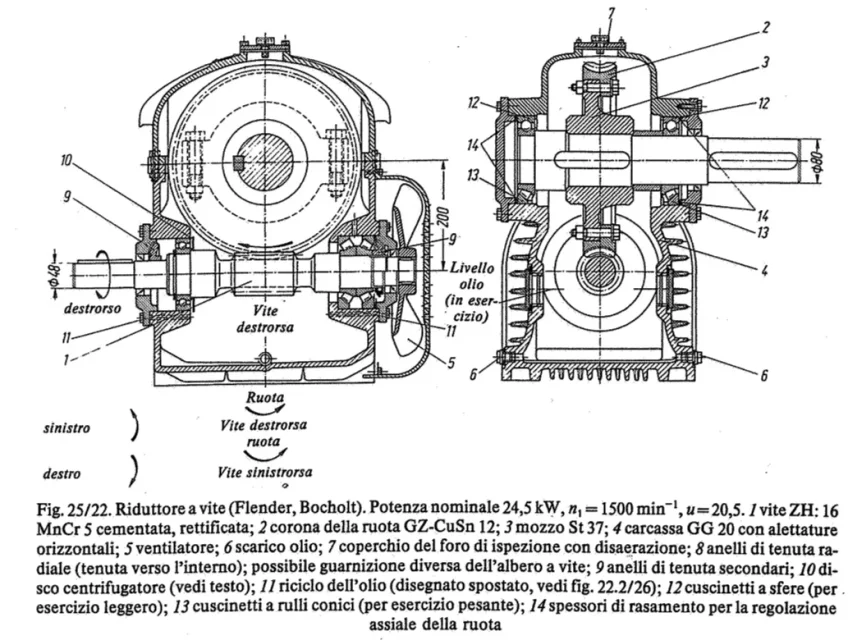
instead, to stay on the theme, below there is a reducer of the famous flender manufacturer, now in the siemens group, which regulated the bearing package simply with the thicknesses under the closing cover; feasible also by inserting a spacer inside the lid that beats on the outer ring of the conical roller bearing.Screenshot_20221207_221531.jpgthere are described all the various parts, to better understand the thing.

definitely now, compared to the 50s, steps have been taken on the gearbox to vsf.
Currently the gearboxes in the rail field are still built heavy duty with redundancy of very high bearings and rigidities, otherwise all battle gears have become more compact and simpler, even in the type of bearing and registration of the game.
 
Excuse me one thing, maybe I will be wrong but I downloaded the track with the phone and its pages are a4, so it goes by itself that the width of the sheet is 210mm.
if I didn't hurt the proportions with the phone we get that being in scale 1:1 as indicated in the track, we have a mal counted primitive diameter of 30mm and an interasse little less than 70mm.Screenshot_20221208_200838.jpgSo I don't understand where the boy took the measurements.

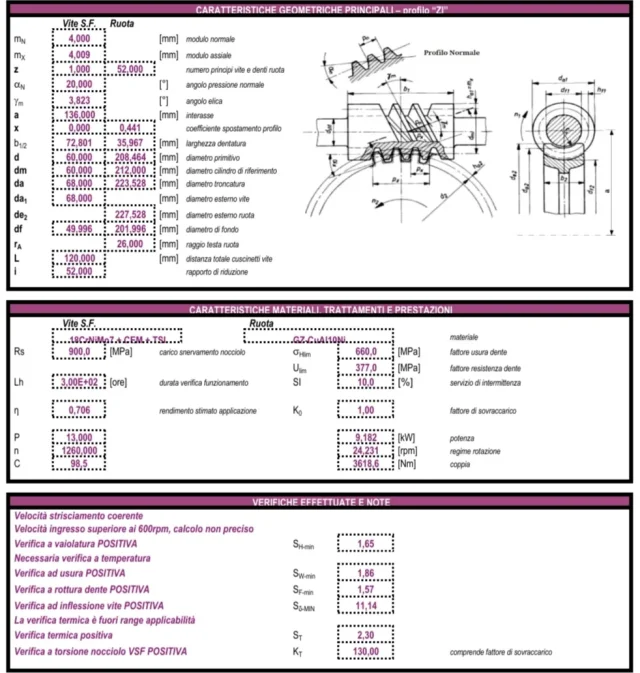
After doing the performance verification, we realize that the size should be increased at least twice because it is not able to endure 13kw at 1260rpm.Screenshot_20221208_201414.jpgso it will be at least so to be resistant to demand:Screenshot_20221208_202544.jpg
 
Excuse me one thing, maybe I will be wrong but I downloaded the track with the phone and its pages are a4, so it goes by itself that the width of the sheet is 210mm.
if I didn't hurt the proportions with the phone we get that being in scale 1:1 as indicated in the track, we have a mal counted primitive diameter of 30mm and an interasse little less than 70mm.View attachment 67054So I don't understand where the boy took the measurements.

After doing the performance verification, we realize that the size should be increased at least twice because it is not able to endure 13kw at 1260rpm.View attachment 67058so it will be at least so to be resistant to demand:View attachment 67056
Yes, my mistake, I had left a different scale on the pdf reader. Fortunately it was just an exercise to train me and not a delivery.
 
Good morning, I'm starting to do another exercise and I have a little theoretical doubt. There is a conical roller bearing that is blocked by two wreaths, I can imagine it is to avoid unscrewing. However, it seems to me a somewhat extravagant solution, even in the skf catalog reference is made to anti-vitamin rosettes and fixing screws/plates to avoid unscrewing. how do you interpret such a solution? Do you think it has to be changed/optimized?Doppia_Ghiera.webp
 
of the double wreath if I was spoken in the forum.
if there is space this solution allows you to avoid further processing such as the tooth of the safety rosette.

In my opinion, these are questions which would be useful to ask a teacher with whom he can more easily address a clarifying discussion
 
In my opinion, these are questions which would be useful to ask a teacher with whom he can more easily address a clarifying discussion
Hello, the problem is that we are about 200 to give the exam and the teachers are only two. Moreover it is only 30 hours course of which at least 20 we have passed them to learn the commands of the cad. therefore many aspects we have to deepen them ourselves. But I'm too instinctive, and I'm supposed to trade in the old topic before I ask, even now I have a doubt about tolerance, but I'm fine looking if it's already been treated.
 
locking with double wreath is alternative to locking with wreath and safety rosette. a more current alternative, but verifying the conditions of use, is represented by integrated locking ring.

However, each student, for any matter, will have the notions that are given to him by teachers and texts, while others derive from the research that must necessarily carry out independently. luck is that today there is the inexhaustible mine of the web that allows to obtain a multitude of updated information, also because often the drawings that are provided for the exercises are now obsolete.
in any case therefore, as suggested also by @massivonweizen, it is preferable to first search your questions, then ask for a comparison with professors or on the forum to dispel any doubts about the solutions found.
 
Last edited:
Good morning, I'm starting to do another exercise and I have a little theoretical doubt. There is a conical roller bearing that is blocked by two wreaths, I can imagine it is to avoid unscrewing. However, it seems to me a somewhat extravagant solution, even in the skf catalog reference is made to anti-vitamin rosettes and fixing screws/plates to avoid unscrewing. how do you interpret such a solution? Do you think it has to be changed/optimized?View attachment 67065
the primary service of the two wreaths is not so much the anti-savory, but calibrate the game of the conical rollers. the more you tighten the first wreath and the more you reduce the game, the second wreath blocks the situation. Obviously everything is entrusted to the experience of the editor on how hard the game is, and therefore with the disappearance of old experts nowadays you prefer other solutions more easily repetitive, indeed the design is old.
 
to complete the drawing argument, in order to draw inspiration, I also attach a quotation of an endless screw.
is the particular of a small industrial end screw reducer (the length is less than 200 mm); It was designed 30 years ago, so the standard symbolism (in particular the symbols that indicate roughness and, perhaps also some referenced norms) has changed, but not quotas, quotation system, material and tolerances.
 

Attachments

  • 20221209_102152 R1.webp
    20221209_102152 R1.webp
    101 KB · Views: 57
the primary service of the two wreaths is not so much the anti-savory, but calibrate the game of the conical rollers. the more you tighten the first wreath and the more you reduce the game, the second wreath blocks the situation. Obviously everything is entrusted to the experience of the editor on how hard the game is, and therefore with the disappearance of old experts nowadays you prefer other solutions more easily repetitive, indeed the design is old.
nowadays, we try to use spacers that go in line that are shaved to the assembly according to indications of the technical office. if you need to change bearing because worn out, replace and remove the spacer and get the factory game. this weighs repeatability and maintenance even by unexperienced personnel.
works on series but not much on individual experimental projects. . There's always some retouching about the u.t. project.
 
hello to all, I kindly wanted to ask for a further doubt inherent to the quotation. in the quotation of the safety rosette (those that are used for the locking needles, for example, of the cuscientti per significarici). I leave you a quick sketch attached. in my head, I've been thinking that those quarries are made with disc brakes. I just wanted to ask if such a quotation could be good. Thank you! Quotatura cava rosetta sicurezza.webp
 
If you look at how the rosette works you realize that if the end of the milling is curved the operation is compromised.
the fried is done with a candle cut so that the bottom is always constant
 
If you look at how the rosette works you realize that if the end of the milling is curved the operation is compromised.
the fried is done with a candle cut so that the bottom is always constant
It depends, you can also do with the disc braking, logically respecting what you said about how the rosette works.
 
If you look at how the rosette works you realize that if the end of the milling is curved the operation is compromised.
the fried is done with a candle cut so that the bottom is always constant
I also thought about it, in fact I did on a test of an assembly. It is not very clear because I do not remember how to download the commercial elements and so I made them a little rush. in blue the cuscientto, in green the safety rosette and in red the wreath. I thought that the bearing went to protrude from its seat to make the rosette fail to reach the curve. Alternatively you could also put a spacer.assemblaggio ghiera e rosetta.webp
 

Forum statistics

Threads
44,997
Messages
339,767
Members
4
Latest member
ibt

Members online

No members online now.
Back
Top