• This forum is the machine-generated translation of www.cad3d.it/forum1 - the Italian design community. Several terms are not translated correctly.

reducers. when should i design them at home?

  • Thread starter Thread starter Sergio_V
  • Start date Start date

Sergio_V

Guest
Good evening to all,I haven't been writing for a while and I'm pretty acerbic about it. .
I recently entered the "world" of the mixers ...I noticed that some competitors tend to propose solutions of transmissions "made in the house" instead of turning to blasoned companies (bonphiles,brevians dana etc...), despite the reducer is the heart of the machine and according to the customers manage to break the costs in this way. .
On the other hand, the trend of recent years is to outsource almost everything ...however I am not entirely convinced that it always agrees to do so (economically at least). . .
Do you ever plan in the house gearboxes? when do you prefer to opt for this choice? There's a maximum criterion. .
I know I'm very vague in asking the question... but I'm curious about the subject
thank you to anyone who answers me!
 
Here's the good question.
known manufacturers, such as bonfiglioli, red, dana and sew produce serial reducers in quantity. therefore become competitive when the gearboxes are standard. manufacturing many pieces and optimizing manufacturing reduce costs. Unfortunately, they do not design custom-made gearboxes, so for particular needs we use the smallest company that designs and builds special gearboxes, and sometimes even at low cost. the companies horned by the family and with very few employees have a very low fixed cost and make very affordable prices.
more structured companies, with a 20ine of employees allow perhaps more reliability but surely much higher cost.
the reasons for choosing the building in the house can be many. list some:
- narrow timing
- employed suppliers
- return to lower costs
- very special gearboxes we want to protect as know-how

I buy many gearboxes even at two exits, but for the rest we build them and design us, at two exits, at 17 exits, at 19 exits etc. Sometimes it happens that the two-out reducer has low copies and the suppliers have the smallest size that is large....so it is advisable to build the decoupler and buy a normal gearbox that makes pre-pair.

definitely make the gearboxes in the house you can optimize the reduction ratios with motor matching especially if you use vector motors under inverter.

having in the park suppliers in carpenter, the dentature, the lathe and the miller, the treatmentist and the editor.... I would say that lowers the time of manufacture.

certainly you need to have a series of capabilities ranging from dimensioning gears, bearings, trees, carcass structure, heat dissipation etc.
 
good evening, what kind of mixer should be operated by these gearboxes?
supposing for example that the mixer shares a slow tree,
It is a matter of understanding whether the reducer, in addition to the normal rpm reduction service, must also support the mixing shaft. In this case it would be necessary an adequate sizing of the slow shaft not foreseen in standard gearboxes, and in the case of mixers with mechanical seals, the custom reducer becomes interesting to facilitate its maintenance operations.
 
Thank you both for the answers given. .
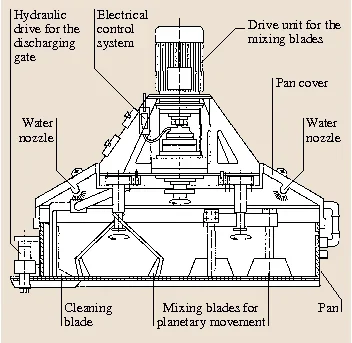
We produce planetary mixers for the construction industry.
Currently we adopt epicicloidali and we order them to warehouse, but to break down costs we could also consider producing them in the house in the future... we do not sell more than 30 mixers per year of about 3 different sizes (small with power of about 9kw , medium 45 kw and large 90kw)...but it is "standard" products regarding the transmission and personalized for the rest... according to you is a path therefore? (I thought I understood that). .
 
certainly that buy 30 gearboxes a year you do not have a high purchasing power and therefore an extra discount you can not do it. if you want to break down the costs you have to go on some "new" producer who wants to take slices of market. Italian producers are there but I do not think that bonfiglioli or red we are willing to lower the prices. Maybe motovary, dynamicil or something like that might have the interest in giving you less.
design and manufacture three sizes of epicicloidali is not a game especially if you do not have in-depth tools and knowledge. you should definitely see if you can achieve something modular and then reduce the pieces in question and then you have to find who is willing to manufacture in series well and at low cost. Then it takes those who mount.
if designing everything by integrating gears into a ready case and eliminating some interface components you can still break down costs and encumbrances.
 
I searched on the net the characteristics of these mixers, there are many varieties, we pass from assisted suicide technology made in India:
to the usual Germans:
without forgetting Italian manufacturers.
Schermata 2021-01-16 a 23.26.41.webpreferring to the conceptual image of a patent used for a planetarium for cosmetic or similar pastes, if your mixer works with this principle I suppose that the epicycloidal reducer you buy from trade serves to operate the pot 6 (in place of the pulley pos. 9). there will then be a detachment lantern contain a rigid joint to couple the slow reducer to the pos.6, while the slow planetary box containing the satellites that operate the mixing blades is built by you because it does not exist on the market.
How did I say in the previous post the improvement would be to integrate in the construction also the primary reduction from the engine turns to 6 or 8 poles up to 20-30??? rpm of the box, with a benefit of number of minor components and encumbrances, in practice would be the black box that you see in the German model. my impression is that with low numbers it is better to stay on standard epicloid gearboxes looking perhaps in the cheaper foreign range, so much if they make noise in the basin of a cement factory it matters little, to the maximum increase the service factor.
 
I searched on the net the characteristics of these mixers, there are many varieties, we pass from assisted suicide technology made in India:
to the usual Germans:
without forgetting Italian manufacturers.
View attachment 60694referring to the conceptual image of a patent used for a planetarium for cosmetic or similar pastes, if your mixer works with this principle I suppose that the epicycloidal reducer you buy from trade serves to operate the pot 6 (in place of the pulley pos. 9). there will then be a detachment lantern contain a rigid joint to couple the slow reducer to the pos.6, while the slow planetary box containing the satellites that operate the mixing blades is built by you because it does not exist on the market.
How did I say in the previous post the improvement would be to integrate in the construction also the primary reduction from the engine turns to 6 or 8 poles up to 20-30??? rpm of the box, with a benefit of number of minor components and encumbrances, in practice would be the black box that you see in the German model. my impression is that with low numbers it is better to stay on standard epicloid gearboxes looking perhaps in the cheaper foreign range, so much if they make noise in the basin of a cement factory it matters little, to the maximum increase the service factor.
exactly...I have seen that German model and it is much more compact than the hydraulic+planetary reducer system that we currently use...but I don't think it is a gearbox, as you have already said (it is made to measure for that application), am I right? . .
Moreover as it stated mechanicalmg we do not produce in such number as to benefit from economies of scale..so maybe we can also save on costs...
 
exactly...i have seen that german model and it is much more compact than the hydraulic+planetary reducer system that we currently use...but i don't think it is a gearbox, as you have already said (it is made to measure for that application), am i right? . .
exactly.
also the italian group imergroup adopts the solution analogous to the german one, with a remarkable investment of design and construction resources.
 

Attachments

  • imergroup.webp
    imergroup.webp
    41 KB · Views: 11
Maybe we should rethink the machinery. at present you have two mixing blades that rotate on themselves or also have rotation motion in the container?
 
Maybe we should rethink the machinery. at present you have two mixing blades that rotate on themselves or also have rotation motion in the container?
Currently the blades rotate around their axis and simultaneously rotate in the container. They're like satellites in a planetarium. .

in practice the output motion of the reducer rotates a disk on which the satellites are mounted...with rotation of the disk the satellites gear with an external crown and then rotate ance around their axis.. .

the speech is that the epicloidal condenses a lot of power in little space .. here of space in the radial sense we have in abundance. ..that made by the Germans is compact in axial sense but it develops radially I seem to see...that would be convenient, seen that almost always these machines have a load system (benna type) and the development in height is only a disadvantage. .
 
some considerations about the adoption of the hydraulic joint: the mixture of cement can change suddenly viscosity: more or less concrete, more or less sand, more or less water. Moreover, the "magutt" can stop the machine and start at full load, and in this case they are pains! hence the need for a flexible element on torque delivery.
But looking at the two pemat and oru models seems to me that there is no trace of this joint. Since the problem remains, I think they have adopted electronic torque control systems with inverter drive. It would therefore be necessary to compare the costs of the two solutions, because from the point of view of the ingombs in height the cypollone of the hydraulic joint occupies much space and so is notable the radial encumbrance of the lantern that contains it.
the heel of this type of machine is the adoption of only one motor. the rotation speed of the satellites with the mixing blades is closely correlated with the rotation speed of the satellite port box. if the box starts flat also the rotating blades turn slowly, while if they were independent with their own speed change they could "open" the road to planetary rotation as if they were "fresh". I think I saw on the pemat site a mixer with two engines, but here things get further complicated. . .
 
so it is as I thought, you could make only one epicycloidal stage to rotate the satellites and the crown but that drags everything and then at this point to realize in the case a parallel orthogonal axes as precoppia.
under these conditions it might make sense to study a completely built reducer in the house, especially if you manage to make pre-pair with one or two stages of reduction.
if you play well a report reduction It is possible, considering well, not to use any type of pre-pair and use a high-pair polar engine.
It could be worth it if studied well. it would take an intern engineer to prepare the thesis on your product so that he could analyze it a little bit, or professionally to a smart gearbox.
 
you could make a single epicycloidal stage to rotate the satellites and the crown but that drags everything and then at this point realize in the case a parallel orthogonal axes as precoppia.
under these conditions it might make sense to study a completely built reducer in the house, especially if you manage to make pre-pair with one or two stages of reduction.
question for sergio_v:
since the final turns of the single satellite box are the fixed data, currently obtained with the standard epicloidal reducer, what is the reduction ratio of this reducer?
place that the speed of the incoming motor does not change, the alternative solution must have the same reduction ratio, it must be very low and possibly extend in diameter.
I know that for these conditions the famous box external reducer of pemat and oru still contains epicloidal rotisms.
 
exact... our schematized machine is summed up so1611001464801.webpand we use an epicloidal at the moment. . .
is the most expensive part of the plant. .
 
I know well the gearbox sector and I think that for the quantities indicated, unless there are specific characteristics that exclude the standard groups of the various manufacturers, it is preferable to buy them. consider that the evaluation is not only based on the pure cost of the product, but you have to put in the calculation the design, the management of the processes and the spare parts, the assistance, the tests and all this for an epicloidal reducer is a burden of a certain weight for a company that has a culture very different from the transmissions.
 
Here's the good question.
known manufacturers, such as bonfiglioli, red, dana and sew produce serial reducers in quantity. therefore become competitive when the gearboxes are standard. manufacturing many pieces and optimizing manufacturing reduce costs. Unfortunately, they do not design custom-made gearboxes, so for particular needs we use the smallest company that designs and builds special gearboxes, and sometimes even at low cost. the companies horned by the family and with very few employees have a very low fixed cost and make very affordable prices.
more structured companies, with a 20ine of employees allow perhaps more reliability but surely much higher cost.
the reasons for choosing the building in the house can be many. list some:
- narrow timing
- employed suppliers
- return to lower costs
- very special gearboxes we want to protect as know-how

I buy many gearboxes even at two exits, but for the rest we build them and design us, at two exits, at 17 exits, at 19 exits etc. Sometimes it happens that the two-out reducer has low copies and the suppliers have the smallest size that is large....so it is advisable to build the decoupler and buy a normal gearbox that makes pre-pair.

you can optimize the reduction ratios with motor pairing especially if you use vector engines below,inverter.

having in the park suppliers in carpenter, the dentature, the lathe and the miller, the treatmentist and the editor.... I would say that lowers the time of manufacture.

certainly you need to have a series of capabilities ranging from dimensioning gears, bearings, trees, carcass structure, heat dissipation etc.
Hello, mechanicsmg... I was very curious about your answer. At this point I wanted to ask you if based on your designer experience, is it possible once you calculate the size of all gear reducer and ask a supplier based on diameters, modules calculated according to the project? and then ask you to provide it based on all your calculated data? .. including displacement coefficients for the teether.. possibly even if it can do it at a good cost...
 
Hello, mechanicsmg... I was very curious about your answer. At this point I wanted to ask you if based on your designer experience, is it possible once you calculate the size of all gear reducer and ask a supplier based on diameters, modules calculated according to the project? and then ask you to provide it based on all your calculated data? .. including displacement coefficients for the teether.. possibly even if it can do it at a good cost...
Are you Mr. Moorish?
 
Hello, mechanicsmg... I was very curious about your answer. At this point I wanted to ask you if based on your designer experience, is it possible once you calculate the size of all gear reducer and ask a supplier based on diameters, modules calculated according to the project? and then ask you to provide it based on all your calculated data? .. including displacement coefficients for the teether.. possibly even if it can do it at a good cost...
Sometimes we make it and we put it together with our staff, other times, when we don't have time, we deliver complete manufacturing designs to the gearboxes that manufacture and mount the gearbox.
Of course it must be worth it.
if you want to make a more standard prodor, you should make the offer directly from the supplier.
 
but what I have not understood mechanically and I wonder, if the gearboxes for most times if they are designing ad hoc or if they are selected from catalogs by suppliers? for the cost of the whole overall sincerely would I have no idea what is more convenient if designing it in the house or choosing it from a supplier? ... between the other even if you go to design what pays should be the customer and not so much less the designer, at least if it should be as normal.... then you have to see if the project you do, the customer approves it, but you should know more, I would ask, if according to the passion of designing a whole reducer, possibly the client would approve the project? ?
 
Sometimes we make it and we put it together with our staff, other times, when we don't have time, we deliver complete manufacturing designs to the gearboxes that manufacture and mount the gearbox.
Of course it must be worth it.
if you want to make a more standard prodor, you should make the offer directly from the supplier.
and then by standard you would hire wheels that have the usual pressure Angle or 20 or 15 degrees? Obviously going to see on the practical manual of the gears there are values other than those normally used, but I do not know if there would be tools able to cut them forming a different pressure angle and not necessarily of 20 or 15 degrees.. and even with a different dedendum value of 1,25 *m or (7/6)* m ...e
 

Forum statistics

Threads
44,997
Messages
339,767
Members
4
Latest member
ibt

Members online

No members online now.
Back
Top