
• This forum is the machine-generated translation of www.cad3d.it/forum1 - the Italian design community. Several terms are not translated correctly.

structural scheme: three-sided beam

  • Thread starter Thread starter RobertoPavan
  • Start date Start date

RobertoPavan

Guest
Good evening to all,

I am a mechanical engineering student and recently discovered this forum.
for a project of construction of machines, I would need an opinion on the beam as from image attached.
In particular, I would like to understand whether it is correct to consider the structural scheme attached to the case in question.

the plates below are fixed through screws to the floor.

Thank you in advance.
 

Attachments

  • trave a 3 appoggi.webp
    trave a 3 appoggi.webp
    20.7 KB · Views: 54
  • unnamed.webp
    unnamed.webp
    17.5 KB · Views: 53
as first approximation the pattern is correct.
In fact, you have quite broad base plates that will lead to not stinging the beam so much. their contribution will be remarkable.

a fem analysis will certainly give you better and more realistic results.
 
Good evening to all,

I am a mechanical engineering student and recently discovered this forum.
for a project of construction of machines, I would need an opinion on the beam as from image attached.
In particular, I would like to understand whether it is correct to consider the structural scheme attached to the case in question.

the plates below are fixed through screws to the floor.

Thank you in advance.
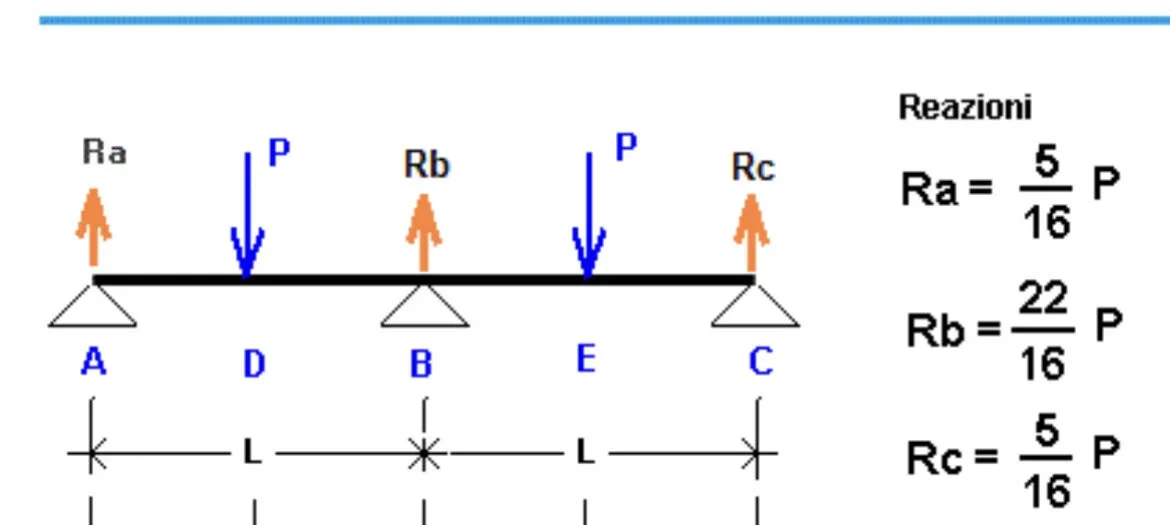
hi, just to shine my vague memories of mechanics, can I ask how you calculated, step-by-step, the breakdown of reactions 5/16; 22/16; 5/16?
Thank you very much
 
good morning and thanks for the mechanical responsemg, the goal was to distribute the weight of a hopper, so I thought about increasing the contact points and increasing the support surface. having not currently available an hour tool to do the fem analysis I am doing the accounts with paper and pen. so I considered the reaction of the constraints divided by the contact surface.

by fabietto, it is a scheme that I found online and did not do the steps having not at disposal much time in the laboratory.
if I can try to make you the steps later however it is a hyperstatic structure so it solves with the usual methods.
 
by fabietto, it is a scheme that I found online and did not do the steps having not at disposal much time in the laboratory.
if I can try to make you the steps later however it is a hyperstatic structure so it solves with the usual methods.
Okay, thank you.
I thought it was your reasoning.
Hi.
 
the reactions so set, lead to the right result that the sum of p1 + p2, equal to the sum of the three reactions ra, rb, rc, but their value must be different.
If the p1 and p2 are at the center of their respective supports, as from drawing, the p1 is divided in half between ra and rb, as well as the p2 is divided in half between rb and rc.
It follows that ra = p1/2, rc = p2/2 and rb collects half p1 and half p2, i.e. a force p.
the total reaction is exactly 2p as the load.
but if the load points are these two, why use a much longer tubular bar, with three floor anchors, forcing it to sting in the two load points?
 
If the p1 and p2 are at the center of their respective supports, as from drawing, the p1 is divided in half between ra and rb, as well as the p2 is divided in half between rb and rc.
It follows that ra = p1/2, rc = p2/2 and rb collects half p1 and half p2, i.e. a force p.
the total reaction is exactly 2p as the load.
It's the same reasoning I did.
But I, with these studies, am still in the early 1990s, and that is why I asked for the reasoning and the steps leading to the proposed solution. .
 
Okay, thank you.
I thought it was your reasoning.
Hi.
It's a very simple calculation. uses the usual method of forces.
the best way to solve it is to consider the moment of continuity as unknown.
I consider directly the moment that stretches the upper fibers and call it x.
if each span is long l: (2l) / (3ej) * x - (pl^2) / (8ej) = 0
from which revenues: x = 3pl / 16
now for simple balance we get the determined values:
ra=rc=5p/16
rb=11p/8
 

Attachments

  • schema.webp
    schema.webp
    54.7 KB · Views: 39
It's the same reasoning I did.
But I, with these studies, am still in the early 1990s, and that is why I asked for the reasoning and the steps leading to the proposed solution. .
I am also curious as you, to see the proposed calculations of the reactions that, as you see, do not lead to my results.
 
who has doubts about the solution look what he has written @legs : this is a structure hyperstatic that does not solve with the simple equations of static that apply instead to structures isostatiche.
 
@legs thanks to the explanation._ I imagined that the difference between my reasoning and the solution was that the structure is hyperstatic and not isostatic.
As mentioned, on this matter, I am firm to the 5th superior, 30 years ago. and maybe hyperstatic structures didn't even make them.
It remains the fact that it has always been a matter that has fascinated me, even if then my working path has brought me to other parts, and I for laziness have not deepened. .
 
@legs thanks to the explanation._ I imagined that the difference between my reasoning and the solution was that the structure is hyperstatic and not isostatic.
As mentioned, on this matter, I am firm to the 5th superior, 30 years ago. and maybe hyperstatic structures didn't even make them.
It remains the fact that it has always been a matter that has fascinated me, even if then my working path has brought me to other parts, and I for laziness have not deepened. .
However to remove any doubt you can download ftool free after registration and calculate anything in the plan without worrying anymore.
 

Forum statistics

Threads
44,997
Messages
339,767
Members
4
Latest member
ibt

Members online

No members online now.
Back
Top