• This forum is the machine-generated translation of www.cad3d.it/forum1 - the Italian design community. Several terms are not translated correctly.

Double flattening profile

  • Thread starter Thread starter nickobellick995
  • Start date Start date

nickobellick995

Guest
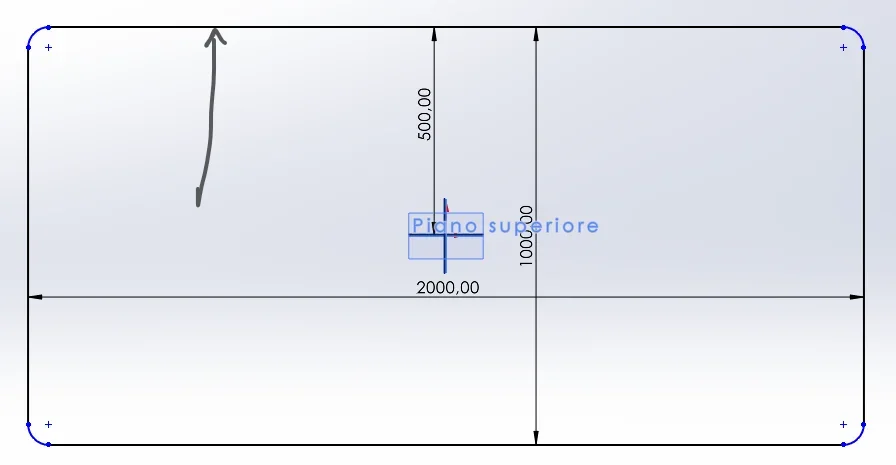
Hello, everyone. I open this discussion because I would like to confront you, expert community, on a problem that I am facing with solidworks in the development of some components: I need to create a piece of sheet metal which is composed of a profile to u that develops (a sweep) along a rectangular profile with round edges (I attach photos and files). until here no problem, just create a sweep with the two profiles and the game is done. the problem is that I must understand (if possible) how to "flatten" the profile to u (then flatten the two tabs highlighted by the red arrows), and also how to "transform" the rectangular profile (indicated in grey) along which the sweep develops in a single longitudinal profile that develops therefore on a single straight line. I hope I've been exhaustive in the explanation. I thank everyone who wants to help me.
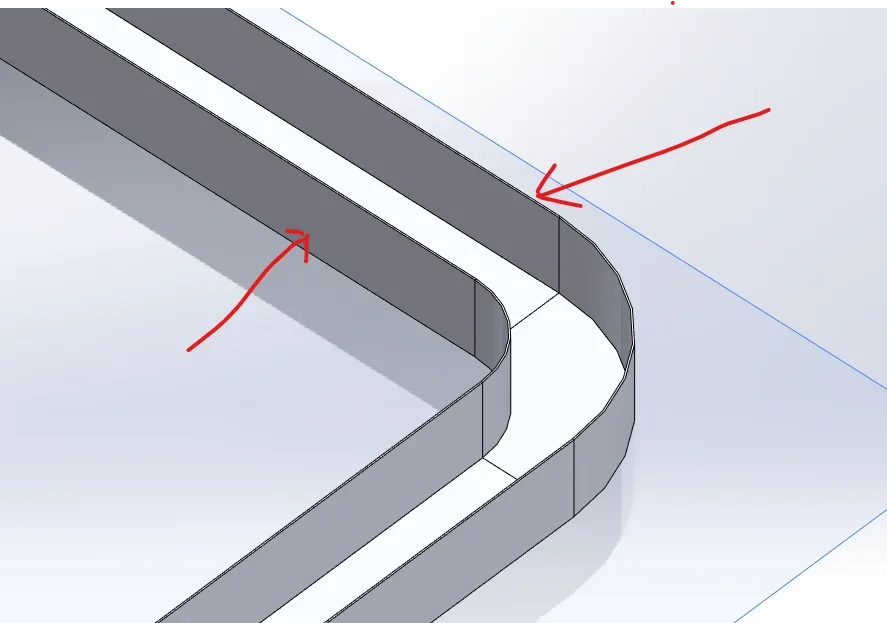
1689927766413.webp1689927900837.webp
 

Attachments

I'm not sure I understand, but the sheet to be able to develop after it was created along a path, must have a small cut that allows it to open.
 
I can't drop the files, but by principle if you want to achieve a sheet metal development you need to use the sheet metal tools.
said that part in a single sheet obtained from fold is not, in reality, feasible, there will always be something to weld. It is enough to think of the inner wing of the curve that if it were lying it would overcome with the inner wing of the right side.
As far as perimetric development is concerned, I believe that a solution is to work through configurations, that is to make a new body perfectly straight and that recovers the length through equation or global value from the rectangle sketch.
remains the fact that the bottom of the curved areas must already be cut curved because not obtainable from fold.
 
si
I can't drop the files, but by principle if you want to achieve a sheet metal development you need to use the sheet metal tools.
said that part in a single sheet obtained from fold is not, in reality, feasible, there will always be something to weld. It is enough to think of the inner wing of the curve that if it were lying it would overcome with the inner wing of the right side.
As far as perimetric development is concerned, I believe that a solution is to work through configurations, that is to make a new body perfectly straight and that recovers the length through equation or global value from the rectangle sketch.
remains the fact that the bottom of the curved areas must already be cut curved because not obtainable from fold.
ok the explanation is clear to me, although I do not know how to work through configurations, I just miss the concept and practical application
 
what are the configurations is definitely explained in the online guide, is present in the tutorials and most likely is explained also in the forum
 
[...]said that part in a single sheet obtained from fold is not, in reality, feasible, there will always be something to weld. It is enough to think of the inner wing of the curve that if it were lying it would overcome with the inner wing of the right side.[...]
This point, to want to be lazy (and this morning I have time to lose, ;)) is a little too perennial.
flying over the measurements of the piece, which are "important", with a funnel you could get the type of piece shown by the opener.
Of course there would be problems to be solved, like the "residuum" radius on the upper edge of the u, which would be dimensioned for excess and trimmed in height. It would also be necessary to assess the connection at the base of the u, to avoid tears during the funnel.
and then there is development, thickness, finishing, etc.etc.
However, in principle you can get that piece without welds (if it were not that the mold costs like a house, and then go to find the suitable press... )
 
This point, to want to be lazy (and this morning I have time to lose, ;)) is a little too perennial.
flying over the measurements of the piece, which are "important", with a funnel you could get the type of piece shown by the opener.
Of course there would be problems to be solved, like the "residuum" radius on the upper edge of the u, which would be dimensioned for excess and trimmed in height. It would also be necessary to assess the connection at the base of the u, to avoid tears during the funnel.
and then there is development, thickness, finishing, etc.etc.
However, in principle you can get that piece without welds (if it were not that the mold costs like a house, and then go to find the suitable press... )
is perennial to the extent that the request concerns the appointment of the sheet through the functions of solidworks. we are not talking about how technologically feasible or what is the best production process in terms of benefits/costs having precise parameters to be respected.
in solidworks there is the imbutting function, but it exulates the requests made
 

Forum statistics

Threads
44,997
Messages
339,767
Members
4
Latest member
ibt

Members online

No members online now.
Back
Top