• This forum is the machine-generated translation of www.cad3d.it/forum1 - the Italian design community. Several terms are not translated correctly.

lifting attachment

  • Thread starter Thread starter Antares89
  • Start date Start date

Antares89

Guest
Good morning.

from a few months I entered the world of lifting equipment design. From the beginning, I get a problem that I haven't solved yet.

which model should I use to dimensional the lifting point of a mechanical component?
I have done various research on regulations, fem / en 13001 / en 1990 / asme bth-1 / cnr / norsork and has always been a hole in the water...
the problem is that all these regulations consider only couplings pin hole and then attach the hook to the grill.
I have also tried to look for the method of sizing of crickets and gulfs, but they are made according to norms that define material and flow dimensions, so there are no mathematical models.

I tried to use fem calculation methods, but the results are exaggeratedly conservative, not to mention that the design through fem is not covered in the regulations and there are no instructions en on how to apply it.

I was currently using as a model for calculating tensions a double ink beam with concentrated load applied to the center. a fairly conservative method, which sometimes generates such a large section not to enter into the lifting hooks. in fact I have gone to set as attacks only pins or crickets.

Now a customer has asked me for a certification on an existing equipment and the working load limit that I find is 6 times lower than what they are currently applying without problems.

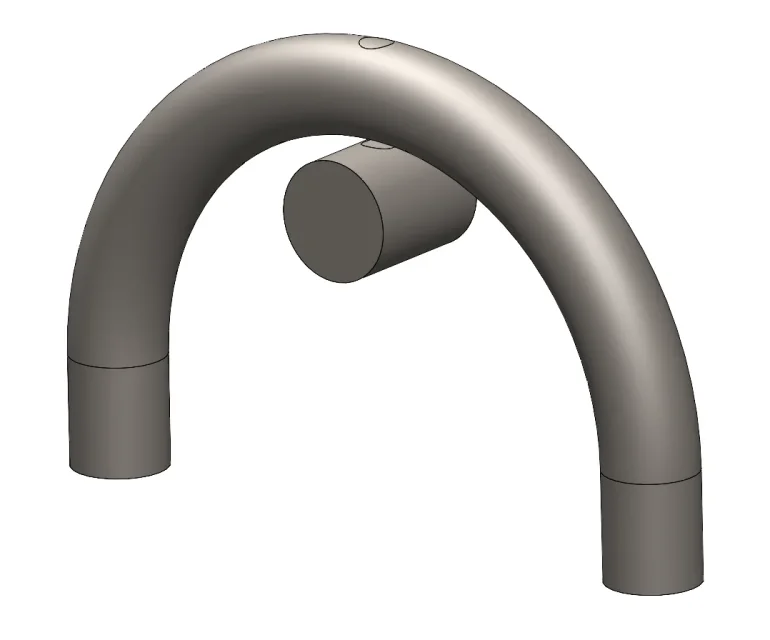
below an image of the equipment, the point in question is the round folded to u, but I have the same problem even when the lifting point is made within a sheet.

This question is exhausting me because I haven't found the answer for 8 months and I have been confronted with all the designers I know.
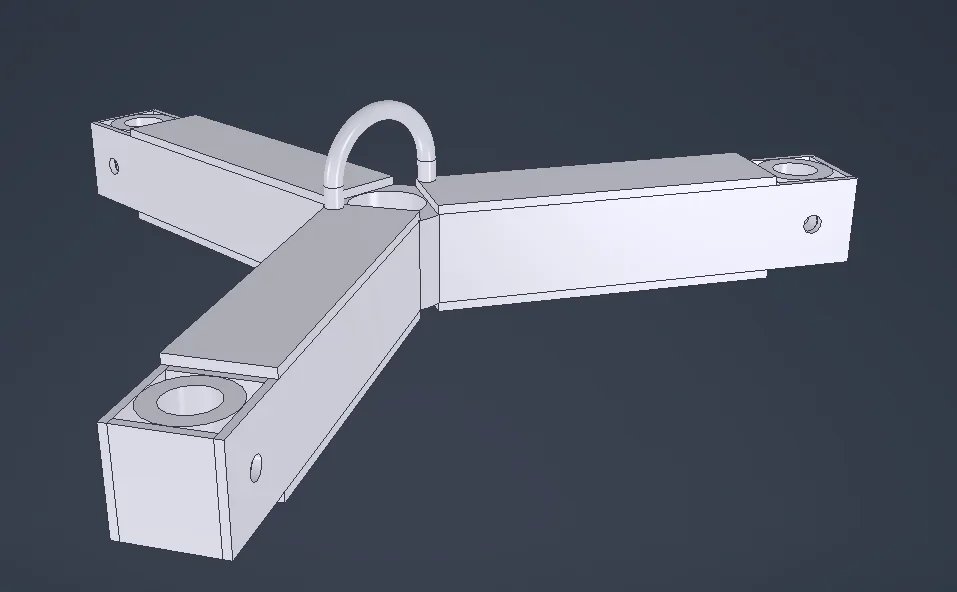
1691256229874.webp
 
This sincerely is a problem to solve.
somewhere we have already discussed it on the forum.
the question we say is divided into two:
- put the golfers or unified lifting systems and nornate and therefore being tabled is a children's game
If you make machinery or anything like that, and you have to do the lifting ears, there's a black hole. there are those who say that the open ears are not there because they can unleash the chains but I have never found norm that I explicitly say. in america and cina are normally used to weld (see second discussion). if you make your ears closed there is a vague norm for pressure vessels but also that is strange. However, the rules say that the certified designer must demonstrate through calculations....bene there is uni en iso 1993-1-8 to measure and verify the closed lifting ears. for the open ones you can still do the same.
Incidentally, the gearboxes were doing them in the 40-50-60s until the 80s. then they started making holes closed to remove each grain... .

Unfortunately, nothing in this world of a thousand secret norms that you have to stick to for 200 years but no one knows what they are.
qui.

above all qui.

the topic is interesting and it would be nice to know what the norms say.

if you build not machinery that must be lifted but lifting equipment you have the industry standards to follow (assurdo.... a barbell and a junk mail cassone must not be a c....as always clear nothing).

I think interrogating one or more certified consultants is the only way out.
 
Thank you for the mechanical responsemg, a little reassuring me that the problem is common means that I am not completely stunned. . .

one of the two articles I read but didn't answer my question.

with regard to the style attacks of the shelf the size would be much easier, moreover I also have an internal norm of the company for which work that works a bit in style din, therefore size and flow rates.

Unfortunately, the regulations are designed only for civil engineering, as if mechanics did not feel the need to share and standardize calculation methods.

the problem of this particular is that it is not contemplated in the norms, it is not comparable to a solid of de Saint Venant, if I use the roark and therefore the theory of curved beams the efforts increase and in the end in practice everything is oversized with a factor that can reach even the ten.

I think in two years I'm gonna do the specialist's thesis or maybe a doctorate.

Honestly, the eurocode and the rules that come for me was a great disappointment, I am of difficult reading, difficult application, in the lifting accessories sector en 13001 and 13155 have exaggerated calculation charges and lack of models and indications as in this case. Not to mention that finite element calculation methods are bottled with a phrase of the type "not used because too conservative". I hope that all these gaps will be added since 2026. by itself the work is colossal, but it seems set as notes.

If I find a solution I'll let you know, while I keep looking!
 
the machine directive says that lifting accessories must resist, without having residual deformations, to 1.5 static load and 1.1 dynamic load.
If there are ok rules (I would use 13155 as a basis) otherwise the directive is consistent. the important thing is that he does not break.
 
yes, indeed rule 13155 provides that it is possible to carry out a verification of the resistance of the equipment by static test with a load 2 times that calculated according to en 13001-3-1.

the problem is that I need to carry out verification by calculation. for me it is necessary to find a method of calculation that gives results compatible with the practical ones, but currently all the methods of calculation I used are extremely conservative (service factor > 5).

I looked at some calculations of other engineers, but unfortunately I found too many discrepancies and errors, honestly I can't trust. . .
one used as model the cut according to jouraski, then for beams subject to bending and cutting. but it did not consider the bending.
another used the simple cut by multiplying by a coefficient of 4/3, perhaps to consider a section increased due to the curvature.
then always in the relationships I found other obvious errors, for example on a heb beam subject to bending on both main axes the resulting effort was calculated by summing up the actions and considering only the moment of greater inertia. . .
I can't trust the method too much. also because in the end they always had 2/3 high service factors.
 
question: why are the gulfs sold with safety factors 4 and 6 compared to the breaking load? for the various types of hooks is not worth?
beautiful that the norms say 1.5 times...bla blah.... but then the gulf makes 4.
Why?
 
The directive says 1.5 on yield.
4, 5 and 7 for chains, ropes and synthetic braces but on breakage.
then machine builders choose even minor coefficients.
the safety coefficient 4 is the ratio between flow and breakage.
 
about golfers, rope chains and related accessories there are specific and different regulations.
I think the reason is due to the production in series often by molding. their load capacity is obtained by testing and there are rules that determine according to the size of the lot how many destructive tests must be carried out and how many in the proportional limit.

unfortunately I have searched there without finding a match
 
The directive says 1.5 on yield.
4, 5 and 7 for chains, ropes and synthetic braces but on breakage.
then machine builders choose even minor coefficients.
the safety coefficient 4 is the ratio between flow and breakage.
thanks for the clarification.
However it is quite a judiciary and sometimes even to ask the advisors' special office do not provide you with equal answers.

returning to the hook that has your system, it is a full round folded to u.
given the proportions, of the first caught cannot be treated as a normal beam, not being straight and not having a preponderant dimension.

fem analysis should give a fairly reliable result with mesh sufficiently fine.

going logically we have traction on the two vertical bits. u undergoes first cutting and bending approximation. Have you tried to assimilate the U to a three-way straight structure with load in the center?

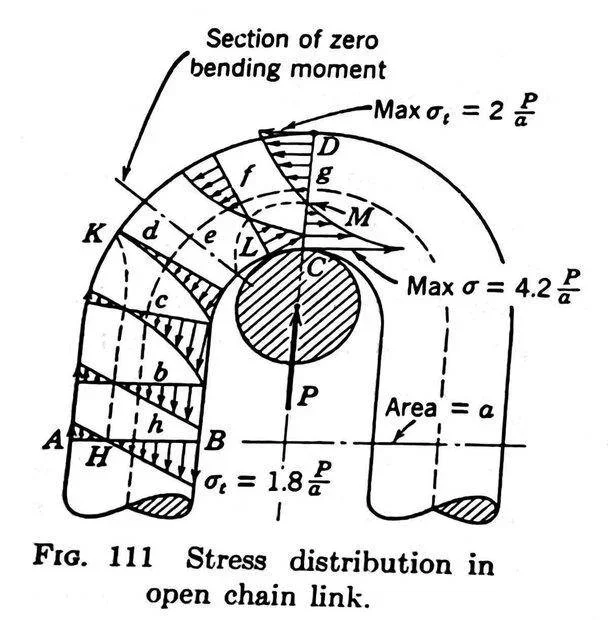
made that way is how to study half chain ring.Screenshot_20230806_204944.jpgI found this interesting image:chain link.webpCould you give us the size of the u and the load value of the application?
 
Last edited:
below you will find the geometry of the detail.
the material is a stainless steel x8crni25-21 + at - 100°c, I consider a yielding of 280 mpa and a breaking load of 620 mpa.
the applied load is 4000 kg without safety coefficients. for this application the fem which is less restrictive but only applicable specific cases. therefore coefficients are 1.31 on the load and 1.5 on the admissible voltage.
1691437087103.webpI see that the formula of efforts is empirical since it does not consider the inertia of the section. the trend is similar to the moment.
I found more refined formulas in the roark on the theory of curved beams, but in the end they added coefficients of increase on the efforts and worsened the situation.

as fem I used the internal one to inventor, and is a very high effort on the point of contact. you could also exclude it by means of a pressure and therefore according to herziana theory to accept even three times the admissible voltage. Unfortunately, it is not a path that can be reached from the regulatory point of view. I also do not know how to exclude tensions due to contact and those at the moment.
 
doing two accounts very quickly without paying too much attention we have, alone traction on the two straight trunks:[math]\sigma=\frac{p}{2•a}=\frac{40000n}{2•\frac{πd2}{4}}=64mpa[/math]using the maximum voltage formula of the post #9 we have:[math]\sigma=\frac{4,2•p}{a}=\frac{4,2•40000n}{2•\frac{πd2}{4}}=534mpa[/math]sincerely the problem is the contact point for a high herziana pressure but also for bending from the u.

so on the practical side, if the equipment are using it for 4ton it means that it does not break but surely will be incruditated the contact zone with the grip of the hook and u. if they stick in hook a little big, you will have that u takes the form of the back of the hook and then stabilizes because it straightens u and copy the curvature of the hook. you no longer have a dot contact but an appreciable area.

Is it possible that you take a closer look at the hook and check?

for the fem you have to do a non-linear simulation with the application of the true curve sn where you will have the definition of the plastic field. you will get lower tensions to equal deformation than the linear analysis you have done with inventor. However if the hook is rigid you will have a larger contact area than the point. Try to define an area and you will see.

definitely it is to be studied.
 
I did with freecad using the linear fem module, so we have a complete linearity between sigma and epsilon.
It is known that the fem make just epsilon while sigma is calculated on the straight or straight or curved linear or not elastic and plastic.
you can set up a nonlinear analysis that has been treated on the forum in a post different.

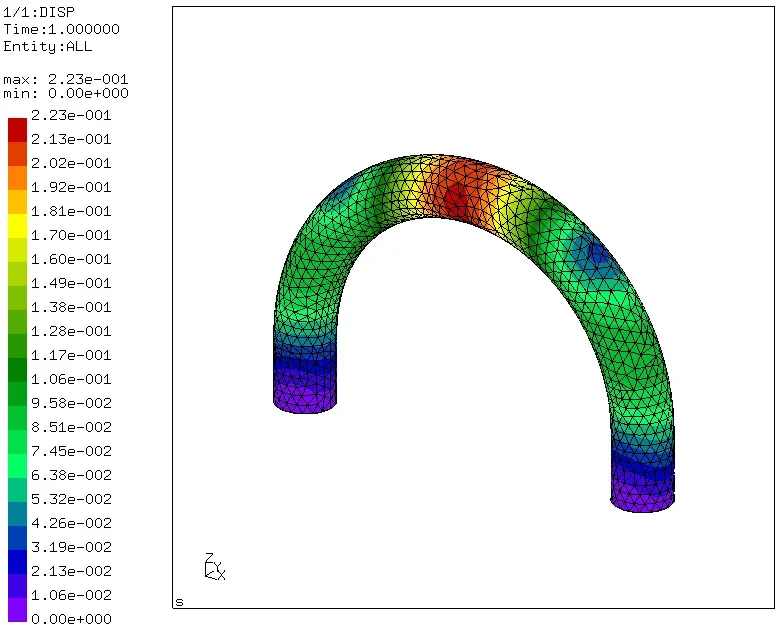
loaded with 40kn in center hook and recess to the bases.

von mises in mpa:vm1.webpvm2.webparrow in mm:y.webpas you see we are perfectly aligned to the hand calculation of the previous post.
 
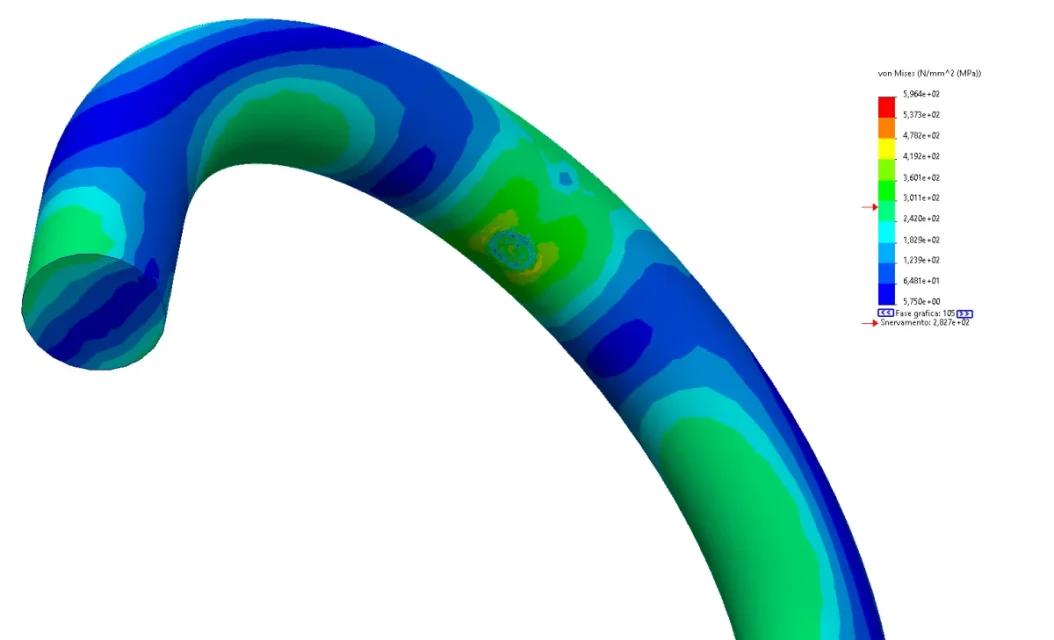
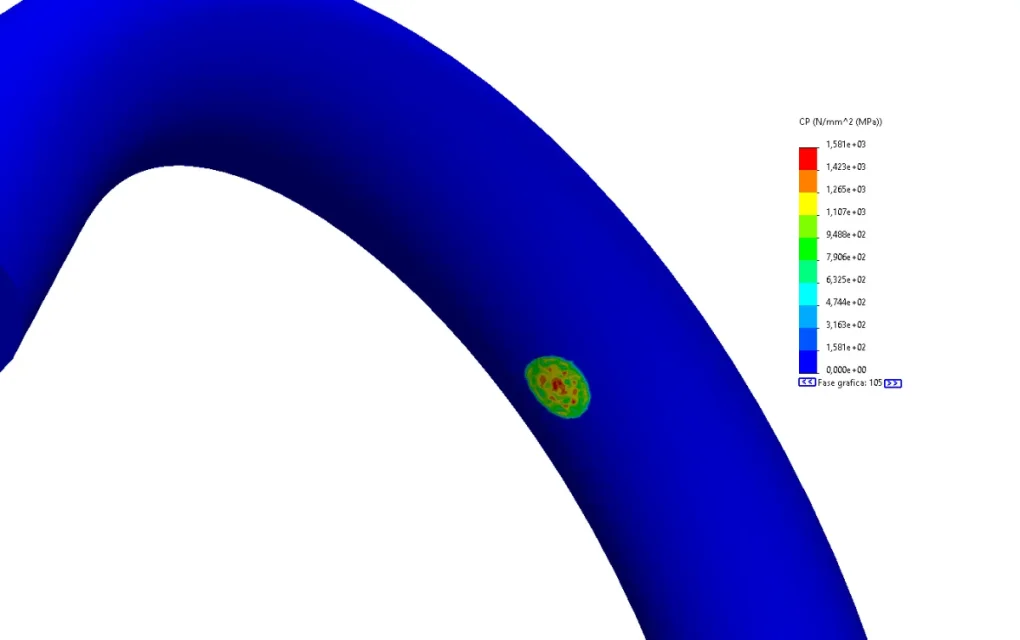
I enjoyed making a non-linear calculation with non-linearity of material and contact, as I also modeled a possible hook that in the worst case is straight (minimum contact area).caso studio_attacco di sollevamento_CAD 3D-Non lineare 1_4.webpcaso studio_attacco di sollevamento_CAD 3D-Non lineare 1_1.webpyou see clearly the contact mark. the convergence test previously performed in linear static analysis led me in choosing the mesh size in the contact area, after evaluating aspect ratio, jacobiano and error in norm. symmetry is not as perfect as you see, however a mesh size was chosen that allowed me to perform the analysis in relatively short times with good accuracy of results. The contact zone is obviously the most difficult to assess in quantitative terms.caso studio_attacco di sollevamento_CAD 3D-Non lineare 1_5.webpview in section. you notice the maximum stress value.
caso studio_attacco di sollevamento_CAD 3D-Non lineare 1_2.webp
caso studio_attacco di sollevamento_CAD 3D-Non lineare 1_3.webpcontact pressure. there would be a series of more punctual evaluations, but these exultane from the general speech. I wanted to perform this analysis to have a vision as close to reality.
 
Hello antares89

antares is the name of a star. astronomy enthusiast?
if it may interest there is a method indicated in the old version ec3 at point 6.5.13
I tried to implement those formulas in a spreadsheet, but I never used it.
I'll show you the job I did. I don't know if it's your case.
Hello everyone
perno1.jpg
perno2.jpg
 
I thank all for the answers and apologize if I have been a little absent these days.

First, here is the image of the tool in question. as you hypothesized the contact area is a little worn out. sincerely I always thought it was a wear caused by rubbing, but following calculations and simulations I think it is mainly due to local voltage spikes.1692648924150.webp
@meccanicamg From the linear point of view I had also achieved similar results, but unfortunately they are not usable from the design and normative point of view. as it is evident that the component functions correctly, therefore the models are not valid unfortunately.

Turning on the internet I found that some American regulations, on the design of medical prostheses, that it is possible to believe valid the results of a fem calculation in case the stresses generally are under the yield and if locally, because of concentration of the efforts, do not exceed 3 times the yield.
I have not studied in detail as regards a totally different field.
News regarding non-linear analysis assures me that the piece exceeds the yield only on the contact point. you encouraged me to learn a serious simulation software, I will try nastran that is part of the autodesk suite
@betoniera I was also encapsulated in that mathematical model of the eurocode but it is valid only for joints (like all the various models of the ec) and specifies that the relationship between the diameter of the pin and that of the hole must be >0.9 . also evaluates the break only for cutting and does not consider the possible bending.

in the end I decided to use the model of American law asme bth-1. chosen because it considers various methods of yield and evaluates the maximum tensions for each of them. also contemplates a corrective factor in the case of the pear diameter and hole ratio <0.9.
I'm a little shocked to admit it, but I've also chosen it according to the fact that it's less conservative. I mixed the calculation method with the safety criteria of the fem legislation.

thanks to all for support. For now I consider the matter closed.
I hope one day to have the opportunity to do the specialist thesis or a doctorate on the subject!

ps: yes the name comes from the star but unfortunately I am not a fan of astronomy, simply like how the ancient names of the stars sound.
 

Attachments

in the appendix of the eurocode 3 in an annex speaks of the models fem and the curve to be applied elasto pleatica.mi appears in part 5, if it were steel.

locally your hook will always be deformed plastically and you see from the photo.

I would do an elasto plastic analysis with curve tension deformation as in the appendix of the eukodice 099DEEB2-4A44-4907-AE7A-968993AD905C.jpegand I would rate the local breaking load at 5% if it were steel. so locally what I deform at the point of contact. You do this by following ec3.

for the theory of curved beams in the book of aztori constructions of machines p 232.

if you are interested I can calculate it analytically, for a while I do not hook, but for a comparison I gladly do

then by curiosity you can make the fem a waxed golf and you will see how it plasticizes locally
 
Last edited:
thanks for the clarification.
However it is quite a judiciary and sometimes even to ask the advisors' special office do not provide you with equal answers.

returning to the hook that has your system, it is a full round folded to u.
given the proportions, of the first caught cannot be treated as a normal beam, not being straight and not having a preponderant dimension.

fem analysis should give a fairly reliable result with mesh sufficiently fine.

going logically we have traction on the two vertical bits. u undergoes first cutting and bending approximation. Have you tried to assimilate the U to a three-way straight structure with load in the center?

made that way is how to study half chain ring.View attachment 68928I found this interesting image:View attachment 68929Could you give us the size of the u and the load value of the application?
These formulas are the most used ones. are in favor of security of about 20%. insert a k factor of intensification of tensions equal to 2 on external and internal deformation to take into account that the neuro axis is not in the middle
 
These formulas are the most used ones. are in favor of security of about 20%. insert a k factor of intensification of tensions equal to 2 on external and internal deformation to take into account that the neuro axis is not in the middle
the voltage values of von mises calculated with the linear fem are very close to the formulas of the reversed u design and very similar to the values of the next nonlinear fem.
 
I thank all for the answers and apologize if I have been a little absent these days.

First, here is the image of the tool in question. as you hypothesized the contact area is a little worn out. sincerely I always thought it was a wear caused by rubbing, but following calculations and simulations I think it is mainly due to local voltage spikes.View attachment 68985
@meccanicamg From the linear point of view I had also achieved similar results, but unfortunately they are not usable from the design and normative point of view. as it is evident that the component functions correctly, therefore the models are not valid unfortunately.

Turning on the internet I found that some American regulations, on the design of medical prostheses, that it is possible to believe valid the results of a fem calculation in case the stresses generally are under the yield and if locally, because of concentration of the efforts, do not exceed 3 times the yield.
I have not studied in detail as regards a totally different field.
News regarding non-linear analysis assures me that the piece exceeds the yield only on the contact point. you encouraged me to learn a serious simulation software, I will try nastran that is part of the autodesk suite
@betoniera I was also encapsulated in that mathematical model of the eurocode but it is valid only for joints (like all the various models of the ec) and specifies that the relationship between the diameter of the pin and that of the hole must be >0.9 . also evaluates the break only for cutting and does not consider the possible bending.

in the end I decided to use the model of American law asme bth-1. chosen because it considers various methods of yield and evaluates the maximum tensions for each of them. also contemplates a corrective factor in the case of the pear diameter and hole ratio <0.9.
I'm a little shocked to admit it, but I've also chosen it according to the fact that it's less conservative. I mixed the calculation method with the safety criteria of the fem legislation.

thanks to all for support. For now I consider the matter closed.
I hope one day to have the opportunity to do the specialist thesis or a doctorate on the subject!

ps: yes the name comes from the star but unfortunately I am not a fan of astronomy, simply like how the ancient names of the stars sound.
I apologize if I go out of the theme, I don't want to pass by sack or for the usual critic, but the welds I see from the photo do not "pay the eye", being a lifting device I hope are subjected to non-destructive controls, like x-rays, penetrating liquids or ultrasound. Maybe, rightly look at the results of a fem and then crush the welds!
 
Good morning.
I exempt an old discussion not to miss the interesting calculations made here on.

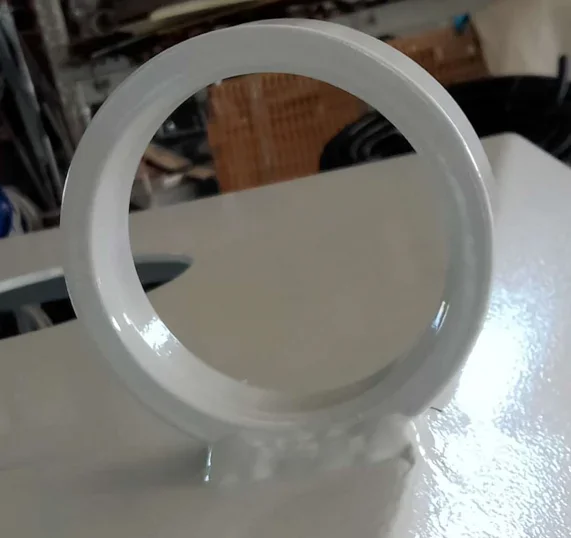
I have a welded ring so, outer diameter 100, inside 80, thickness 25.
1721757631047.webpI made two accounts assuming y=235mpa should hold 2400 kg with r=5 (calculating only the section of the ring because the welding holds more.

If I use formula 4.2 p/a I get that it only holds 285kg, always with r=5 which worries me not little.

Moreover, given the geometry, how do I assess any ovalization? Who helps me think?
 

Forum statistics

Threads
44,997
Messages
339,767
Members
4
Latest member
ibt

Members online

No members online now.
Back
Top