• This forum is the machine-generated translation of www.cad3d.it/forum1 - the Italian design community. Several terms are not translated correctly.

manual cutter family use, with design defect to be discovered.

  • Thread starter Thread starter Marco F inox
  • Start date Start date

Marco F inox

Guest
a great greeting to all,
It is time for chestnuts and browns and I make the roasts every day, rolling them electrically inside a perforated sphere, over the gas stove.
to avoid any injuries, during cutting on their back, I built this simple tool, manual but very efficient and safe.
on a rectangular nylon base, I fixed a vertical wall to whose top is placed a horizontal pin.
on this pin rotates a cylinder carrying a fork, operated by a lever.
frontally to this fork, longitudinally, is fixed oscillatingly, a support that contains the cutting blade protruding a couple of mm, a rear spring and an oscillating tray.
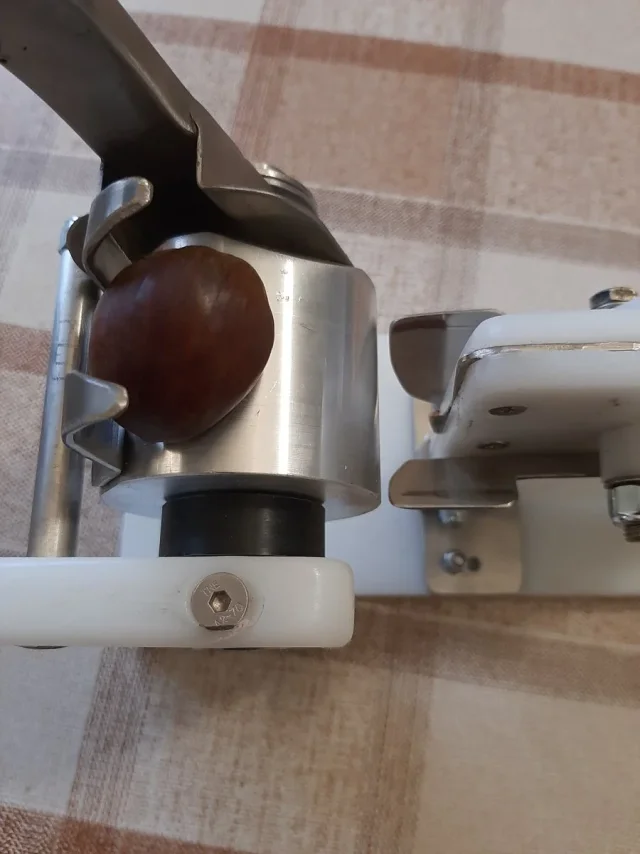
lift the lever, place the chestnut between the wings of the fork with back on, or over the two arms of the tank.
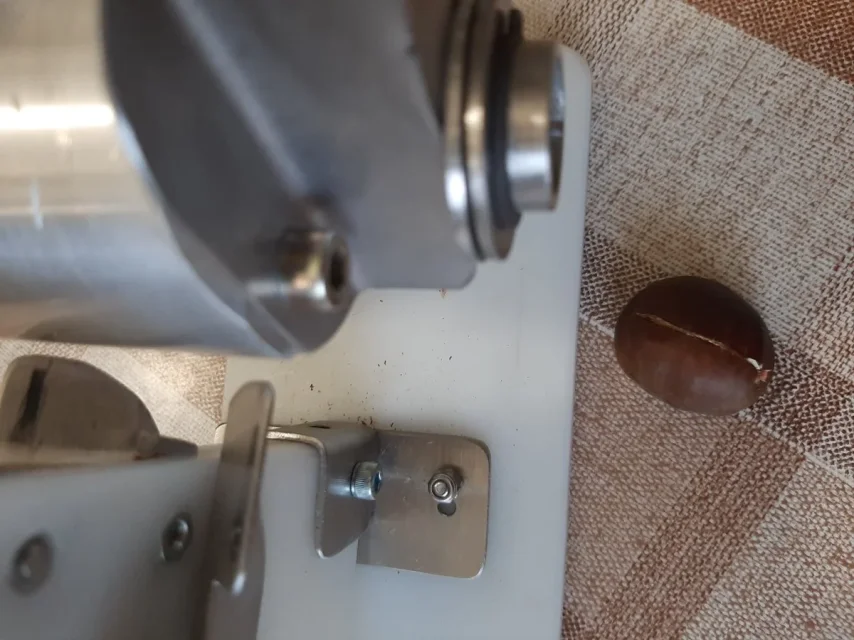
lowering the lever, the chestnut passes in front of the knife with all its back, it is cut and falls on the floor below.
This support is oscillating to adapt to the different thicknesses of the chestnuts, while the adjustable spring ensures that the blade is always pressed for cutting.
the two sides of the tank, inclined to 45°, accommodate all the dimensions of the chestnut, but this must be oscillating and held up by a spring.
lowers when the chestnut passes, but also the fork, in its rotation lowers it.
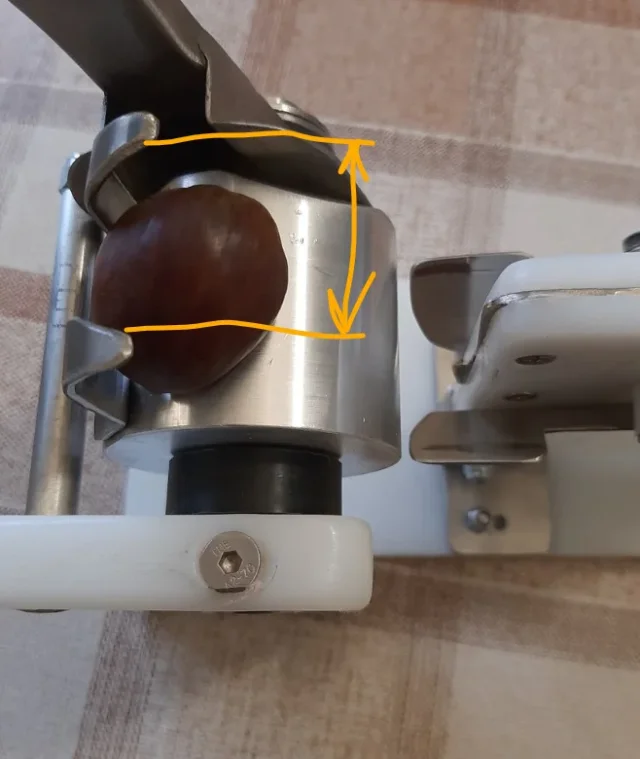
as you see it from the photos, it works more than well, but I deliberately inserted a project error, almost insignificant, but technically not admissible.
when you find out this error, I will send the definitive photos.
Good luck to all!
 

Attachments

  • Tagliacastagne 1 con errore tecnico.webp
    Tagliacastagne 1 con errore tecnico.webp
    132.1 KB · Views: 126
  • Tagliacastagne 2 con errore  tecnico.webp
    Tagliacastagne 2 con errore tecnico.webp
    155.7 KB · Views: 120
  • Tagiac. 3 con errore tecnico.webp
    Tagiac. 3 con errore tecnico.webp
    85.1 KB · Views: 111
  • Tagliac. 4.webp
    Tagliac. 4.webp
    309.1 KB · Views: 117
ciao @marco f inox Dude! your chestnut size.
according to me.. lacks the chestnut
by the joke: No, I haven't discovered the mistake yet.
But in the meantime I have a curiosity:
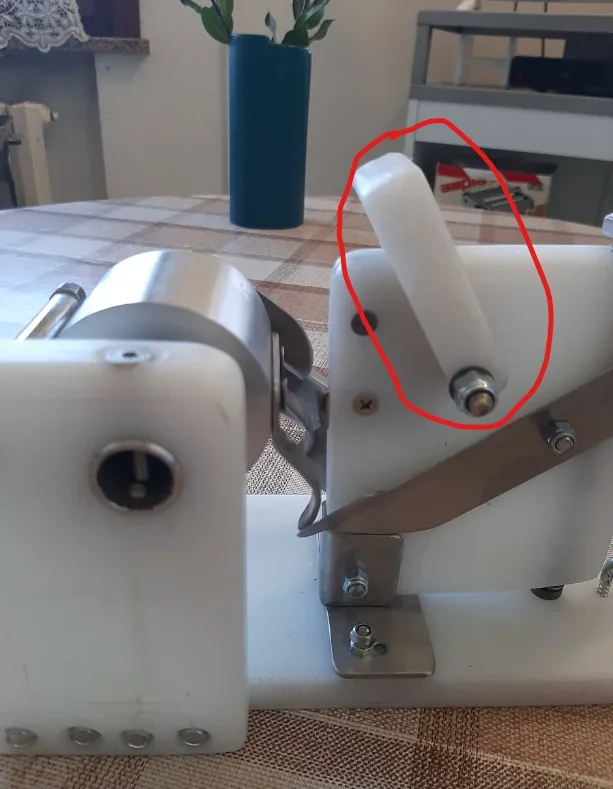
What I've been looking for in red... Is it a blade protection once the tool is placed?
1699522241020.webp
 
ciao @vittori, that circled in red is an eccentrically fulcrated lever, to vary vertically, the initial position of the tray, then the position of the chestnut according to its size.
If you place the chestnut on the cylinder within the fork, this lever is influential.
the cutting blade is placed at the height of the cylinder axis, very small and already quite protected.
in the next design there will be also the chestnut.
 
Given that these 4 photos do not allow a unique interpretation of the operation, it seems to me that the deposit of brown cannot be stable having to lean on the cylindrical surface of the drum. I think it would be necessary to spy on the drum to offer better stability of brown. and I would like to see if the orientation of the cut on the skin of brown is what allows the best peeling.
 
almost insignificant, but technically not admissible.
without a video that shows the operation, with so much chestnut, it is practically impossible to find out what you mean as insignificant, but not admissible.
or even a drawing with a lot of sections.
judgment in this case is very susceptible and opinable.
then you said it works nicely. .
for me could also be the aesthetic aspect ...that for charity.. It will work nicely but it is not the maximum.

by helping us
 
hi, according to me missing the second vertical wall, lever side drive.
seen so, it seems excessively thin the wall where the horizontal pivot of rotation is fixed, considering that the lever is on the opposite side and therefore I would have added a further wall.
Moreover, at sight, it seems that by activating the lever, everything can turn right. I would have done the widest base. .
 
answers to some comments:
-This very close picture, distorts the proportions of the measures a bit.
-the structure is more than valid and sufficient for the task it has to carry out.
- the horizontal pin carrying the cylinder, is a pipe diameter 20 mm. very short, and the vertical support of nylon does not fit absolutely.
- the base also welcomes the end of the lever, so there is no tipping.
- provided that the chestnut must be cut on the back, with a transverse cut as long as possible, according to a circular segment, it is evident that the cylinder must have a smaller diameter as possible.
- to make a baseline on the cylinder, it would be ideal if the chestnuts had the same size, but that is not why, to satisfy them all, it is good that the belly of the chestnut is always tangent to the cylinder and that it supports directly on it.
-there are the two arms of the fork that contain it laterally, so the support is
always stable.
- the rotation of the lever becomes so fast, that the chestnut does not move.
- as I have already said, the chestnut can also be placed between the cylinder and the knife, where the two wings
- The spoon contains it laterally.
- in one of the previous photos you can see the error very well, while in these two you can also see the chestnut.
 

Attachments

  • Castagna in posizione.webp
    Castagna in posizione.webp
    72.1 KB · Views: 74
  • Castagna tagliata.webp
    Castagna tagliata.webp
    107.4 KB · Views: 72
a great greeting to all,
It is time for chestnuts and browns and I make the roasts every day, rolling them electrically inside a perforated sphere, over the gas stove.
to avoid any injuries, during cutting on their back, I built this simple tool, manual but very efficient and safe.
on a rectangular nylon base, I fixed a vertical wall to whose top is placed a horizontal pin.
on this pin rotates a cylinder carrying a fork, operated by a lever.
frontally to this fork, longitudinally, is fixed oscillatingly, a support that contains the cutting blade protruding a couple of mm, a rear spring and an oscillating tray.
lift the lever, place the chestnut between the wings of the fork with back on, or over the two arms of the tank.
lowering the lever, the chestnut passes in front of the knife with all its back, it is cut and falls on the floor below.
This support is oscillating to adapt to the different thicknesses of the chestnuts, while the adjustable spring ensures that the blade is always pressed for cutting.
the two sides of the tank, inclined to 45°, accommodate all the dimensions of the chestnut, but this must be oscillating and held up by a spring.
lowers when the chestnut passes, but also the fork, in its rotation lowers it.
as you see it from the photos, it works more than well, but I deliberately inserted a project error, almost insignificant, but technically not admissible.
when you find out this error, I will send the definitive photos.
Good luck to all!
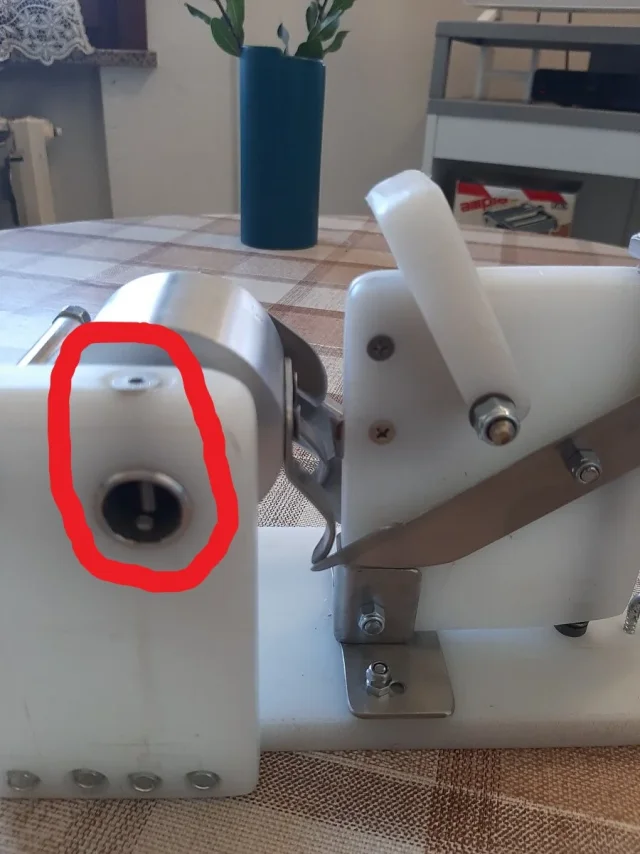
Too short screw? ?
 

Attachments

  • Tagiac. 3 con errore tecnico.webp
    Tagiac. 3 con errore tecnico.webp
    91.4 KB · Views: 75
Well, one that produces such a tool to hack a chestnut, is unequivocal sign of being retired. Am I right?
 
Of course I've been retired for many years, but my picture is quite recent.
but if the professionals of the boilers have pushed the builders to the realization of the industrial cutters, (see the fairs), I too in my little one, can think to simplify and make this operation more secure, even for only 15-20 chestnuts at a time.
to those who have quoted the fork, I reply that being divaricate, contains both the small chestnuts and the big ones, as well as the spoon tray.
 
but just to understand. .
when you designed and built this chestnut size, it all worked immediately and well?
or, at the first test, you noticed the project error,
Putting hands on us personally, and did you correct?
and now come and ask us to find him by photo, without a test, we say physical. . .
 
Is there any mistake to find or is it okay? ahahahaha
In my opinion, in that case, the chestnut remains infiltrated in the upper jaw, and you have to hand off it. with considerable defeat. .

edit. ah no, the upper jaw is double.. Maybe to parade the chestnut from the teeth. .
 
In my opinion, in that case, the chestnut remains infiltrated in the upper jaw, and you have to hand off it. with considerable defeat. .
We have to put an extraction point under a spring and we have to patent it! :cool:
 

Forum statistics

Threads
44,997
Messages
339,767
Members
4
Latest member
ibt

Members online

No members online now.
Back
Top