
You are using an out of date browser. It may not display this or other websites correctly.
You should upgrade or use an alternative browser.
You should upgrade or use an alternative browser.
TETRASTORE
Guest
other information, certainly not exhaustive, you can find it in this debate.do you know how to adapt the graphic constructions of the evolving profile of a gear from a basic circumference to a basic flat curve? It is a curiosity that I have always had: building the evolved from a basic circumference is quite easy; but at the moment I found myself, for example, having to roll a gear/circumference on a parable, how would I orientate the teeth on the parable? would change the evolving profile in the teeth of the parable or would I just take a tooth, and to one to one to orientate them according to the curvature, covering the whole parable? Are there any parametric software that does this? in freecad is there a form? In addition, the transmission performance, is calculated equally?
you can also see This is document and quest'altro (elliptical gears and dynamic geometry).
Last edited:
Giag
Guest
I managed to spin kysssoft on ubuntu 22.04. Now, where can I find kisssoft tutorials where you design non-circular gear or in any case useful information about how to start using this software?
meccanicamg
Guest
if you have downloaded the trial by doing the steps correctly and so lawfully, you will have a complete package of executables, installations etc. you will also find pdfs with instructions and tutorials. However you can always contact the staff and give you the necessary material to address the theme.
meccanicamg
Guest
right for information kissssoft only turns on windows.
I have seen that there is a kiss pack for ubuntu/linux but I do not think it is the application that we mean....visto that: unless on ubuntu you have a virtual machine with windows.
I have seen that there is a kiss pack for ubuntu/linux but I do not think it is the application that we mean....visto that:
unless on ubuntu you have a virtual machine with windows.Giag
Guest
I managed to turn kisssoft on uuntu with wine.
I'm researching non-circular gear and I would like to know if kisssoft, according to your experience, does what makes gearify 1.0:
(the big limit of this version is the absence of evolving profiles for teeth)
or gerify 2.0:gearify 2.0 is going out.
before you go too far and waste time, does kisssoft have more features?
I'm researching non-circular gear and I would like to know if kisssoft, according to your experience, does what makes gearify 1.0:
or gerify 2.0:gearify 2.0 is going out.
before you go too far and waste time, does kisssoft have more features?
meccanicamg
Guest
the dedicated site where it speaks of uncircular gears is qui.
there are references to English presentation documents that I attach.
If you managed to turn kissssoft....use it and you will see. You have 30 days to prove it.
there are references to English presentation documents that I attach.
If you managed to turn kissssoft....use it and you will see. You have 30 days to prove it.
Attachments
simoneorio
Guest
do you know how to adapt the graphic constructions of the evolving profile of a gear from a basic circumference to a basic flat curve? It is a curiosity that I have always had: building the evolved from a basic circumference is quite easy; but at the moment I found myself, for example, having to roll a gear/circumference on a parable, how would I orientate the teeth on the parable? would change the evolving profile in the teeth of the parable or would I just take a tooth, and to one to one to orientate them according to the curvature, covering the whole parable? Are there any parametric software that does this? in freecad is there a form? In addition, the transmission performance, is calculated equally?
meccanicamg
Guest
wandering the net I found this more complex formulation for the calculation of the yield of the helical toothed wheels.
η = (1 - μs + (μs2 - μd2) * tan2(α) • cos(β)2 / (cos(β) * (z1 / z2 + tan(α))))where:
- η represents the performance of helical dentate wheels
- μs represents the coefficient of static friction
- μd represents dynamic friction coefficient
- α represents the angle of helical dentate wheels
- β represents the pressure angle of the helical dentate wheels (usually 20°)
- z1 represents the number of teeth of the conductor gear
- z2 represents the number of teeth of the gear.
Does anyone use it? Do we have any numerical comparisons? the formulation is a little different from the classic.
η = (1 - μs + (μs2 - μd2) * tan2(α) • cos(β)2 / (cos(β) * (z1 / z2 + tan(α))))where:
- η represents the performance of helical dentate wheels
- μs represents the coefficient of static friction
- μd represents dynamic friction coefficient
- α represents the angle of helical dentate wheels
- β represents the pressure angle of the helical dentate wheels (usually 20°)
- z1 represents the number of teeth of the conductor gear
- z2 represents the number of teeth of the gear.
Does anyone use it? Do we have any numerical comparisons? the formulation is a little different from the classic.
meccanicamg
Guest
I also found this formula but it is far from reality because there is no friction coefficient between teeth:
η = (1 - a) / (1 + a) * 100where η is the yield, expressed as a percentage, and to is the loss factor.
to calculate the loss factor to, you can use the following approximate formula:
a = sin(α) / (sin(α) + cos(α))
where α is the angle of helical inclination.
then I found another one but also here lacks the coefficient of friction and therefore I do not think it is realistic.
θ = (π * (d1 * cos(α1) + d2 * cos(α2)) / (2 * π * p) * (cos(α2) / cos(α1))where:
η is the performance of the two cylindrical helical wheels
d1 is the primitive diameter of the pinion (wheel with less teeth)
d2 is the primitive diameter of the wheel
α1 is the pressure angle of the pinion
α2 is the pressure angle of the wheel
p is the passage of the propeller
I'm a little confused.
η = (1 - a) / (1 + a) * 100where η is the yield, expressed as a percentage, and to is the loss factor.
to calculate the loss factor to, you can use the following approximate formula:
a = sin(α) / (sin(α) + cos(α))
where α is the angle of helical inclination.
then I found another one but also here lacks the coefficient of friction and therefore I do not think it is realistic.
θ = (π * (d1 * cos(α1) + d2 * cos(α2)) / (2 * π * p) * (cos(α2) / cos(α1))where:
η is the performance of the two cylindrical helical wheels
d1 is the primitive diameter of the pinion (wheel with less teeth)
d2 is the primitive diameter of the wheel
α1 is the pressure angle of the pinion
α2 is the pressure angle of the wheel
p is the passage of the propeller
I'm a little confused.
meccanicamg
Guest
I put the numbers but this formulation is not right....boh must have some kissing.wandering the net I found this more complex formulation for the calculation of the yield of the helical toothed wheels.
η = (1 - μs + (μs2 - μd2) * tan2(α) • cos(β)2 / (cos(β) * (z1 / z2 + tan(α))))where:
- η represents the performance of helical dentate wheels
- μs represents the coefficient of static friction
- μd represents dynamic friction coefficient
- α represents the angle of helical dentate wheels
- β represents the pressure angle of the helical dentate wheels (usually 20°)
- z1 represents the number of teeth of the conductor gear
- z2 represents the number of teeth of the gear.
Does anyone use it? Do we have any numerical comparisons? the formulation is a little different from the classic.
volaff
Guest
Marco F inox
Guest
In these calculations and simulations, I think we have neglected a fundamental fact not only important but indispensable.I did as you say with solidworks ... but it is a tedious work ... and the number of teeth you cannot parameterize it!!!! (at least I didn't succeed)
These connections with "elliptic" dense wheels are not made to vary the entire shafts, but are used to transmit different and repeatable angle speeds, within a single spin of the shaft.
If the rotational centers were marked, in these simulations it would be noticed how the cleavage varied continuously, when this should be a fixed starting date.
In addition, these gears need a weaving, two elliptical wheels cannot be mounted with both larger horizontal axes, as is shown in a simulation.
a very simple rule to make them, is to ingrain them among themselves at the point where they converge the primitive rays greater than one and less than the other toothed wheel.
TETRASTORE
Guest
there are several more or less detailed discussion on the subject as This is what, This is what e This is what.I also found this formula but it is far from reality because there is no friction coefficient between teeth:
η = (1 - a) / (1 + a) * 100where η is the yield, expressed as a percentage, and to is the loss factor.
to calculate the loss factor to, you can use the following approximate formula:
a = sin(α) / (sin(α) + cos(α))
where α is the angle of helical inclination.
then I found another one but also here lacks the coefficient of friction and therefore I do not think it is realistic.
θ = (π * (d1 * cos(α1) + d2 * cos(α2)) / (2 * π * p) * (cos(α2) / cos(α1))where:
η is the performance of the two cylindrical helical wheels
d1 is the primitive diameter of the pinion (wheel with less teeth)
d2 is the primitive diameter of the wheel
α1 is the pressure angle of the pinion
α2 is the pressure angle of the wheel
p is the passage of the propeller
I'm a little confused.
in the power transmission industry, manufacturers of gearboxes are almost all aligned on these values: 0.98 1 reduction stage, 0.96-0.95 2 stages, 0.94-0.92 3 stages.
where I worked these values were compared with real data (total yield) which I found in the room experiences on the gearboxes to which magnetic powder brakes were applied, performing tests on both prototypes of new design and on gearboxes intended for particular applications.
variables were many such as speed, lubricant, temperature, load, surface finish, rodage, etc. but I must say that fundamentally in normal operating conditions and gears adjusted the lower shocks, compared to the theoretical values mentioned above, did not exceed a 3-5%.
there were only a few exceptions, for example for small gearboxes with motor powers less than 0.13 kw in which there was a greater influence determined by the friction of the lip of the sealing ring of the shaft entered especially before the rod.
generally in the calculation of applications it tends to overwhelm in the calculation of the couple, so this largely covers a possible deviation of the real performance and for this reason in the many applications that I have verified I have never seen underdimensions due to a poor performance, except for a single case many years ago: translation of a monotrave crane installed outside.
In this case, the power (0.18 kw) had been calculated according to a coefficient of friction of 0.012 to be able to exploit the inertia of the flywheel of autofrenant motors with progressive start.
the reducers were lubricated (to life) with synthetic fat tivela compound to (nlg00) so for the first 6 months they worked correctly but they stuck in December when the ambient temperature fell below 0 degrees and the increased viscosity of the fat prevented its operation.
the problem was solved by replacing fat with a synthetic oil iso vg 150.
moral me, especially for the media and great power reducers, I would not make calculations by pharmacist to find a return that all in all can have only a slight deviation compared to that assumed by the manufacturers of standard gearboxes.
Last edited:
meccanicamg
Guest
great, very good especially the last link you put. Thank you.there are several more or less detailed discussion on the subject as This is what, This is what e This is what.
in the power transmission industry, manufacturers of gearboxes are almost all aligned on these values: 0.98 1 reduction stage, 0.96-0.95 2 stages, 0.94-0.92 3 stages.
where I worked these values were compared with real data (total yield) which I found in the room experiences on the gearboxes to which magnetic powder brakes were applied, performing tests on both prototypes of new design and on gearboxes intended for particular applications.
variables were many such as speed, lubricant, temperature, load, surface finish, rodage, etc. but I must say that fundamentally in normal operating conditions and gears adjusted the lower shocks, compared to the theoretical values mentioned above, did not exceed a 3-5%.
there were only a few exceptions, for example for small gearboxes with motor powers less than 0.13 kw in which there was a greater influence determined by the friction of the lip of the sealing ring of the shaft entered especially before the rod.
generally in the calculation of applications it tends to overwhelm in the calculation of the couple, so this largely covers a possible deviation of the real performance and for this reason in the many applications that I have verified I have never seen underdimensions due to a poor performance, except for a single case many years ago: translation of a monotrave crane installed outside.
In this case, the power (0.18 kw) had been calculated according to a coefficient of friction of 0.012 to be able to exploit the inertia of the flywheel of autofrenant motors with progressive start.
the reducers were lubricated (to life) with synthetic fat tivela compound to (nlg00) so for the first 6 months they worked correctly but they stuck in December when the ambient temperature fell below 0 degrees and the increased viscosity of the fat prevented its operation.
the problem was solved by replacing fat with a synthetic oil iso vg 150.
moral me, especially for the media and great power reducers, I would not make calculations by pharmacist to find a return that all in all can have only a slight deviation compared to that assumed by the manufacturers of standard gearboxes.
meccanicamg
Guest
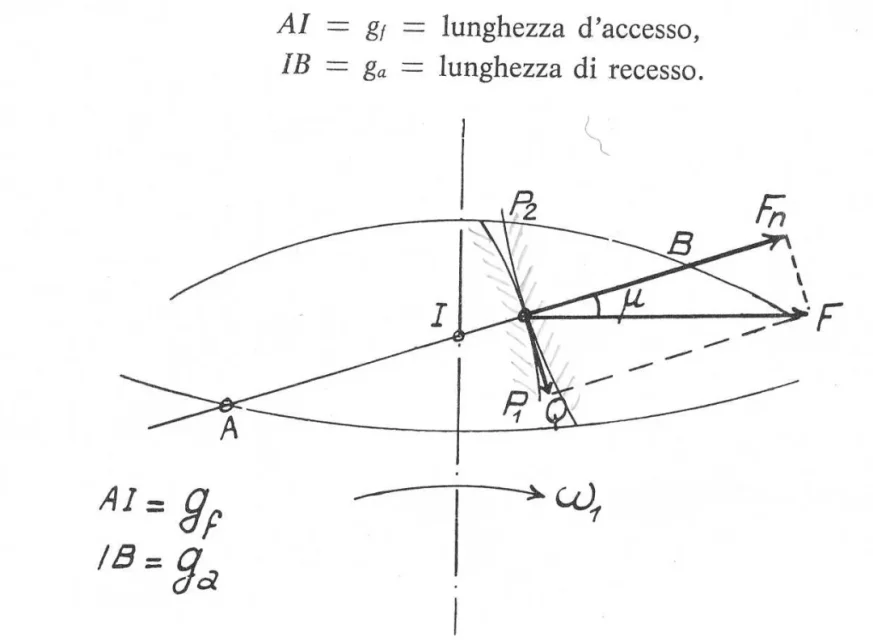
henriot in fact says that the yield is calculated with the following formulas that are then those of buckingham where the friction on the tooth is evaluated according to the crawling in the area of access and withdrawal.
 I believe that in the end it is the method that approaches more than others, although the simplified formula of the first post is almost always more than enough.
I believe that in the end it is the method that approaches more than others, although the simplified formula of the first post is almost always more than enough.simoneorio
Guest
the purpose of the video was to show a dense parametric elliptical wheel (of course I did not manage to parameterize the number of teeth) . sincerely I do not understand how from the video it can be deduced that the elliptical dense wheels are a mechanism to vary the entireness of the trees ... it is clear in the video that at every change corresponds a couple of different gears and therefore the purpose was not to show denworked what it is to doIn these calculations and simulations, I think we have neglected a fundamental fact not only important but indispensable.
These connections with "elliptic" dense wheels are not made to vary the entire shafts, but are used to transmit different and repeatable angle speeds, within a single spin of the shaft.
If the rotational centers were marked, in these simulations it would be noticed how the cleavage varied continuously, when this should be a fixed starting date.
In addition, these gears need a weaving, two elliptical wheels cannot be mounted with both larger horizontal axes, as is shown in a simulation.
a very simple rule to make them, is to ingrain them among themselves at the point where they converge the primitive rays greater than one and less than the other toothed wheel.
instead you can mount two elliptical wheels with both larger horizontal axes, as it turns out in a simulation. look at this other video
simoneorio
Guest
in simulation does not continuously vary the intersection. solidworks motion, change parameter and restart the simulation. the intent of the video was to show that without big problems you can create with solidworks a pair of elliptical gears to evolving parametrised (only limit of my files is that the teeth number is fixed but all other parameters are editable)In these calculations and simulations, I think we have neglected a fundamental fact not only important but indispensable.
These connections with "elliptic" dense wheels are not made to vary the entire shafts, but are used to transmit different and repeatable angle speeds, within a single spin of the shaft.
If the rotational centers were marked, in these simulations it would be noticed how the cleavage varied continuously, when this should be a fixed starting date.
In addition, these gears need a weaving, two elliptical wheels cannot be mounted with both larger horizontal axes, as is shown in a simulation.
a very simple rule to make them, is to ingrain them among themselves at the point where they converge the primitive rays greater than one and less than the other toothed wheel.
On the other hand, two elliptical wheels can be fitted with both larger horizontal axes, as is shown in a simulation and are called elliptical toothed wheels to a lobe.