• This forum is the machine-generated translation of www.cad3d.it/forum1 - the Italian design community. Several terms are not translated correctly.

biella project from foundry

  • Thread starter Thread starter Ivo99100
  • Start date Start date

Ivo99100

Guest
Hello, we are a group of mechanical engineering boys and we have as a task to design a biella disassata da foundria, with the obligation to use a steel for castings. do you have any advice that only the experience can give?

 
What would be a biella disapproved from foundry?
google doesn't help.
If you put a design we understand, since we are not poets but technical.

foundry materials are found qui.
in This is links there are materials for biella.

This is the biella period.
 
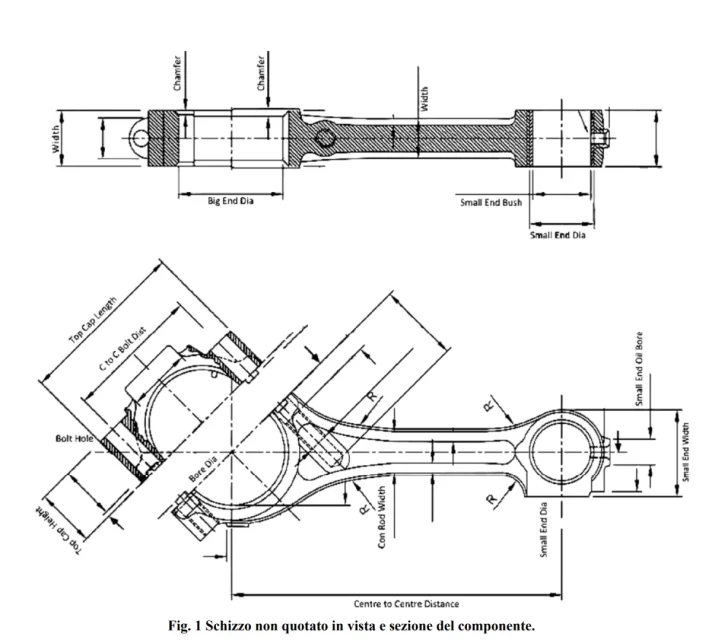
allego element:biella.webpwe have as only given the maximum load on the head of the piston to which our biella will have to resist.
for the design part of measuring verification:
as reasoning we have thought of studying the pin on which this load acts and then dissect it. assuming that the pin is a rested beam and that such force act in the center of it, through a randomly taken safety coefficient (in this case we chose 3 since we do not know what type of use we have to do) and the equation of design verification with multiaxial fatigue, we have obtained the diameter of pin (before cable for 50%). Once we choose the suitable bronzine we have verified the sizing through the annex.
by scruple we searched for an alternative calculation: taking the most solicited section (according to us) of the biella, that is the center of the arm, we have obtained the width of this using the admissible load on safety coeff., assimilating it obviously to a double beam t.
in the first case we have a biella arm of 56cm (maximum load in the head of 400 kn)
in the second case an arm of about 42cm.

I hope it is all clear, and yes, this is the period of the biellas in wisdom.

I also attach design trace, to clarify the doubts about the foundry part:testo lavoro d anno.webpnot having ever faced this design process, we have no comparison, quality that we may be able to find here perhaps.
 
we are all accustomed to the symmetric biellas, precisely because the stem will work mainly in traction) compression even if there are components that make the biella sting (frusted) if the accelerations allow it.
1715106291414.pnghere we have that the closing screws of the lower shell, that is of the hat of the head of biella, are subject to traction.
in your case, you have the cut at 45°.
Will it be an advantage? Will it be okay for certain cycles? surely the screws will be subject to cutting; If you look well, there are laughter and female centrings so as not to make the screws work pure.
This is something not to be neglected.
also has a blind threaded hole that weakens the base of the biella.

all make them differently.... will there be a reason?

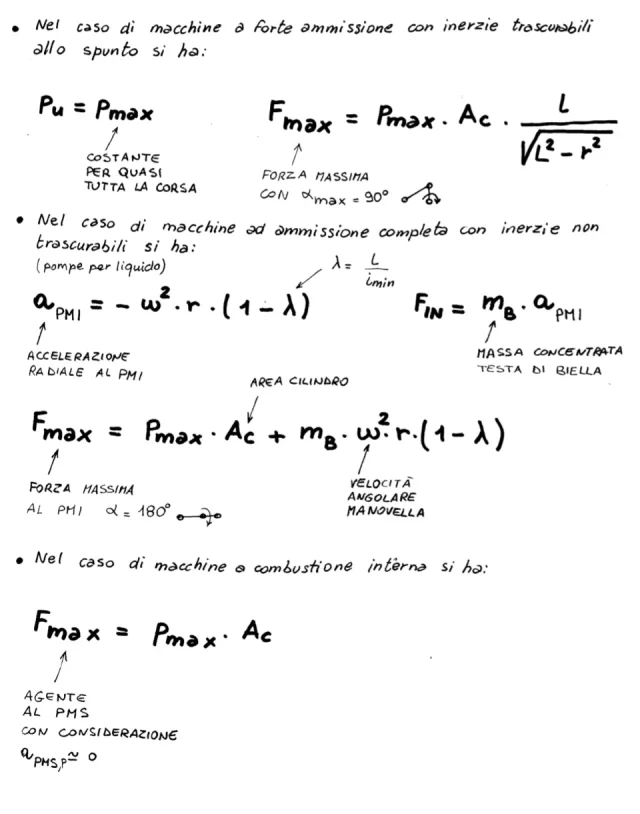
Here below I leave my notes for biella checks. are normally found on design books and manuals.

the evaluation of forces depends whether there are inertias or not relevant.Screenshot_20240507_203236_Drive.jpgif the girls are slow you have:Screenshot_20240507_203333_Drive.jpgif the biella are fast instead it is evaluated:Screenshot_20240507_203353_Drive.jpgand finally a test to fatigue.Screenshot_20240507_203415_Drive.jpg
 
Where is the annex?
Sorry I meant the attached image. we related all measurements, in the first case according to the diameter of the biella eye, in the second according to the width of the arm.
measurements taken directly from the drawing to understand us.
 
diagonal cut biella are used to reduce the head's footprint and allow the extraction (with piston) from the top of the cylinder: vice versa, if the cut is perpendicular to the axis (technically preferable solution), the head may not pass through the barrel of the cylinder and would be removable only base side.
Usually the hat is centered on the stem or with thorns or with other systems of "positive locking" (as in this case, surface to "zig zag" in others); can also be the screw itself to do centering, by means of bold. greases with very precise coupling in the hole should always be expected to reduce bending stress in the screw to the maximum.
the centering (together with the tightening of the screws) is fundamental for a correct assembly of the two semi-guards (lisci) of head.
 

Forum statistics

Threads
44,997
Messages
339,767
Members
4
Latest member
ibt

Members online

No members online now.
Back
Top