• This forum is the machine-generated translation of www.cad3d.it/forum1 - the Italian design community. Several terms are not translated correctly.

pinion sizing, rack, motor and motor

  • Thread starter Thread starter zano777⁶
  • Start date Start date

zano777⁶

Guest
Good morning, I'm a mechanic student of a second degree superior. I am working on a personal project in which I intend to design a concealed automatic gate in the ground (it flows vertically instead of horizontal). I thought of moving it through two electric motors placed on the sides of the gate, exploited lazy and rack as a method of transmission. assuming I have a gate that weighs 280kg, which flows for a length of 1650mm, having a useful thickness of 50 mm on which to place a rack. I started with the project choosing a rack through the catalog of a company (hotel transmissions); the rack, reported in photo, has b×h =40 ×40, a primitive length = 2000mm (which I then shortened to 1650mm using the formulas present in an old discussion of the forum), a module = 4, number of teeth = 160. Starting then from the rack I found a pinion to associate you (reported in photo), assuming as number of teeth = 14.
I determined the force applied through this formula: f=m×g+m×a=2750n
being split on two f/2=1375n engines for each engine.
I then calculated the pair on the pinion: cp =f×r (primitive) = 38.5 nm.
I also found the n rpm of the pinion: n= l/zp×p= 9.4 rpm.
I also determined the speed of the gate through the angle speed: v = w×r=0.028m/s.
finally I determined the required power(fs=service factor=1)(dynamic Yield=0.9 looking through various discussions): (cp/fs)×n2)/ (9550 × 0.9)= 0.042 kw.
was the correct method used?
having this data I went in search of the engine to be applied to you by catologist (reported in photo), taking the t63b. Is the engine enough to give me the necessary torque to move my gate? Do you need a reducer? how to calculate the reducer? Should the pinion be checked down? (if yes, I was a maximum voltage = 35 n/mm2, and comparing it with the yielding voltage values of a steel c45 (about 300÷400 n/mm2) I should be largely safe). thanks for the attention, I apologize for any errors
 

Attachments

  • IMG-20240524-WA0009.webp
    IMG-20240524-WA0009.webp
    59 KB · Views: 34
  • IMG-20240524-WA0008.webp
    IMG-20240524-WA0008.webp
    56.7 KB · Views: 22
  • IMG-20240524-WA0010.webp
    IMG-20240524-WA0010.webp
    106.9 KB · Views: 17
the calculations seem sensible to me, I would make some considerations:
having two motors to be synchronized, otherwise the system will impurities, to do this a motor does as master and the other that chases from slave, this must be done in closed ring therefore with the use of brushless motors that are equipped with encoder, but to move a gate seems to me a pure madness for the costs! Question: Can't you use a single engine that commands the two pinions that you will connect through a tree?
Surely you will need a reducer if you use a motor that will turn at 1400 rpm.
 
I determined the force applied through this formula: f=m×g+m×a=2750n
being split on two f/2=1375n engines for each engine.
there is little difference, but in the calculation you should consider the actual weight of the gate (280 kg) as an agent force on the pinion corresponding to 1400 n of force on pinion ciscun; considers also a performance of the pinion-cremagliera transmission equal to approximately 0.9 so the force on each pinion becomes about 1500 n.
I confirm the risk feared by @ pietro2002 to avoid which it recommends a single gear motor that drives the two connected pinions.
for the choice of the motor you need to have the turns out to the reducer, coincident with those of the pinion and the torque out, consulting the catalogs of the various manufacturers or their configurators, the power of the three-phase motor c.a. to be applied will therefore be based on the two values mentioned above.
Moreover, whether you choose a gear reducer or an endless screw, the engine will have to be self-freshing.
be careful that if you use a single-phase motor you need as well as a higher power even a larger capacitor to ensure the starting point torque.
If you could attach a pattern would be useful.
for the checks of the pinions we wait for the opinion @meccanicamg.
 
Thank you for the answer!
I had thought about doing it with a single engine but then the system seemed unbalanced as the engine would push on one side. I ideally thought of placing the engine inside the columns on the sides of the gate. with only one motor would be more complex to realize the transmission.
 
interesting project... 2 complications come to mind. the first is that it is necessary to try to limit the water that goes inside the pit when it rains if the gate is outside or to foresee a drain in white waters at the bottom of the pit that maybe is not easy to do. the second thing is that the gate will have a length of a few meters and therefore it is necessary to consider also the thermal expansion of the steel during the various seasons of the year. this to say that the verification of the teeth should be done both in the condition of the minimum width of the gate (pignone and cremaliera distant) and in that of maximum width of the gate (pignone and cremaliera neighbors). I leave the word to the experts to correct the cauliflowers I may have shot.
 
very interesting idea, the accounts would seem correct, consider the possibility to adopt a 4 pole @1400rpm with a reducer.
but also carefully evaluates the fact that anything will end in the middle between the gate and its headquarters could obstruct its proper operation over time and it will certainly not be very easy to perform its maintenance
 
If you want to restart the effort on two vertical racks, you can use a motor and a parallel bar, on which the two pinions are mounted.
you must check that the twist bar does not twist too much to avoid phase loss. I do it daily to sync the axes moved by two hydraulic cylinders.

use security factor 1 would say that it is not enough due to dirt, additional accidental loads, the babbeo sitting above.. .
I agree that the engine must have the gearbox. normally you try to turn the engines to 50hz on the nominal turns and the reducer increases the pair and lowers the number of turns to go to as much as you need.

of trade the pinions m=4 are 40mm wide and are in c43 or down there. there are hardened versions but basic are not.
on serious catalogs find the strength that is allowed.
according to the literature to verify a lazy system and rack can be transformed into two gears where the rack becomes a wheel with at least 300 teeth.
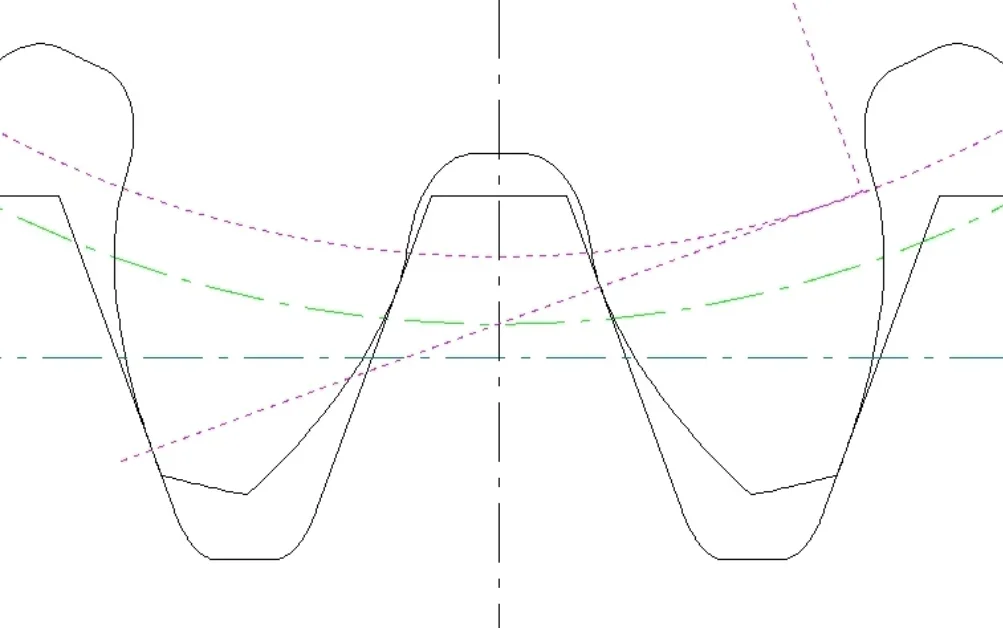
you should know that a gear with 14 teeth under cut:Screenshot_20240524_231941_Chrome.jpgthen we find the base of the tooth narrower and therefore weaker. the alternatives are: number of teeth greater...17...18.... or see with shift of positive profile at least with x=0,2.
I chose m=4, z=14, x=+0,2, b=40 because I am accustomed to making profile shifts and I build gears from a specialized company, in this way increase by about 30% the tooth capacity.
Screenshot_20240524_231714_Chrome.jpgpinion and rack have a bending safety factor on 5000 hours of more than 8 for the pinion and more than 14 for the rack but wear on the pinion is very accentuated and for this it is recommended the surface tempering of 54/56hrc.
also with the free online computer khk gear you get rough the same results with the jis rules.
Obviously dirt, humidity and bad lubrication significantly shorten life.
you can possibly simplify the account using lewiss and make the calculation to wear according to the hardness.
 
if it is an exercise, ok. but if you really intend to implement this application there are many but many more things to consider, especially regarding safety. remaining on the academy, for the sizing of the engine, you should leave, besides the weight of the gate, also from the speed you want it to have. in your calculations, if the race is 1,65 meters, it takes almost a minute before the passage is passable. typically the automatons for sliding gates move them to 12 m/min... your move to 1,68 m/min. you imagine being in the car waiting for the descent of your gate for a minute... I assure you it would seem like an eternity.
 
interesting project... 2 complications come to mind. the first is that it is necessary to try to limit the water that goes inside the pit when it rains if the gate is outside or to foresee a drain in white waters at the bottom of the pit that maybe is not easy to do. the second thing is that the gate will have a length of a few meters and therefore it is necessary to consider also the thermal expansion of the steel during the various seasons of the year. this to say that the verification of the teeth should be done both in the condition of the minimum width of the gate (pignone and cremaliera distant) and in that of maximum width of the gate (pignone and cremaliera neighbors). I leave the word to the experts to correct the cauliflowers I may have shot.
in the project I had thought about the problem of dirt and water, I solved it by building a channel of water drain placed at the base below the gate, with which it went then to pour or in the discharge or in a possible system of recovery of rainwater. for the dirt I had thought instead of simple bands connected through hinges to the gate so as to be able to flow when the gate drops and when it is completely high they come down for their weight.
 
if it is an exercise, ok. but if you really intend to implement this application there are many but many more things to consider, especially regarding safety. remaining on the academy, for the sizing of the engine, you should leave, besides the weight of the gate, also from the speed you want it to have. in your calculations, if the race is 1,65 meters, it takes almost a minute before the passage is passable. typically the automatons for sliding gates move them to 12 m/min... your move to 1,68 m/min. you imagine being in the car waiting for the descent of your gate for a minute... I assure you that it would seem like an eternal
I had also thought about speed, but reaching a speed like that provided by her I thought there were problems related to the inertia of the gate. if this can be solved by applying a plc that regulates opening and closing then I will apply a speed of 12 m/min
 
If you want to restart the effort on two vertical racks, you can use a motor and a parallel bar, on which the two pinions are mounted.
you must check that the twist bar does not twist too much to avoid phase loss. I do it daily to sync the axes moved by two hydraulic cylinders.

use security factor 1 would say that it is not enough due to dirt, additional accidental loads, the babbeo sitting above.. .
I agree that the engine must have the gearbox. normally you try to turn the engines to 50hz on the nominal turns and the reducer increases the pair and lowers the number of turns to go to as much as you need.

of trade the pinions m=4 are 40mm wide and are in c43 or down there. there are hardened versions but basic are not.
on serious catalogs find the strength that is allowed.
according to the literature to verify a lazy system and rack can be transformed into two gears where the rack becomes a wheel with at least 300 teeth.
you should know that a gear with 14 teeth under cut:View attachment 71264then we find the base of the tooth narrower and therefore weaker. the alternatives are: number of teeth greater...17...18.... or see with shift of positive profile at least with x=0,2.
I chose m=4, z=14, x=+0,2, b=40 because I am accustomed to making profile shifts and I build gears from a specialized company, in this way increase by about 30% the tooth capacity.
View attachment 71263pinion and rack have a bending safety factor on 5000 hours of more than 8 for the pinion and more than 14 for the rack but wear on the pinion is very accentuated and for this it is recommended the surface tempering of 54/56hrc.
also with the free online computer khk gear you get rough the same results with the jis rules.
Obviously dirt, humidity and bad lubrication significantly shorten life.
you can possibly simplify the account using lewiss and make the calculation to wear according to the hardness.
thank you so much, so I can keep "the same" lazy adding profile shift as you recommended. what value should I bring back? Considering valid solutions to reduce dirt and water problems, can I reduce this factor?
the safety factor corresponds to the electrical service factor for the nominal power, or for the service factor in the calculation of the required torque?
 
I had also thought about speed, but reaching a speed like that provided by her I thought there were problems related to the inertia of the gate. if this can be solved by applying a plc that regulates opening and closing then I will apply a speed of 12 m/min
but in the end, is it an exercise or do you really think you can achieve it?
 
there is little difference, but in the calculation you should consider the actual weight of the gate (280 kg) as an agent force on the pinion corresponding to 1400 n of force on pinion ciscun; considers also a performance of the pinion-cremagliera transmission equal to approximately 0.9 so the force on each pinion becomes about 1500 n.
I confirm the risk feared by @ pietro2002 to avoid which it recommends a single gear motor that drives the two connected pinions.
for the choice of the motor you need to have the turns out to the reducer, coincident with those of the pinion and the torque out, consulting the catalogs of the various manufacturers or their configurators, the power of the three-phase motor c.a. to be applied will therefore be based on the two values mentioned above.
Moreover, whether you choose a gear reducer or an endless screw, the engine will have to be self-freshing.
be careful that if you use a single-phase motor you need as well as a higher power even a larger capacitor to ensure the starting point torque.
If you could attach a pattern would be useful.
for the checks of the pinions we wait for the opinion @meccanicamg.
I apologize if I'm unclear.
 

Attachments

  • IMG-20240525-WA0008.webp
    IMG-20240525-WA0008.webp
    149.3 KB · Views: 23
  • IMG-20240525-WA0007.webp
    IMG-20240525-WA0007.webp
    129.9 KB · Views: 31
but in the end, is it an exercise or do you really think you can achieve it?
I am thinking purely theoretically as it is a personal project required by the school. I therefore do not think I can achieve it in reality, but I would like to try to realize a truly feasible project
 
I am thinking purely theoretically as it is a personal project required by the school. I therefore do not think I can achieve it in reality, but I would like to try to realize a truly feasible project
ah, ok. because the gate automations are regulated by different regulations, some quite stringent. The photocells alone are not enough to secure an automated gate.
 
ah, ok. because the gate automations are regulated by different regulations, some quite stringent. The photocells alone are not enough to secure an automated gate.
I apologize, I wasn't aware that automatic gate automation was regulated
where can I find these regulations?
Although the project is only theoretical I would like to try to make it applicable, to realize a complete 360° project.
 
thank you so much, so I can keep "the same" lazy adding profile shift as you recommended. what value should I bring back? Considering valid solutions to reduce dirt and water problems, can I reduce this factor?
the safety factor corresponds to the electrical service factor for the nominal power, or for the service factor in the calculation of the required torque?
I don't know what you mean by an actor electric service but if the application works h24 or if it starts 2 times now....or if it has bumps or does not have any tabled service factors.
you can also do unscheduled if you have experience.
 
I don't know what you mean by an actor electric service but if the application works h24 or if it starts 2 times now....or if it has bumps or does not have any tabled service factors.
you can also do unscheduled if you have experience.
where can I find these tables for service factors? around what value should it get around?
I apologize for the trouble
 

Forum statistics

Threads
44,997
Messages
339,767
Members
4
Latest member
ibt

Members online

No members online now.
Back
Top