• This forum is the machine-generated translation of www.cad3d.it/forum1 - the Italian design community. Several terms are not translated correctly.

tolerance on biella

  • Thread starter Thread starter Stan9411
  • Start date Start date
As for the load that would become the interference in the biella head, I see if upon the arrival of new bronzines I can translate (in a similar and practical way ) the formunla that you kindly put in the message and make it an assessment of it; for now I can anticipate this in temporary response.
only one clarification: the very "basic" formula I put serves to determine the maximum size of the bearing, diameter and length: the forcing of the same in the biella head, that is the size of the seat, are usually determined by the manufacturer (or reported on the catalogs in the case of commercial components).
 
hi paul, it seems to me to remember that you work in the field of oil & gas, so I imagine it is alternative compressors for natural gas... a curiosity: in addition to the bronzine of the biella-manovella system you also do a study of inertias and verification of resistance?
Bye!
work in the field of compressors in general, oil & gas sector but not only: mainly alternative machines, although I happen to have to deal with other types of machines.

You mean if we do a study of the inertial forces on the maneuver and gas forces? If I have understood the question the answer is yes, indeed the study of the inertial forces is of fundamental importance for the sizing of the manovellism and for the balance, as well as for the determination of the actions on the ground (which are not negligible and serve the customer to dimensional the structures on which the machines are placed).

Although the machines turn flat (as I said max 1500/1800 rpm, but generally slower still, especially when the power increases), the larger ones have alternate masses that are around 100 kg, and it is easy to understand how important the inertial actions are: in case the machine functions to "empty" (condition that can occur at start or stop) the alternate forces - which are the only ones present in the absence of gas forces, under these conditions - can easily exceed by themselves the load admitted on the spindle or on other parts of the machine, so it is essential to know them in every operating condition.
 
thanks to the paul answer, it was exactly what I wanted to ask you.... do you use any specific software or implement the classic formulas found in literature in excel/matlab?? ? Thanks again
 
the second you have said, considering it up to the second order and for every critical point of the machine (connection piston/steel, rod/head to cross, pushbutton, head of biella, etc.), adding away the respective alternate masses as they “come” along the manovellism. I hope to have been clear 😉
 
some more or less I find myself in the process you described, I had begun to make also a spreadsheet to graphics speed, accelerations, forces and torrent moment, implementing the formulas of the pidatella that was used in 5th above itis... project left in half for lack of time.. .
 
I am not an engineer to forgive me for the practicality of my explanations, as I have also finished the school for many years, so I will try to translate into practical response what I was asking.
in the engine I was talking about, a 2446cc produced from 1985 to 1990 turbo diesel with pot max 63 kw at 4000 turns, and torque max 188nm at 2400 turns that is the area where the turbo and motor realize the maximum, I have a biella neck from 55mm.
data : biella neck 55mm, biella head housing 58.02 mm , bronze thickness declared 2,972 mm. therefore it would be like to say that the game between biella neck and bronze is 0.048 mm. Actually the mother house gives up to 0.06mm and I compare it by measuring 0.08 with new bronzines (which are the best I found, others were worse, with even wider game).
here of course we have a result, but we do not know how precisely I asked in the initial speech the interference between bronzina and biella head that was the beginning of the discussion started from vs. connects to the then student moment.
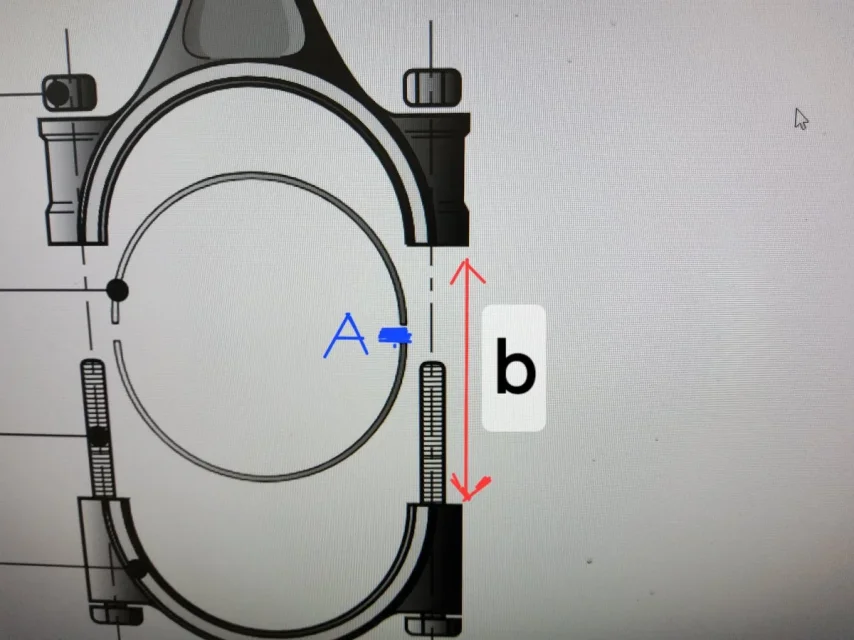
by attaching the photo I point out to you how in the measures I have performed I find the following data:
by tightening the two bronzes (i.e. by canceling to zero the zone to in blue) in the housings, leaning with a slight load on the screws of about 5nm, I find the zone b still slightly open, even after a lock of 30nm (which leads to zero i.e. in total contact the bases) bringing it to rest, liberating the vines, the zone b remains open from both sides of 0.12 mm.
We know that we could not measure them in diamentro, because in their manufacture and elasticity they appear as an ellipse leaning on each other.
Measuring the area b that tightening it generates the interference between bronzine and biella head, we calculate that already to accounts made if the diameter of the housing is 58,02mm will have a circumference of 182,1828 mm (diameter for p greek= 58,02 3,14= 182,1828). if the biella head as first explained advances a game before the tightening (already arranged) of about 0.12mm per side , will be 0.12mm x 2 =0,24mm to be added to the already calculated circumference of the biella head of : 182,1828 + 0.24 = 182,4228 mm = effective circumference to empty without definitive clamping load of the two bronzes. from this we get the hypothetical diameter because it goes in compression tightening the hat of biella, and it will be diameter / p greek = 182,4228/3,14 = 58,096433 . at this point you could imagine an interference of 0.24mm on the diameter that in reality will be finally 0.20mm because I to slightly compensate for the extra tolerance given from the exchanges of manufacture today that I went to play 0.006mm
therefore the real interference of 0.20mm on the diameter is generated by the compression of the two circumferences (bronzines) that with their elasticity compressing generate this resulting. If we were steel with steel it would obviously not be possible such a high value. this would go to show how this interference is the result of the specific design and material of which they are created.
thanks and greetings, luca.
 

Attachments

  • ACCOPPIAMENTO BRONZINA SU TESTA DI BIELLA RISCONTRO FISICO.webp
    ACCOPPIAMENTO BRONZINA SU TESTA DI BIELLA RISCONTRO FISICO.webp
    148.4 KB · Views: 13
Hello forgives the delay but I was super busy. I try to answer you:
data : biella neck 55mm, biella head housing 58.02 mm , bronze thickness declared 2,972 mm. therefore it would be like to say that the game between biella neck and bronze is 0.048 mm.
I imagine that 2,972 mm is already the thickness multiplied by two, otherwise the account does not return:)
We should know the tolerances of the neck, housing and the thickness of the bronzine: Do you know them? the values indicated above are the nominal values (drawing/manual) or result from a measure? in the latter case, the diameter of the housing should be measured by tightening the required screws: did you do it?

based on these answers we then see to continue!
 
Hello forgives the delay but I was super busy. I try to answer you:


I imagine that 2,972 mm is already the thickness multiplied by two, otherwise the account does not return:)
We should know the tolerances of the neck, housing and the thickness of the bronzine: Do you know them? the values indicated above are the nominal values (drawing/manual) or result from a measure? in the latter case, the diameter of the housing should be measured by tightening the required screws: did you do it?

based on these answers we then see to continue!
hello paul and thank you, I reply as follows:

I imagine that 2,972 mm is already the thickness multiplied by two, otherwise the account does not return:)
Yes is the sum of both

One should know the neck tolerances
neck 54,988 / 55,000 and here real we are from 54,99/55,00 measuring in different points

of the housing and the thickness of the bronze: do you know them?
housing 58,000 / 58,021 real measured in different points 58,01 / 58,02

in the latter case, the diameter of the housing should be measured by tightening the required screws: did you do it?
measurement performed 58,01 / 58,02 also increasing in degrees the clamping does not change.

regarding the thickness of bronzine:
It is a real measure with difficulty in the corners, because as soon as I get rude, it measures me badly and increases for the curvature, the ones that were not well are 1,45 / 1,46 that for its double are 2,90 / 2,92 that would confirm the previous problem. I measured these only now, because I measured the result at the head of the closed bile to understand the result and the problem. the last climbed I did not measure them, I had measured the result to bronzine always installed in the head of biella, therefore those ok, it is obvious that they will have a few extra cents to get to the result reached.
Thank you, luca.
 
I have just tried to re-measure the bronzines, and according to what you take to sample we can say further to the measures of the previous message ranging from 1,44 to a maximum of 1,47. of course these have already been mounted and dismantled on the head of biella, so I do not know the effect that can be compression in the closing, if it slightly deforms the edges of coupling or not. those measured are those that I decided not to mount permanently, because I did not trust to leave a game too high, as anticipated at the beginning.
 
with the data you wrote, the minimum game would be 0.06 mm the maximum 0.155 mm: I believe that these values are a false measure of the thickness of the bronzine, which is not easy to carry out. even without counting, the first value seems quite correct (consider that a valid reference, as we said, is nominal diameter/1000), the second seems excessive and unrealistic.
what in the end said law for acceptability or not is the comparison between the diameter of the head hole (with mounted bronzes) tightened in pairs and that of the neck: must be within the range provided by the manufacturer, as you said. Unfortunately, at the distance of years it is difficult to find components with the same manufacturing tolerances of the original ones.
I don't think you have a lot of room for manoeuvre: working the mating surfaces of stem and hat I think you go to deform the housing and to recover the game only on part of the circumference. I'm unbalanced and I say that the 0.08 mm game still seems acceptable to me.

if I succeed in the next few days I try to make a more thorough verification: would you also have engine alesage/race, number cylinders and oil you think you use? if I also had mass of the alternate parts (pistone+fasce+spinotto+seeger etc.) and of the biella with bearings and mounted screws would be top. the temperature of the oil I imagine will wind up on the 110-120 °C max.
 
with the data you wrote, the minimum game would be 0.06 mm the maximum 0.155 mm: I believe that these values are a false measure of the thickness of the bronzine, which is not easy to carry out. even without counting, the first value seems quite correct (consider that a valid reference, as we said, is nominal diameter/1000), the second seems excessive and unrealistic.
what in the end said law for acceptability or not is the comparison between the diameter of the head hole (with mounted bronzes) tightened in pairs and that of the neck: must be within the range provided by the manufacturer, as you said. Unfortunately, at the distance of years it is difficult to find components with the same manufacturing tolerances of the original ones.
I don't think you have a lot of room for manoeuvre: working the mating surfaces of stem and hat I think you go to deform the housing and to recover the game only on part of the circumference. I'm unbalanced and I say that the 0.08 mm game still seems acceptable to me.

if I succeed in the next few days I try to make a more thorough verification: would you also have engine alesage/race, number cylinders and oil you think you use? if I also had mass of the alternate parts (pistone+fasce+spinotto+seeger etc.) and of the biella with bearings and mounted screws would be top. the temperature of the oil I imagine will wind up on the 110-120 °C max.
hello paul and thank you, unfortunately I do not have all the data, because I mounted the engine and started today...
on the weekend I can weigh the old seeger spinotti pistons, but not the biellas.
the engine is picture: 92 x 92. the oil will travel around 100° / 110° normally because they use it on the mountains, I presume to max 120 (max max 125° if they drive uphill). oil is a 10w40.
for the speech of increase of the interference lightening slightly the hats, I have earned 2 cents or almost 2 cents on the biellas, I will never know if the bronzines had generated an effect of possible harmonization (hot) towards the motor tree, I think not, because measuring them empty the diameter was almost coasting, difference 1 cent.
spying also the bronzine becomes risky, I had already tried, but it goes to get caught the certainty about interference and there you enter the risk that at a distance of time they die. . . !
Thank you and good day, luca.
 
hello paul and thank you, unfortunately I do not have all the data, because I mounted the engine and started today...
on the weekend I can weigh the old seeger spinotti pistons, but not the biellas.
the engine is picture: 92 x 92. the oil will travel around 100° / 110° normally because they use it on the mountains, I presume to max 120 (max max 125° if they drive uphill). oil is a 10w40.
for the speech of increase of the interference lightening slightly the hats, I have earned 2 cents or almost 2 cents on the biellas, I will never know if the bronzines had generated an effect of possible harmonization (hot) towards the motor tree, I think not, because measuring them empty the diameter was almost coasting, difference 1 cent.
spying also the bronzine becomes risky, I had already tried, but it goes to get caught the certainty about interference and there you enter the risk that at a distance of time they die. . . !
Thank you and good day, luca.
p.s. a detail of my perhaps fancy, but tidy, it was that I have the obsession that if I had left a larger game, I do not have a parameter that gives me assurance of how the pressure of hot oil will behave with motor at the minimum or low regime, because the car often works with towing and low regime therefore maximum risk of this condition. clear that being a repairer is not mine to test certain things, but the curiosity of how it would behave the pressure of the oil to equal conditions of temperature and graphically in function of every cent in more of the game (example from 6 cents up to 12 cents) on every neck of biella multiplied by 4 cylinders, it is interesting, because the decrease goes first to affect the lubrication in the upper part (castle props, tree to cams, bila .
when I retire maybe I will run 6 times a motor and I will get this satisfaction...:):)
thanks and greetings, luca.
 
in reality a game too wide, in addition to “fuggie” more oil to the sides and then lower the pressure, it also hurts the bearing. The worst conditions are exactly what you say: hot oil, maybe not too viscous, wide game, high loads and low speed (we say around the maximum torque).
 
hello paul, the weight of the piston with spindle and seeger and 971 grams.
Unfortunately for the biella it is no longer possible to know, as it is already in activity. . .
Moreover as it is devoid of two rings on three, if I remedy the two old missing bands (somewhere will be) and I recur the answer tomorrow.. .
thanks and greetings, luca.
 
hello paul, the weight of the piston with spindle and seeger and 971 grams.
Unfortunately for the biella it is no longer possible to know, as it is already in activity. . .
Moreover as it is devoid of two rings on three, if I remedy the two old missing bands (somewhere will be) and I recur the answer tomorrow.. .
thanks and greetings, luca.
piston also complete with elastic bands grams 1002,
Greetings, luca.
 
@luca1234yf I am sorry for my latitude but I was a little caught up in various things;)
below, some engine performance parameters that I calculated from your data:
maximum power [kW]63
maximum speed [1/min]4000
maximum torque [Nm]188
race [mm]92,00
ales [mm]92,00
number cilindri4
times4
unit capacity [cm3]611,6
total cilindrata [cm3]2446,3
travel/loss ratio1,00
piston surface [dm2]0,66
total surface pistons [dm2]2,66
specific power [kW/dm3]25,75
specific power range [kW/dm2]23,69
average speed piston [m/s]12,3
effective media pressure [bar]9,7
In particular, with the pme data I calculated the gas force media agent on the piston, which is about 6500 n (it is actually variable, but just to have a comparison); with the data of the piston mass that you gave me (1 kg) and suming 1/3 of the mass of the biella that I assumed of 1 kg, I get an inertial alternating force of 12600 n approximately to the upper dead point, where it is maximum (in the absence of more precise data, 1/3 of the mass of the biella is considered alternating, 2/3 rotating). from this is evident, as it is often for fast engines, that inertial forces govern the dimensioning: in a 4 times like this, the maximum load is therefore at the end of the exhaust and at the beginning of the aspiration (maximum inertial force, minimum gas force), species in release (motor tending to "ballare", maximum minimum load turns), and is pairs to 12600 n. to this, it is added on the neck the load deriving from the rotating part of the biella, 5700 n approximately, for a total - always to the necks and only 4000 n.

Now I don't know the width of the biella bearing, but I assumed it by 20 mm (I believe realistic) so that I have an average pressure of 16.6 mpa (also this quite realistic): if you have the width data recalculate better this data.

After that, we check how the bearing works with 10w40 to 125 °C.
 
@luca1234yf I am sorry for my latitude but I was a little caught up in various things;)
below, some engine performance parameters that I calculated from your data:
maximum power [kW]63
maximum speed [1/min]4000
maximum torque [Nm]188
race [mm]92,00
ales [mm]92,00
number cilindri4
times4
unit capacity [cm3]611,6
total cilindrata [cm3]2446,3
travel/loss ratio1,00
piston surface [dm2]0,66
total surface pistons [dm2]2,66
specific power [kW/dm3]25,75
specific power range [kW/dm2]23,69
average speed piston [m/s]12,3
effective media pressure [bar]9,7
In particular, with the pme data I calculated the gas force media agent on the piston, which is about 6500 n (it is actually variable, but just to have a comparison); with the data of the piston mass that you gave me (1 kg) and suming 1/3 of the mass of the biella that I assumed of 1 kg, I get an inertial alternating force of 12600 n approximately to the upper dead point, where it is maximum (in the absence of more precise data, 1/3 of the mass of the biella is considered alternating, 2/3 rotating). from this is evident, as it is often for fast engines, that inertial forces govern the dimensioning: in a 4 times like this, the maximum load is therefore at the end of the exhaust and at the beginning of the aspiration (maximum inertial force, minimum gas force), species in release (motor tending to "ballare", maximum minimum load turns), and is pairs to 12600 n. to this, it is added on the neck the load deriving from the rotating part of the biella, 5700 n approximately, for a total - always to the necks and only 4000 n.

Now I don't know the width of the biella bearing, but I assumed it by 20 mm (I believe realistic) so that I have an average pressure of 16.6 mpa (also this quite realistic): if you have the width data recalculate better this data.

After that, we check how the bearing works with 10w40 to 125 °C.
hello paul and thank you for this great evaluation, I measured the width of the bronzines that remained to me, is 26 mm.
with the opportunity seen your calculation, I recovered a compression test that I had done with a pressure sensor connected to the osciloscope module, I had measured all 4 cylinders before disassembling, so first know the real situation and then do the debit evaluations with all disassembled. two cylinders had broken bands with the seats of the bands on the enlarged wear piston, and the best of the two remaining ok is that of which I attach photos I also divided into degrees. It's a photo, otherwise if you send the file you can't see it because it serves the program of the pico, and being the old, I don't even know if it's still downloadable; I don't use the new one because I have the old man for 10 years, and I will slowly train on the new one, so it's a photo.
thanks and good day COMPRESSIONE TOYOTA LAND CRUISER.webpluca.
 
I calculated the operation of the 4000 rpm bearing with only inertial loads hypothesized above:

oil data (sae 10w40 at 110 °C, I think quite realistic):
oil temperature100°c
cinematic viscosity13,3cst (mm2/s)
dynamic viscosity0,011438ns/m2
bearing working conditions under maximum inertial load conditions (4000 rpm, closed gas)
bearing characteristics
nominal diameter [2*R]55,0mm
Length [L]26,0mm
form ratio (l/d)0,47
operating conditions
rotation speed [n]4000Log in
maximum load18,3kn
specific pressure [P]12,80pa
minimum meato height and max 0.155 mm reach
minimum meato height2,23x10-3mm
side flow2,4708[l/min]
minimum meato height and flow rate min 0.106 mm
minimum meato height4,22x10-3mm
side flow0,8631[l/min]
with regard to the minimum height of the meate is quite small values, especially the case with max play: for these conditions, the minimum height value should be about 5-7 microns, so we must expect a high wear (but it is also a limit working condition: the max force is present only for a fraction of a second and only at 4000 rpm).
of course the flow that escapes the sides (at the same pressure of the pump) is much greater with big game, which would be avoided as much as possible and hold around the one per thousand of the diameter of the neck.

if I can, next days we check to maximum torque, where we should have maximum gas forces (smaller than 4000 rpm inertials) but also lower speed, which worsens the operation of the bearing.
 
I calculated the operation of the 4000 rpm bearing with only inertial loads hypothesized above:

oil data (sae 10w40 at 110 °C, I think quite realistic):
oil temperature100°c
cinematic viscosity13,3cst (mm2/s)
dynamic viscosity0,011438ns/m2
bearing working conditions under maximum inertial load conditions (4000 rpm, closed gas)
bearing characteristics
nominal diameter [2*R]55,0mm
Length [L]26,0mm
form ratio (l/d)0,47
operating conditions
rotation speed [n]4000Log in
maximum load18,3kn
specific pressure [P]12,80pa
minimum meato height and max 0.155 mm reach
minimum meato height2,23x10-3mm
side flow2,4708[l/min]
minimum meato height and flow rate min 0.106 mm
minimum meato height4,22x10-3mm
side flow0,8631[l/min]
with regard to the minimum height of the meate is quite small values, especially the case with max play: for these conditions, the minimum height value should be about 5-7 microns, so we must expect a high wear (but it is also a limit working condition: the max force is present only for a fraction of a second and only at 4000 rpm).
of course the flow that escapes the sides (at the same pressure of the pump) is much greater with big game, which would be avoided as much as possible and hold around the one per thousand of the diameter of the neck.

if I can, next days we check to maximum torque, where we should have maximum gas forces (smaller than 4000 rpm inertials) but also lower speed, which worsens the operation of the bearing.
Thank you, luca.
 
Sorry, I put 1 like, and I ran out the quota+ key on the last message above and on my photo, I don't know what it's for or what it does... Sorry
 

Forum statistics

Threads
44,997
Messages
339,767
Members
4
Latest member
ibt

Members online

No members online now.
Back
Top