
• This forum is the machine-generated translation of www.cad3d.it/forum1 - the Italian design community. Several terms are not translated correctly.

analysis finite elements alternative volumetric compressor

  • Thread starter Thread starter Strego
  • Start date Start date

Strego

Guest
Good evening, everyone.
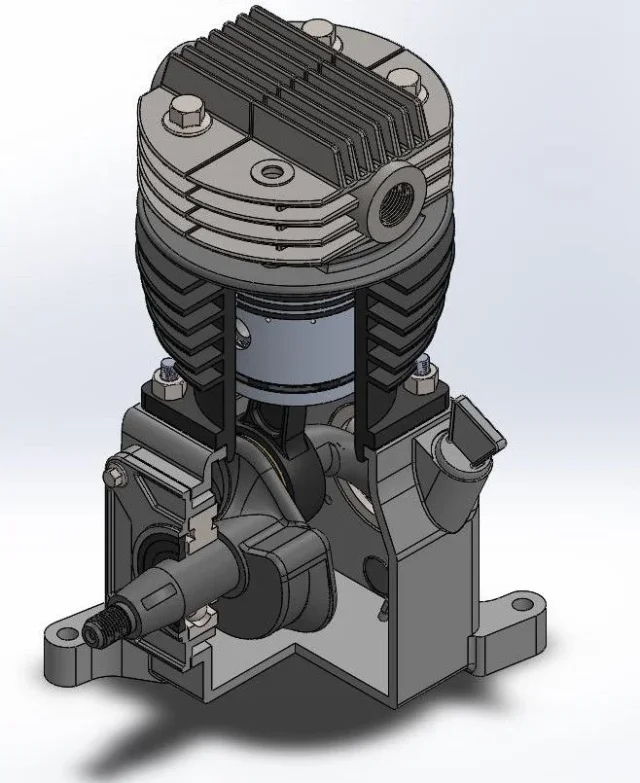
I created a 3d model of an alternative volumetric compressor. Now I have to proceed with a structural analysis. in particular the case.
I hypothesized 8 bars like pmax. the max temperature (to be inserted as heat load) is about 550 k. the swept volume is 1.64e-4 m3, the race 42mm. as rpm I hypothesized 3000.
in the house I will have the following loads: 1)supports: force weight of all parts + force deriving from pressure 2)force weight of everything except case + pressure 3) clamping forces on side and top faces

the force deriving from the pressure I calculated it and is pairs to 3079n. I don't know how to calculate them.

Can you tell me if the values so far are similar and how to adjust for the locks? Thank you.Quarter section.webp
 
Hi.
in a compressor, but also in most machines, the weight force is usually never considered, because it is negligible compared to other forces.

the first seal to be considered for the structural dimensioning of a compressor is the "gas force", given by the pressure product in the room for the piston area. In your case, since the machine is simple effect, the pressure is maximum at the pms and equal to the pressure of dispatch (plus the load losses to the valves), and minimum to the pmi, where it is equal to the suction pressure (less the load losses to the valves). of course the pressure varies with the rotation angle of the shaft, but the maximum and the minimum in general you have them at the points I told you. the gas push "closes" in the machine, as it weighs on one side on the counter supports, on the other on the cylinder head: your base therefore is "longed" under the effect of gas force, fatigued: this force determines the load (satisfactory) for example on the rods of the cylinder head, from which flows the value of the preload and therefore of the minimum tightening couple of these. By dismantling forces on tacticalism, you can then get the "gas actions" on all other components. you will also realize that - due to the inclination of the biella - you will also have an agent gas push perpendicular to the shirt in correspondence of the piston coat, which pairs with an equal and contrary force applied to the counter supports: This couple (reaction pair) would tend to rotate the base, and is contrasted by the supports of this (and hence by "where you need to take" the necessary information to dimensional the base's wallpapers).

the second corporal are the inertial forces: on the organs of manovellism also act inertial actions (I refer you to any book of applied mechanics or manuals to determine them). alternate ones (piston, spindle, part of the biella) vary according to the angle of rotation, and are algebraically added to the gas forces, sometimes decreasing them (e.g. at pms and pmi - only for double-acting machines), sometimes increasing them (e.g. at pmi in a simple effect machine): also these - because of the inclination of the biella - give you a couple of reaction on the base that must therefore be contrasted, but - on the contrary of the gas - do not "close in the machine", and are carried out outside through the counter supports (and the already mentioned reaction couple), and are responsible for the vibrations transmitted to the ground.
rotary ones (shaft and part of the biella) should instead be balanced with counterweights, and do not generate forces on the supports. with monocylinder then you have no pairs of inertia to worry about, as long as you have the symmetrical tree.
Even inertial forces are maximum (or minimum) at the dead points, so at this point you can easily get the resulting force: be careful that if the machine works at variable speed (under inverter), you must consider the worst condition regarding the resulting force.

for the locks you first calculate the loads agents: as a general rule, I consider multiplying them by 2.5 if the load is fatigued, and I consider this result as the total value of the preload to be entrusted to the coupling: knowing then the maximum precarious ones sustainable from vines of a given class (corresponding for example to a yield of 90% of the tie: you can find different tables for example on niemann or shigley but also in other manuals) you will find a combination of pulling diameter/number that meets the first condition, and then find the preload for single-tier. the torque m (which in your analysis should not serve you) you can then calculate approximately with m = 0.18vd, where v is the preload and of the nominal diameter of the thread. this for a first dimensioning: obviously the accurate verification of the coupling should be made, considering the rigidities.
 
a special load condition is that of vacuum machine: since a compressor generally leaves a vacuum ("without pumping", thanks to the opening of a bypass valve) so as to reduce the torque of the point of the engine, you have a condition (more or less long) in which only the inertial forces are present, which then completely change the state of stress of the tactical organs: It is also advisable to check this condition (which gives rise to traction loads), which for machines with a simple effect, with a manovellism working almost always in compression, could be critical.

the so-called "pump rod", algebraic sum of gas thrust and inertial thrust of the alternate masses as well (and as these vary according to the rotation angle) is therefore the starting point of the structural dimensioning of each alternative machine.
 
a special load condition is that of vacuum machine: since a compressor generally leaves a vacuum ("without pumping", thanks to the opening of a bypass valve) so as to reduce the torque of the point of the engine, you have a condition (more or less long) in which only the inertial forces are present, which then completely change the state of stress of the tactical organs: It is also advisable to check this condition (which gives rise to traction loads), which for machines with a simple effect, with a manovellism working almost always in compression, could be critical.

the so-called "pump rod", algebraic sum of gas thrust and inertial thrust of the alternate masses as well (and as these vary according to the rotation angle) is therefore the starting point of the structural dimensioning of each alternative machine.
Thank you very much. It was incredibly accurate and exhaustive. After an interview with the professor of the course we have come to conclude that a not too detailed analysis is sufficient. I used only the force coming from the pressure, applying it on the lower supports, on the cylinder supports and in the bearing housings. I’m working on femap. I’ll attach you a screen of the result obtained for total translation.1525978399651.webp
 

Forum statistics

Threads
44,997
Messages
339,767
Members
4
Latest member
ibt

Members online

No members online now.
Back
Top