• This forum is the machine-generated translation of www.cad3d.it/forum1 - the Italian design community. Several terms are not translated correctly.

analysis on particular harmonic steel

  • Thread starter Thread starter Daniele-san
  • Start date Start date

Daniele-san

Guest
Hello.
I wanted to know if someone can help me with an analysis (stress/snervation) of a very small size in harmonic steel (the one used for contacts of the batteries stylus or button to understand us)

thanks to all
Hi.
 
Maybe you should better explain what you need. component geometry, loads and constraints, type of analysis, what help you need. otherwise I doubt you may receive an answer
greetings
 
Maybe you should better explain what you need. component geometry, loads and constraints, type of analysis, what help you need. otherwise I doubt you may receive an answer
greetings
thanks for the surgery,
I would have shared an image and model 3d as soon as any of the forum interested to give me help
Could I send it to you?
 
you do not have to send it to me, but post it on the forum where everyone can contribute and give their contribution. beyond learning from what is discussed
 
you do not have to send it to me, but post it on the forum where everyone can contribute and give their contribution. beyond learning from what is discussed
Sure. .
the flat part of the spring flows parallel to the horizontal plane being subjected to a force of 10/12kg
the particular is stuck on the semicircular part
questions:
1. how does the theoretical packing of the "sinusoid" occur as a result of the thrust and a stroke of 2.6mm?
2. the particular in harmonic steel (type that of contacts for batteries stylus or button) returns to the starting position naturally?
3. after 1,000k cycles a/r creates a deformation?

if no information please let me know
thanks for the help
 

Attachments

Sure. .
the flat part of the spring flows parallel to the horizontal plane being subjected to a force of 10/12kg
the particular is stuck on the semicircular part
questions:
1. how does the theoretical packing of the "sinusoid" occur as a result of the thrust and a stroke of 2.6mm?
2. the particular in harmonic steel (type that of contacts for batteries stylus or button) returns to the starting position naturally?
3. after 1,000k cycles a/r creates a deformation?

if no information please let me know
thanks for the help
Nobody?
Thank you.
Hi.
 
I don't think anyone here is doing free analysis. cad3d is a site of exchange, enrichment where you compare to learn. I don't think it's usual for someone to do the work of others, free of charge.
Anyway, good luck
 
I don't have much time, but I can help you make reasoning.
I don't know what software you use but I can recommend freecad 0,19 that is absolutely free and open the file step and saved. then open the workbench fem and start setting material, mesh, constraints and applied force.
at this point write the input file and throw the solutor calcullix. if you like more you can install bconverged calcullix that you can use it later to open the file frd and view and handle results more fully.
at the end of the simulation you can see the result of the analysis and see the shift and tension of von mises, for example and you can make a first static assessment of what happens.
if the behavior is not linear, you have the possibility to evaluate the non-linearity of the study and also of the materialScreenshot_20191007_223840.webp(so if you have the true curve of the material you can use it and insert it as series of three points or more points if you edit the file inp).
If you want curve theory you can go qui and look for your material or determine the curves with excel.
I remember that the values to be inserted in the simulation curve are with mises and eps (equivalent plastic elongation defined as the difference between total elongation and elasticity, compared to actual plasticization. It is worth 0 with rp0,2 and simplified it is calculated as a square root of 2/3 multiplied by plastic elongation).
using the true curve you can see if there are areas that plasticize and with those you can make some dynamic reasoning.
If there are no plasticized areas it means that there will be no permanent deformations.
 
Last edited:
I don't have much time, but I can help you make reasoning.
I don't know what software you use but I can recommend freecad 0,19 that is absolutely free and open the file step and saved. then open the workbench fem and start setting material, mesh, constraints and applied force.
at this point write the input file and throw the solutor calcullix. if you like more you can install bconverged calcullix that you can use it later to open the file frd and view and handle results more fully.
at the end of the simulation you can see the result of the analysis and see the shift and tension of von mises, for example and you can make a first static assessment of what happens.
if the behavior is not linear, you have the possibility to evaluate the non-linearity of the study and also of the materialView attachment 54752(so if you have the true curve of the material you can use it and insert it as series of three points or more points if you edit the file inp).
If you want curve theory you can go qui and look for your material or determine the curves with excel.
I remember that the values to be inserted in the simulation curve are with mises and eps (equivalent plastic elongation defined as the difference between total elongation and elasticity, compared to actual plasticization. It is worth 0 with rp0,2 and simplified it is calculated as a square root of 2/3 multiplied by plastic elongation).
using the true curve you can see if there are areas that plasticize and with those you can make some dynamic reasoning.
If there are no plasticized areas it means that there will be no permanent deformations.


ciao MechanicalThank you first!
I am trying to use it I wanted to ask you some info if you have time to answer
it is not said that the evidence he is doing is 100% right
once started and finished the calculix solutor how I can get the file frd ?
I downloaded the bconverged calcullix but despite the fact that the folder in the installation directory is not found the startup icon of the wrong program in something?
 
when you write the inp file you must then click on the calculation start command and wait for it to end.
Once finished, in the calculation folder you find the frd file and click on it and he opens it natively with bconverged. has no icon the executable....is an integrated system mixed with console in ms-dos / windows.
 
After writing inp you have to press calculix.
first set the folder where you want all its saved....maybe in the project folder and not in the default folder so you find them.
I put you image taken from one of the reference sites.Screenshot_20191008_185920.webpKeep in mind that you find everything on wikipedia, all the explanations of the various workbench and the procedures of the main things.
then on youtube find all the tutorials for how to do the various things.
 
I tried to make a few fems to figure out how this item goes.
First I framed the tab back and kept the tab aligned on a plane with only normal reaction as indicated by you and loaded with a force f the front.
simulations are linear. as first I find myself applying 10kg i.e. 100n to the model I have a compression 0.2 mm and not value 2.6 that you indicated.100N.webpso I think we are wrong the load to apply, then it will be 100kg = 1000n and see what happens.
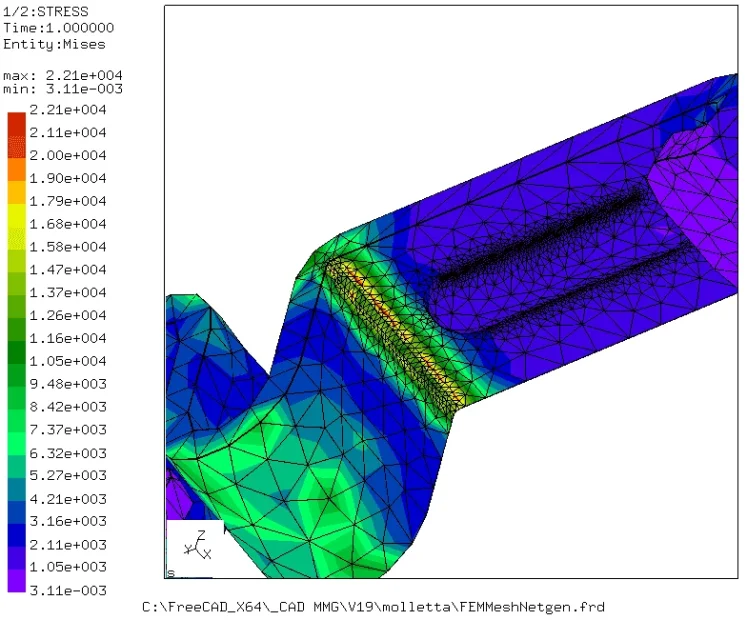
1000N.webpnow we find ourselves a move 2,35 mm....when we are there but the tensions of von mises? we have spikes 22100pa in the lower range of the horizontal tab (impossible to resist these values).VM1000N.webpat this point there are considerations to be made:
- to understand better you would need to refine the mesh at that point and see if the values are stable or not
- take the mechanical characteristics of steel and realize a non-linear fem
- maybe the loads are excessive, maybe you should not do 2,6 mm maybe something in the data is wrong

we look for the mechanical characteristics of a silicon steel for springs 52 (rm=2500mpa rp0.2=1780mpa and a=5%) and we get all the parameters to insert into the simulator using the true curve and then realize a completely non-linear fem.acciaio_molla.webpon the first lap the fem provides as error the fact that there are differences in iterations. therefore we pass from the method of calculation of the matrices from standard a....all...including that iterative....nothing to do then we fit the mesh and see what happens....nothing to do. it is necessary to lower the load and try to set it to 200n.plastc_200N.webphere we can see the areas subject to plasticization, that is that they have tensions of von mises greater than the yielding (rp0.2) and that they are in the field of elasto-plastic deformations.
by definition all that is plasticized maintains a certain permanent deformation that will never return to the origin. in this case you have a compression of about 0,94 mm.

the results we obtain are more correct than a linear analysis because at equal epsilon elongation correspond to the lowest tensions and this means that we are using the plastic field of the material.

definitely in all of this there are project data that must be checked taxally.
 
I tried to make a few fems to figure out how this item goes.
First I framed the tab back and kept the tab aligned on a plane with only normal reaction as indicated by you and loaded with a force f the front.
simulations are linear. as first I find myself applying 10kg i.e. 100n to the model I have a compression 0.2 mm and not value 2.6 that you indicated.View attachment 54971so I think we are wrong the load to apply, then it will be 100kg = 1000n and see what happens.
View attachment 54972now we find ourselves a move 2,35 mm....when we are there but the tensions of von mises? we have spikes 22100pa in the lower range of the horizontal tab (impossible to resist these values).View attachment 54973at this point there are considerations to be made:
- to understand better you would need to refine the mesh at that point and see if the values are stable or not
- take the mechanical characteristics of steel and realize a non-linear fem
- maybe the loads are excessive, maybe you should not do 2,6 mm maybe something in the data is wrong

we look for the mechanical characteristics of a silicon steel for springs 52 (rm=2500mpa rp0.2=1780mpa and a=5%) and we get all the parameters to insert into the simulator using the true curve and then realize a completely non-linear fem.View attachment 54975on the first lap the fem provides as error the fact that there are differences in iterations. therefore we pass from the method of calculation of the matrices from standard a....all...including that iterative....nothing to do then we fit the mesh and see what happens....nothing to do. it is necessary to lower the load and try to set it to 200n.View attachment 54976here we can see the areas subject to plasticization, that is that they have tensions of von mises greater than the yielding (rp0.2) and that they are in the field of elasto-plastic deformations.
by definition all that is plasticized maintains a certain permanent deformation that will never return to the origin. in this case you have a compression of about 0,94 mm.

the results we obtain are more correct than a linear analysis because at equal epsilon elongation correspond to the lowest tensions and this means that we are using the plastic field of the material.

definitely in all of this there are project data that must be checked taxally.
mechanical good

I thank you for the analysis and comments, I press that of fem I do not understand anything, I wanted to understand if we are going in the right direction, because I do not understand the increase to 100kg to bend (close) the sinusoidal zone, a lamella of 0.3mm
take into account that already 10kg are abundant for the function you have to have.
 

Attachments

  • 1256.webp
    1256.webp
    25.1 KB · Views: 4
from fem analysis a load of 10kg i.e. of 100n does not produce 2.6mm shortening. These are the data you gave us at the beginning, that with 10/12kg you had to compact 2,6mm... or do I read wrong?Screenshot_20191104_193012.webpScreenshot_20191104_192946.webpwith 100n is compact of only 0.2mm via fem.
What do you want to do? force or move?
I think the values you gave us are not compatible. It may be that the fem is not accurate, we also put a 50% error if not set correctly....but we are not yet.

to make 2,6mm of excursion takes 1000n i.e. 100kg but the tensions are exaggeratedly high, so something does not return....maybe only the step model.
 
from fem analysis a load of 10kg i.e. of 100n does not produce 2.6mm shortening. These are the data you gave us at the beginning, that with 10/12kg you had to compact 2,6mm... or do I read wrong?View attachment 55062View attachment 55063with 100n is compact of only 0.2mm via fem.
What do you want to do? force or move?
I think the values you gave us are not compatible. It may be that the fem is not accurate, we also put a 50% error if not set correctly....but we are not yet.

to make 2,6mm of excursion takes 1000n i.e. 100kg but the tensions are exaggeratedly high, so something does not return....maybe only the step model.
Good morning.
thanks again for the comment
Regardless of the results of the fem analysis it seems strange to me that the part of the sinusoidal lamella cannot compress with the application of a force of 10kg

Thank you.
 
for me the model of mechanicsmg will never correctly approximate reality: a sheet of 0.3 mm thick shaped with solid elements, tetrahedral, I also bet of order 1. for longer all development there is only one element along the thickness. absolutely insufficient to properly shape the compression and bending of that spire. It is clear that the model is much more rigid than we can imagine in reality: a sheet thickness 1/3 of steel millimetre for springs the snap between two fingers without developing 10 kg of force, figure 100.

I would evaluate to extract from the step a shell model (or draw one based on the step) where the thickness and number of knots in the thickness are inserted as variables. It is also important to try to use square order elements in this situation.
lighter model, I bet no convergence problem in using a solutor for non-linearity and management of the mesh much more accurate.
 
spring.webpmade to the flight using the average axis of the profile (simplified in several details), with a version for students limited in the number of nodes and in the choice of the type of element (however guaranteed three knots = 2 elements along the whole thickness, unfortunately of order 1), incarceration posteriorly, load of 100 n distributed along the front line : 1,059 mm compression.

you can definitely review the type of application of the load (even the enclosure on the whole back surface does not convince me so much) and make an analysis of convergence by increasing, number and order of the elements and you should achieve realistic results. if then this result is actually 2.6 mm I don't know and I don't think.
 

Forum statistics

Threads
44,997
Messages
339,767
Members
4
Latest member
ibt

Members online

No members online now.
ciao
Back
Top