• This forum is the machine-generated translation of www.cad3d.it/forum1 - the Italian design community. Several terms are not translated correctly.

angle reference design

  • Thread starter Thread starter np426
  • Start date Start date

np426

Guest
Good evening to all, my name is nicola and I am a mechanical engineering student.
I am facing the design of an angle reference at 90° with 1 pair of straight tooth conical wheels, of which I know:
- engine power: 0.55 kw
-Input number: 1380
- Couple. 3,81 nm
-transmission ratio: 10
- Yield: 0,95
- working hours: 16
-type of load: lightweight
- useful life: 50,000 hours

from the calculations I got:
conductor: 17 teeth, dn 25.5mm, delta 5,71°
conduct: 170 teeth, dn 255mm, delta 84,29°

I chose radial ball bearings as they respect loads (I checked on skfbearingselect.com):
-conductor skf 6202
-conduct skf 6003

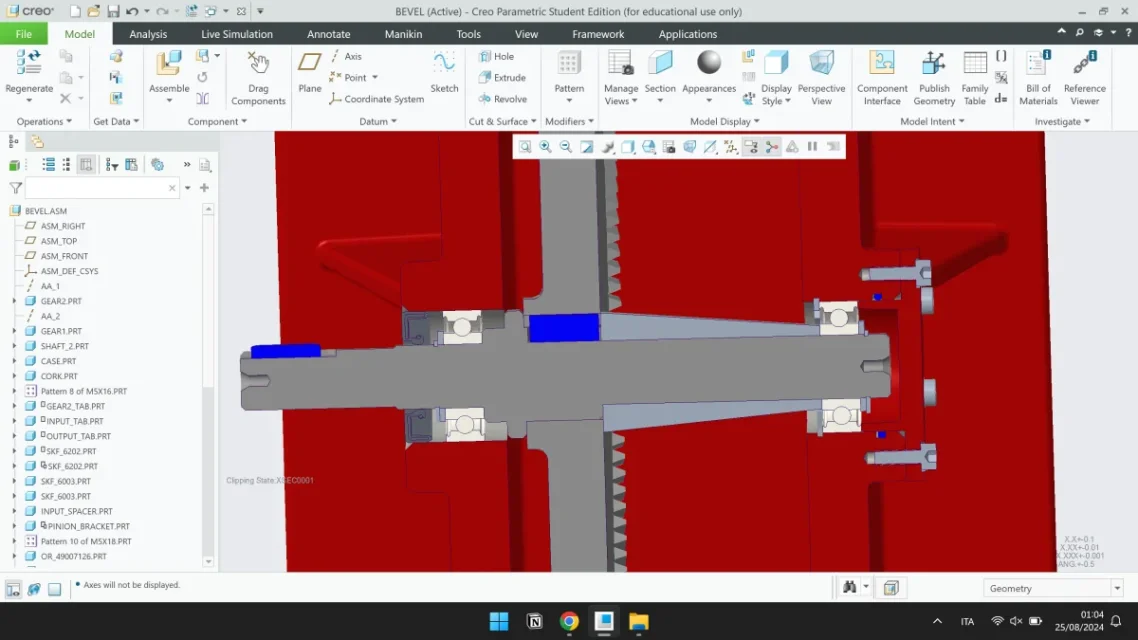
I attach the cad section I've made, do you have advice on how to improve it?
Thank you.
 

Attachments

  • Riduttore.webp
    Riduttore.webp
    23.6 KB · Views: 45
Last edited:
Bye. as first impact, the reduction ratio of 10 is very high. this in fact turns out the crown conducted very large and disproportionate to the exit shaft.
bearings, ball bearings are not indicated to have a high rigidity, however being pushed in all directions. then maybe at the load level we can also be but it probably allows a slightly more accentuated oscillation and therefore risks that the enlargement of the teeth is not right and therefore wear the teeth quickly.
There is to say that we are all accustomed to heavy-duty gearboxes and so we are more accustomed to seeing more robust solutions and here we are the ones who have to make a mental effort to adapt to a more "moderate" mechanical demand.

interpreting the data you entered we have:Screenshot_20240824_085627_Microsoft 365 (Office).webp
 
Last edited:
observing well I have seen some merits, as the fact of having a "ceiling" bearing then stuck axially and the other "carrello" free to move if you stretch the tree with the heat. The classic solution for heavy applications often involves the use of frame bearings.
as the determination of the operating center is a virtual point that could differ from the theoretical one, it becomes necessary on the two axes (at least on one) to have the possibility to approach and remove the whole axis (e.g. all the sprocket package with bearings that you rightly put in a sleeve).

this ensures the perfect ingration, low noise, optimal working games and if you wear it you can correct after roding and register the magnification again.

I'm missing a detail because I don't have all the views available: the wheel conducted, how is it stuck axially on the exit shaft? I don't understand. you must not move or lose the engraving.

the lids that stick and must pass on the o-ring need a bevel at 20° in favor of invitation. If you look at a catalog you can get an idea of the size. if it is not present, the flange stops and if hammers cuts the seal.

a tip for flanges: you have the holes to put the screws, but also make two threaded holes for the extraction of the lids.

This is a heavy industrial reducer from which you can peek some things but it is not that you have to do the same because it is much more to read yours.
1724488635418.png
 
Last edited:
observing well I have seen some merits, as the fact of having a "ceiling" bearing then stuck axially and the other "carrello" free to move if you stretch the tree with the heat. The classic solution for heavy applications often involves the use of frame bearings.
as the determination of the operating center is a virtual point that could differ from the theoretical one, it becomes necessary on the two axes (at least on one) to have the possibility to approach and remove the whole axis (e.g. all the sprocket package with bearings that you rightly put in a sleeve).

this ensures the perfect ingration, low noise, optimal working games and if you wear it you can correct after roding and register the magnification again.

I'm missing a detail because I don't have all the views available: the wheel conducted, how is it stuck axially on the exit shaft? I don't understand. you must not move or lose the engraving.

the lids that stick and must pass on the o-ring need a bevel at 20° in favor of invitation. If you look at a catalog you can get an idea of the size. if it is not present, the flange stops and if hammers cuts the seal.

a tip for flanges: you have the holes to put the screws, but also make two threaded holes for the extraction of the lids.

This is a heavy industrial reducer from which you can peek some things but it is not that you have to do the same because it is much more to read yours.
View attachment 71899
Thank you very much for the advice, I correct the existing problems.
So should I use conical bearings by preloading them? (I do not reach the axial thrust necessary for their proper functioning)
how can I approach the axis by exploiting the lazy package I created?
 
I wouldn't change the bearing type. you said you don't get to the minimum load so if you use a tapered roller, you're obliged to charge much more than one ball, as well as having a lower performance.
for the registration of the pipe you can put a pelabile seal or a disk to be able to rectify. see the two blue lines.Screenshot_20240824_132033_Chrome.jpgincreasing or decreasing the thickness approaching or moving everything (spring and bearings) to the center.

try to look for other discussions about the orthogonal gearboxes we discussed on the forum and maybe find something to add....livelli oil, gaskets... .
 
the second axial locking of the crown had just escaped me. looking at the attached photo: Is it better to move the shoulder on the left of the wheel, to decrease the diameter of the shaft I have where there is the current shouldering and to create a spacer that blocks me axially also the inner ring of the right bearing?
(I attach photos hoping you will understand)
See a better way?
 

Attachments

  • 1.webp
    1.webp
    30.5 KB · Views: 16
  • Bloccaggio ruota.webp
    Bloccaggio ruota.webp
    24.7 KB · Views: 17
or keeping the current configuration and using a locking ring, I should fill the shaft even where I have the tab seat and do not know if it is possible as processing.
other choice could be the use of a larger bearing (left of the wheel) so as not to have problems with the spacer
 
Last edited:
the second axial locking of the crown had just escaped me. looking at the attached photo: Is it better to move the shoulder on the left of the wheel, to decrease the diameter of the shaft I have where there is the current shouldering and to create a spacer that blocks me axially also the inner ring of the right bearing?
(I attach photos hoping you will understand)
See a better way?
 

Attachments

  • prova.webp
    prova.webp
    21.8 KB · Views: 18
the second axial locking of the crown had just escaped me. looking at the attached photo: Is it better to move the shoulder on the left of the wheel, to decrease the diameter of the shaft I have where there is the current shouldering and to create a spacer that blocks me axially also the inner ring of the right bearing?
(I attach photos hoping you will understand)
See a better way?
as you did here now is correct. a tip for the seeger: if you want them to carry 100% of the load always insert a spacer to live edge (a bava puzzle 0.2x45° or similar) between the object (engineering) and the seeger.

See you qui. manual seeger qui post #9.

per la teoria dei seeger ti consiglio seeger rings - a designer's handbook che trovi anche in rete.
 
or keeping the current configuration and using a locking ring, I should fill the shaft even where I have the tab seat and do not know if it is possible as processing.
other choice could be the use of a larger bearing (left of the wheel) so as not to have problems with the spacer
Also this is an option, that of the threaded wreath more small space.
 
as you did here now is correct. a tip for the seeger: if you want them to carry 100% of the load always insert a spacer to live edge (a bava puzzle 0.2x45° or similar) between the object (engineering) and the seeger.

See you qui. manual seeger qui post #9.

per la teoria dei seeger ti consiglio seeger rings - a designer's handbook che trovi anche in rete.
Thanks again for the answer.
the option of the washer between bearing and seeger I used it in the pinion (first photo), I will also extend it to those of the crown.
 
Also this is an option, that of the threaded wreath more small space.
in this regard we have a corner head of an old manual milling machine of which we have an internal design where it shows the use of the wreath to lock. See you qui.
definitely the solution with the wreath is more robust than the one with seeger and has the advantage of being more rigid. clearly has a higher cost.
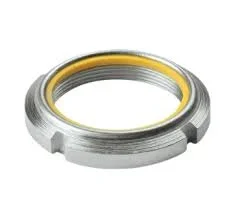
not to use safety rosettes 1724537237341.webpand then avoid additional caves, I suggest you use wreaths with type kmt grain of skf.1724537192864.webpor you can use special spieth needles in the version with front locking rather than other systems.

recently replaced the guk wreaths 1724537591546.webpthat are not of precision but self-locking with nylon element to deform, with a series completely made of steel with the possibility to have the elastic return of the thread and therefore you can mount and disassemble all the times you want but has a cost less than the kmt. is the flat lock series that is coming out in these months.

in general, being fine step need to always have a jump of at least 0.5-1mm on the diameter between the calettamento diameter of the wheel conducted and the thread. in this way the insertion takes place without shadow of interference.
It is also true that if the cylindrical part is for example 40h6 you will have that the m40x1.5 thread will still have the outer diameter that will be 40 -0,05/-0,1 approximately and this allows the passage of the gear with hole 40g6....but the margin of play and ease of assembly is reduced.

I would like to, if @terastore e @ pietro2002 They were not in vacation, to give us their precious contribution in this discussion.
 
regarding the lubrication, it will be in the bathroom from oil I imagine and not to fat.
It will be good that you define how far you get with the level.
I think the first picture you posted is how the reducer will be used, as I mean.

the considerations to be made are:
- if it had been a low reduction ratio (1...3...5) you could get with the wire oil of the input axis balls
- with the fact that the driven wheel is great it would perhaps be better to stay low with oil and put an electric pump or mechanical recirculation to lubricate high bearing and ungrazing.... but this has a cost
- you might think to fill the same as at step one and to add oil hold tanks but you can always do it only on the input axis
- think of grease lubricating the upper shaft bearing output
- I would exclude total filling with oil because it would shake a lot and not having vent would discharge the overpressure from the seals making them lose

as you see there is no unique solution and a decision must be taken. I don't see where you put the level spy and the load cap (and whether it has the vent or not).
 
Good evening to all, my name is nicola and I am a mechanical engineering student.
I am facing the design of an angle reference at 90° with 1 pair of straight tooth conical wheels, of which I know:
- engine power: 0.55 kw
-Input number: 1380
- Couple. 3,81 nm
-transmission ratio: 10
- Yield: 0,95
- working hours: 16
-type of load: lightweight
- useful life: 50,000 hours

from the calculations I got:
conductor: 17 teeth, dn 25.5mm, delta 5,71°
conduct: 170 teeth, dn 255mm, delta 84,29°

I chose radial ball bearings as they respect loads (I checked on skfbearingselect.com):
-conductor skf 6202
-conduct skf 6003

I attach the cad section I've made, do you have advice on how to improve it?
Thank you.
16 hours are reported on a 24h day?
 
regarding the lubrication, it will be in the bathroom from oil I imagine and not to fat.
It will be good that you define how far you get with the level.
I think the first picture you posted is how the reducer will be used, as I mean.

the considerations to be made are:
- if it had been a low reduction ratio (1...3...5) you could get with the wire oil of the input axis balls
- with the fact that the driven wheel is great it would perhaps be better to stay low with oil and put an electric pump or mechanical recirculation to lubricate high bearing and ungrazing.... but this has a cost
- you might think to fill the same as at step one and to add oil hold tanks but you can always do it only on the input axis
- think of grease lubricating the upper shaft bearing output
- I would exclude total filling with oil because it would shake a lot and not having vent would discharge the overpressure from the seals making them lose

as you see there is no unique solution and a decision must be taken. I don't see where you put the level spy and the load cap (and whether it has the vent or not).
I was just thinking about how to solve this problem.
the first thought fell on the oil bath and the level about half of the lower ball of the bearings (although it seems to me an amount of oil exaggerated for such a reducer)
allego photos
 

Attachments

  • Olio.webp
    Olio.webp
    30.7 KB · Views: 17
in this regard we have a corner head of an old manual milling machine of which we have an internal design where it shows the use of the wreath to lock. See you qui.
definitely the solution with the wreath is more robust than the one with seeger and has the advantage of being more rigid. clearly has a higher cost.
not to use safety rosettesView attachment 71909and then avoid additional caves, I suggest you use wreaths with type kmt grain of skf.View attachment 71908or you can use special spieth needles in the version with front locking rather than other systems.

recently replaced the guk wreathsView attachment 71910that are not of precision but self-locking with nylon element to deform, with a series completely made of steel with the possibility to have the elastic return of the thread and therefore you can mount and disassemble all the times you want but has a cost less than the kmt. is the flat lock series that is coming out in these months.

in general, being fine step need to always have a jump of at least 0.5-1mm on the diameter between the calettamento diameter of the wheel conducted and the thread. in this way the insertion takes place without shadow of interference.
It is also true that if the cylindrical part is for example 40h6 you will have that the m40x1.5 thread will still have the outer diameter that will be 40 -0,05/-0,1 approximately and this allows the passage of the gear with hole 40g6....but the margin of play and ease of assembly is reduced.

I would like to, if @terastore e @ pietro2002 They were not in vacation, to give us their precious contribution in this discussion.
does not need a working space (to close the screw) more than the hole I did (diameter 35mm as the bearings)?
I finally followed your advice and added support washers between bearing and seeger. seems to me the best compromise also as a function-price ratio
 

Attachments

  • Screenshot.webp
    Screenshot.webp
    54.4 KB · Views: 30
Last edited:
does not need a working space (to close the screw) more than the hole I did (diameter 35mm as the bearings)?
I finally followed your advice and added support washers between bearing and seeger. seems to me the best compromise also as a function-price ratio
you will certainly need space to manoeuvre the wreath with front screws, but it is also true that a tile key enters the same.
certainly that the wreath had to be put side "distantial" even if far from the bearing. access from the cover to work.
with good probability you should have mounted a little larger bearings to maneuver the wreath but it is not said.
However I agree on the choice seeger.
 
I was just thinking about how to solve this problem.
the first thought fell on the oil bath and the level about half of the lower ball of the bearings (although it seems to me an amount of oil exaggerated for such a reducer)
allego photos
OK, then it will be supported on the basis of the image of your post. the oil will come to the cap where there is oil but it would be better to use a transparent spy as This is what, so when the cold level reaches half circle means that it is the optimal level.1724588135795.pngcertainly it is an important oil volume and the onlyode not to put so much is to introduce a small gear pump or motoropompa to gears to inject oil in the input bearings and those of the duct.

Sure....son extra money...but it's the alternative to leaving everything in the oil bath. the secondary turns to 138rpm may also not emulsify the oil and therefore you could also think of leaving everything to the bathroom.

for lubrication types you could look at niemann and still look qui.

In general I found This is what to look at if there is something good.

Since you seem like a curious person and I would say that every point can be useful.

question: is the choice of the reduction ratio 10 made in orthogonal with a stage imposed or not? I ask you this because the ideal, to have something more compact would be to make a parallel axle pecoppia with i=3...5 and do the rest with the conical couple. you would have noise menp, more general compactness and even with the lubricant you may need less because everything more compact.

attention with long input/output trees....with short tab.
mazes the commercial gearboxes....they are not so exiled. if there is no particular reason not to make them so long especially in the entrance otherwise they flettono.

then do not prefer open quarries for tabs and enter standard lengths.
 
OK, then it will be supported on the basis of the image of your post. the oil will come to the cap where there is oil but it would be better to use a transparent spy as This is what, so when the cold level reaches half circle means that it is the optimal level.View attachment 71914certainly it is an important oil volume and the onlyode not to put so much is to introduce a small gear pump or motoropompa to gears to inject oil in the input bearings and those of the duct.

Sure....son extra money...but it's the alternative to leaving everything in the oil bath. the secondary turns to 138rpm may also not emulsify the oil and therefore you could also think of leaving everything to the bathroom.

for lubrication types you could look at niemann and still look qui.

In general I found This is what to look at if there is something good.

Since you seem like a curious person and I would say that every point can be useful.

question: is the choice of the reduction ratio 10 made in orthogonal with a stage imposed or not? I ask you this because the ideal, to have something more compact would be to make a parallel axle pecoppia with i=3...5 and do the rest with the comic couple. you would have noise menp, more general compactness and even with the lubricant you may need less because everything more compact.

attention with long input/output trees....with short tab.
mazes the commercial gearboxes....they are not so exiled. if there is no particular reason not to make them so long especially in the entrance otherwise they flettono.

then do not prefer open quarries for tabs and enter standard lengths.
thanks again for the data ideas, I replace the screw with the spy.

Report 10 with one conical couple at 90° was imposed by the professor.

the length of the trees I chose it by neglecting the bending, I set immediately.
 

Forum statistics

Threads
44,997
Messages
339,767
Members
4
Latest member
ibt

Members online

No members online now.
Back
Top