
• This forum is the machine-generated translation of www.cad3d.it/forum1 - the Italian design community. Several terms are not translated correctly.

angle reference design

  • Thread starter Thread starter np426
  • Start date Start date
I was doubtful, for the thickness of registration of the pinion I thought of using This is so as to facilitate registration, alternatively as suggested by mechanicsmg was to do it from full to then rectify it.
In both cases, removing material can only advance to the right... In case the recording should be in the opposite direction, how do I fix it? should I take it for example of 4mm (what I did in the cad is 3mm) so as to have a discard to be able to use in case of need?
 
I was doubtful, for the thickness of registration of the pinion I thought of using This is so as to facilitate registration, alternatively as suggested by mechanicsmg was to do it from full to then rectify it.
In both cases, removing material can only advance to the right... In case the recording should be in the opposite direction, how do I fix it? should I take it for example of 4mm (what I did in the cad is 3mm) so as to have a discard to be able to use in case of need?
the peelable thickness is because if you need 3 theorist....he is 3.5....4 and you touch it until it comes to measure. If you have to increase, you have to take a new one.
idem with the iron disc to be rectified. we take it more often and then lower it to the operating value.
 
here it is necessary to block also the outer ring of the bearing? or can I remove that seeger and adopt the same solution as shaft bearings?
 

Attachments

  • Screenshot (104).webp
    Screenshot (104).webp
    39.6 KB · Views: 21
you can remove it and become a type of assembly as it is represented in the total that you have attached in your post 38; the difference is that you stop the two external bearing ralles with the pins on the support and in the design are provided two seeger rings.
 
you can remove it and become a type of assembly as it is represented in the total that you have attached in your post 38; the difference is that you stop the two external bearing ralles with the pins on the support and in the design are provided two seeger rings.
so it is convenient to remove it to save a processing and the functionality of the support does not change, right?
also because as axial load I have 10,8 n
 
remove it to save a workmanship and support functionality does not change, right?
I confirm.
it would make sense to leave it only if you considered the first bearing a zipper and the other a trolley, but in this case you should lock the inner ralles of the bearings on the shaft with two other seeger and let free to slide the outer ralla of the second bearing.
 
quotation and tolerances so can they fit?
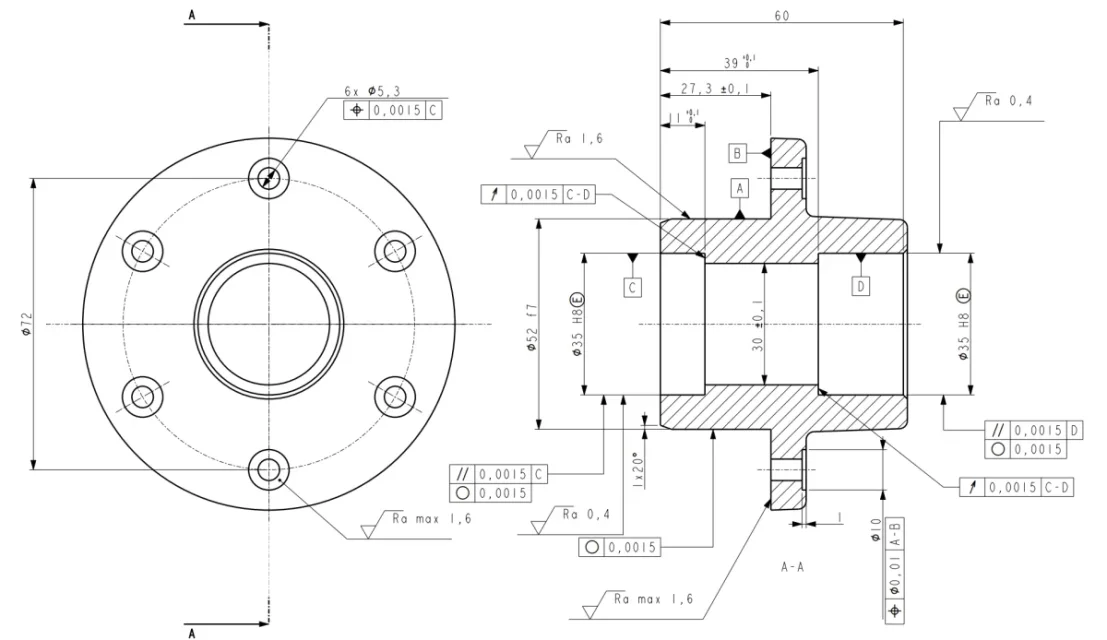
I made the blind hole with standard pass hole function for screw m5x.8 not threaded, returned me a hole of diameter 5,3mm, is subject to dimensional tolerance, should I add a note?
 

Attachments

  • Screenshot.webp
    Screenshot.webp
    44.1 KB · Views: 23
quotation and tolerances so can they fit?
I made the blind hole with standard pass hole function for screw m5x.8 not threaded, returned me a hole of diameter 5,3mm, is subject to dimensional tolerance, should I add a note?
I also horrify at work... the bevel 1x45° according to norm only with 45 degrees.
for corners of the stands two odds are made: one represents the quotated dimension parallel to the axis of revolution and the other is the corner of the bevel. if necessary you make enlargement to quote.

Why do 10 prof 1 borchues have 1 cent location?
then if there were screws m5 because fido 5,3 when the norm says 5.5? Do you have a specific reason?

the metric screws to grosdo step are m5 and you do not quote the step.... That says the norm.

quota 60 on the bevel is not good....the total you have to quote.

references abcd... only 1 or 2 at most.
 
I also horrify at work... the bevel 1x45° according to norm only with 45 degrees.
for corners of the stands two odds are made: one represents the quotated dimension parallel to the axis of revolution and the other is the corner of the bevel. if necessary you make enlargement to quote.

Why do 10 prof 1 borchues have 1 cent location?
then if there were screws m5 because fido 5,3 when the norm says 5.5? Do you have a specific reason?

the metric screws to grosdo step are m5 and you do not quote the step.... That says the norm.

quota 60 on the bevel is not good....the total you have to quote.

references abcd... only 1 or 2 at most.
I forgot to say that it only serves the useful quotas for the processing of the crude obtained by foundry (of which we must deliver the 3d)
for the unquoted 1x45° bevel: I put the note written above the cartilage, I cut the photo badly...

can I also remove geometric tolerance for studs? I just need to get the flat surface and with the roughness required for the screw

I did not know of the norm on the width of the holes depending on the screw, as mentioned above to get that hole I used the software hole command which, inserting the screw m5x.8, made a hole from that diameter.
I will delete the feature and proceed with the extrusion of a circle of diameter 5.5

the quota 60 I put it because being from foundry, I will not have a flat surface for the measure... I'll take it.

for references I am based on the manual schaeffler (photo attached)
 

Attachments

  • Screenshot (108).webp
    Screenshot (108).webp
    51.5 KB · Views: 18
quotation and tolerances so can they fit?
I made the blind hole with standard pass hole function for screw m5x.8 not threaded, returned me a hole of diameter 5,3mm, is subject to dimensional tolerance, should I add a note?
Good morning, I don't usually intervene by limiting myself to read the discussions,
I would still like to say two things on the table:
- only to me seem extremely narrow all geomeric tolerances ? for example we are talking about 1.5 microns of position for holes passing by screws m5..
- the reference to is used only for the tolerance of the position of the lamatures diameter 10, according to me lack the concentric tolerances between 52 f7 (a) and the two diameters 35 h8 (c and d)
- I don't understand the tolerance of parallelism on diameters 35 h8 to what is it?
- I think there is a tolerance of oscillation between plan b and diameter 52 f7
- if the particular is obtained from a rough fusion there is a reference to the crude (for example between the reference b and the opposite face).

greetings
pier
 
Good morning, I don't usually intervene by limiting myself to read the discussions,
I would still like to say two things on the table:
- only to me seem extremely narrow all geomeric tolerances ? for example we are talking about 1.5 microns of position for holes passing by screws m5..
- the reference to is used only for the tolerance of the position of the lamatures diameter 10, according to me lack the concentric tolerances between 52 f7 (a) and the two diameters 35 h8 (c and d)
- I don't understand the tolerance of parallelism on diameters 35 h8 to what is it?
- I think there is a tolerance of oscillation between plan b and diameter 52 f7
- if the particular is obtained from a rough fusion there is a reference to the crude (for example between the reference b and the opposite face).

greetings
pier
Good morning, thank you for the answer
for tolerance values not having experience I used the same calculated for bearings. Usually what values are used for that type of tolerance?
I should therefore remove to, use for the position of the lamature c, and assign where I put to a concentric tolerance regarding c?
for the tolerance of parallelism on the bearing diameters, I used the same as the schaeffler guide for their bearings (post #70)

for the share on the crude: Can I quote the same using an unworked surface? I thought it was a mistake.
 
Good morning, thank you for the answer
for tolerance values not having experience I used the same calculated for bearings. Usually what values are used for that type of tolerance?
I should therefore remove to, use for the position of the lamature c, and assign where I put to a concentric tolerance regarding c?
for the tolerance of parallelism on the bearing diameters, I used the same as the schaeffler guide for their bearings (post #70)

for the share on the crude: Can I quote the same using an unworked surface? I thought it was a mistake.
Good morning.
I would leave reference to and position tolerance of holes diameter 5.3 I would refer it to this with a value of 0.05

the position tolerance of the diameter 10 lamatures, since they only serve for the head of the screws, I would turn it into concentricity regarding the hole itself 5.3 and put it to 0.1

for the 35 h8 diameter seats I would place a concentricity of 0.01 to the diameter of the sx compared to , and a concentricity of 0.005 compared to c to the diameter of dx.

I read the schaeffler guide, but honestly I did not understand the sense of that parallel tolerance. .

the share on the crude is not an error, but serves as a base for all subsequent work. of course you will have to tolerate it widely type +/- 0.5

greetings
pier
 
quotation and tolerances so can they fit?
I do not correct the design because that is the task of your teacher, but I attach a drawing similar to your relative to the support of a conical pinion where you can see the quotation system and the tolerances used.
in the specific case there are two conical bearings arranged to or stuck on the pinion by a bar on the shaft and a seeger. registration takes place as in your referral.
considers that it is a 1992 design of a reducer currently in production, which shows the sign of = to indicate the symmetry; currently this sign would not be normal but is still often used for convenience.

generally on holes for screws and lamature do not apply position tolerances (at least, I have never seen them); If you want, for small holes, only a tolerance on the whole with +/-0.05 is applied.
 

Attachments

Last edited:
I do not correct the design because that is the task of your teacher, but I attach a drawing similar to your relative to the support of a conical pinion where you can see the quotation system and the tolerances used.
in the specific case there are two conical bearings arranged to or stuck on the pinion by a bar on the shaft and a seeger. registration takes place as in your referral.
considers that it is a 1992 design that still shows the sign of = to indicate symmetry; currently this sign would not be normal but is still often used for convenience.

generally on holes for screws and lamature do not apply position tolerances (at least, I have never seen them); If you want, for small holes, only a tolerance on the whole with +/-0.05 is applied.
Thank you very much
 

Forum statistics

Threads
44,997
Messages
339,767
Members
4
Latest member
ibt

Members online

No members online now.
Back
Top