• This forum is the machine-generated translation of www.cad3d.it/forum1 - the Italian design community. Several terms are not translated correctly.

axial force of a screw depending on the tightening couple

  • Thread starter Thread starter molix
  • Start date Start date

molix

Guest
Good morning to all,
I was evaluating the calculation of the axial thrust force given by a screw m6x1 screwed with a pair of 1.5 nm.
looking at the general manuals found on the internet I calculated the following data:
medium screw diameter d2 = 5.395 [mm]step threaded screw p=1 [mm]couple m= 1.5 [Nm]through the manual I read that the formula to empirically calculate the axial force q (without friction) is given by:

(m*2*3.14)/p = 9420 [N]always from the same manual, considering friction μ=0.14 -> q = 6924 [N] ♪

but can it be so high the force that axially exercises the screw?


...
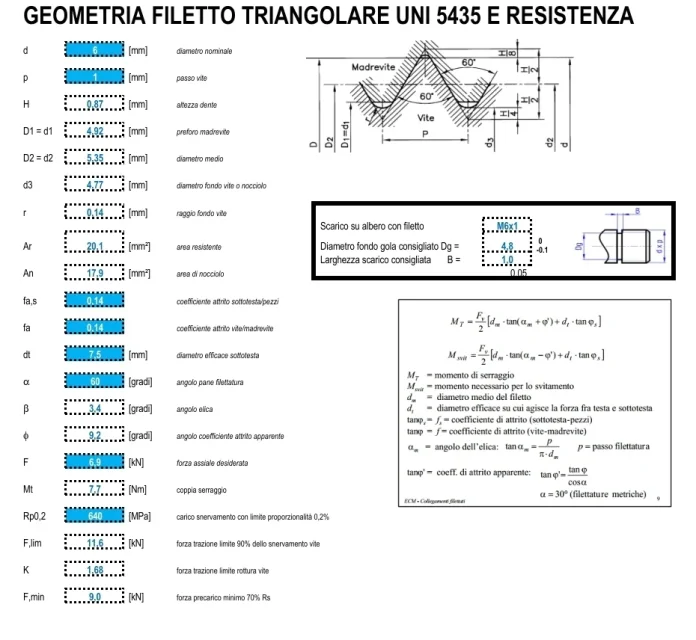
 
without friction:
[math]q=\frac{mt•2•\pi}{p}=\frac{1.5nm•2•\pi}{0.001m}=9420n[/math]actually then you have to consider the effective underhead diameter, friction between the threads and between the head and the plate and then the torque you need can climb much more than you have calculated.
Screenshot_20231013_072946_Microsoft 365 (Office).webp
 
Last edited:
Interesting, is it an excel file? Would it be possible to have it?
It's an excel sheet.
Just take and formulas related to geometry and torque.
a little beat leads to more knowledge of the subject and to learn how to use excel....2 in 1.
 
It's an excel sheet.
Just take and formulas related to geometry and torque.
a little beat leads to more knowledge of the subject and to learn how to use excel....2 in 1.
But it's because I'm confused with tangents and their value, :) as soon as I have time I can write what doesn't come back? If you give me a hand I thank you very much! !
 
But it's because I'm confused with tangents and their value, :) as soon as I have time I can write what doesn't come back? If you give me a hand I thank you very much! !
We're here. write to the public that we see where you're wrong.
 
I'm sorry I'm late. .
I said I had a problem with the tangents and the little thing.
start with order:

with the procedure I get an apparent friction angle "fi1" of 15,64 degrees and I can not get the 9.2 degrees as from your table.
the procedure I follow is:
tangfi = 0.14
what 60 degrees = 0.5
tangfi1 = tangfi / t 60 degrees = 0.14 / 0.5 = 0.28
angle = arctan(tangfi1) * 180 / pi = arctan(0.28) * 180 / pi = 15.6422 degrees
Where am I wrong?
 
if you look well the original formulas I used indicate alpha of 30 degrees which is the seminangle of the threaded bread that physically is worth 60 degrees.
As I think it makes no sense to use the seminangle, I insert the bread and I split two.Screenshot_20231026_203038_Chrome.webp
 
here I found the square, in fact I used a corner of bread = 60° instead of 30° :)
This is all coming back! !
to continue, can I ask you some disappointments? because then I become very curious about some aspects. . .

with this formula is what is (of course generic) the axial force of a screw.
Some questions arise at this point:
(1)
Should this axial force be the same developed under the head of a screw to keep a lid closed (yellow)? for example how in figure sketched below?
1698657465699.webp(2)
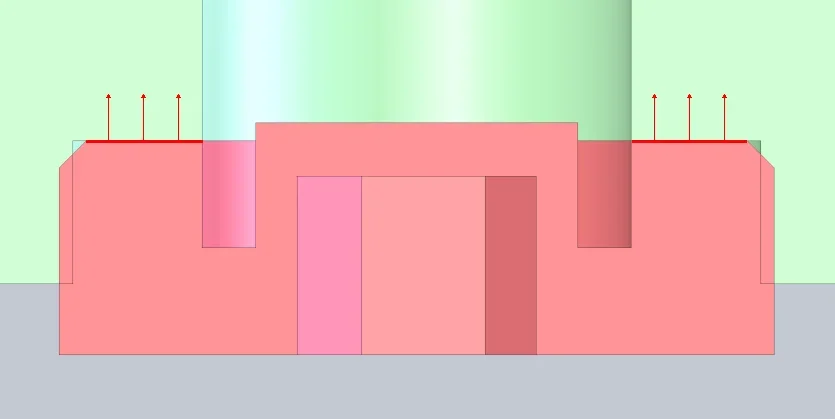
in the case of a compass, which acts as a cap, can you consider the same calculation procedure to estimate the strength it exercises on the surface indicated in red?1698658097711.webpif you then come to the then with another question:)
Thank you in advance!
 
here I found the square, in fact I used a corner of bread = 60° instead of 30° :)
This is all coming back! !
to continue, can I ask you some disappointments? because then I become very curious about some aspects. . .

with this formula is what is (of course generic) the axial force of a screw.
Some questions arise at this point:
(1)
Should this axial force be the same developed under the head of a screw to keep a lid closed (yellow)? for example how in figure sketched below?
View attachment 69499(2)
in the case of a compass, which acts as a cap, can you consider the same calculation procedure to estimate the strength it exercises on the surface indicated in red?View attachment 69500if you then come to the then with another question:)
Thank you in advance!
I'm glad you came to convergence with the results.
certainly that your axial force that generates is the one that keeps the lid closed.
In case two, I don't understand if the red one is a threaded needle that acts as a cap.
It could actually be the same behavior as a screw as long as there's a "underhead" joke.
in reality then you will have the rigidity of a tox or slender screw, the rigidity of the plates and other things that determine the real behavior of the bolted joint.
 
In case two, I don't understand if the red one is a threaded needle that acts as a cap.
It could actually be the same behavior as a screw as long as there's a "underhead" joke.
si the red one is an externally threaded wreath for all its height, which is screwed up to bar in the green body (the battutta is evidenced by the red rows, indeed with the hind of then I could have used other colors). I'm sorry because it's really bad. However it acts as a stopper. there are not represented the sealing oring and a spring working inside (the seats are not there or are just sketched right for the question I am proposing)
in reality then you will have the rigidity of a tox or slender screw, the rigidity of the plates and other things that determine the real behavior of the bolted joint.
Of course, in this case I also have a spring and an oring that will create their frictions I suppose. However, bypassing them, in the case of the threaded compass, which rightly acts as you said as a cap, the axial force (determined by the torque of tightening) repercussions on the intake threads, fitted with spring force, "force" of compression of the oring (even if it is irrisoria), and possibly of the force exerted by the internal pressure, when present. is it correct as reasoning?

in this case is correct to size the compass thread only to cut, for the whole section of the average diameter of the threads in socket?
 
Actually threads occur with specific industry regulations.
certainly that if we want to make a more "localized" speech you have that the closing force affects the number of threads and acts on the average diameter. submits the two-action thread bread: one of bending and one of cutting. The thread is like a swipe beam.
 
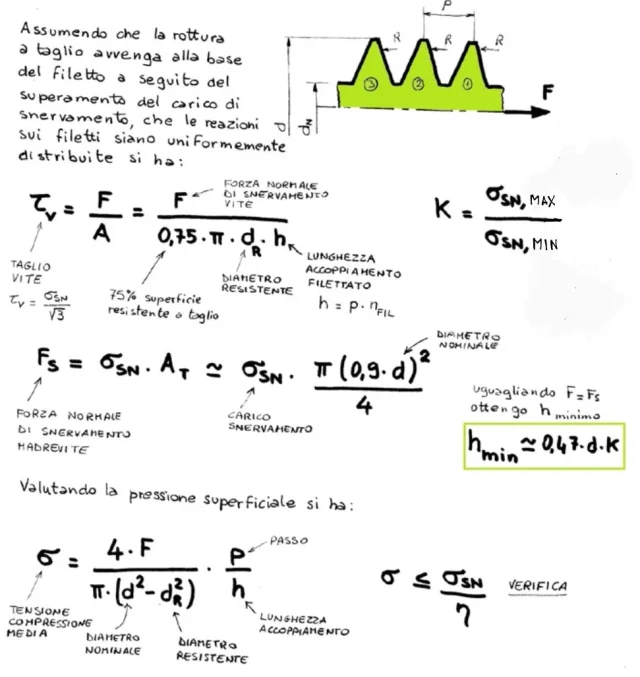
just to give an idea I propose the summary of my notes about the screw/magnet coupling length.
Screenshot_20231101_163957_Chrome~2.jpgI remember that k is given by rs,max/rs,min evaluated between lives and mothers.
find this image also in other discussions with any extra explanations.

Keep in mind that several laboratory studies have shown that over 5-6 threads in grip the load is no longer broken and therefore the threads no longer cooperate. Moreover between the 5-6 intake does not distribute the traction force equal.
img_20190128_231946-jpg.52361
 
Actually threads occur with specific industry regulations.
certainly that if we want to make a more "localized" speech you have that the closing force affects the number of threads and acts on the average diameter. submits the two-action thread bread: one of bending and one of cutting. The thread is like a swipe beam.
I have actually found documentation indicating exactly what you say (i.e. cutting voltage + bending voltage and consequently you calculate the ideal voltage <= material yield/n) , on the cut ok, I approach very much also to your clipboard formula, but on the bending I can not understand how to calculate it on the thread (considering that it is a shelf as you say, but it is "a spiral" of 360° x n turns/filetti).
 

Forum statistics

Threads
44,997
Messages
339,767
Members
4
Latest member
ibt

Members online

No members online now.
Back
Top