• This forum is the machine-generated translation of www.cad3d.it/forum1 - the Italian design community. Several terms are not translated correctly.

bearings in a variable section shaft

  • Thread starter Thread starter tesi
  • Start date Start date

tesi

Guest
Hello
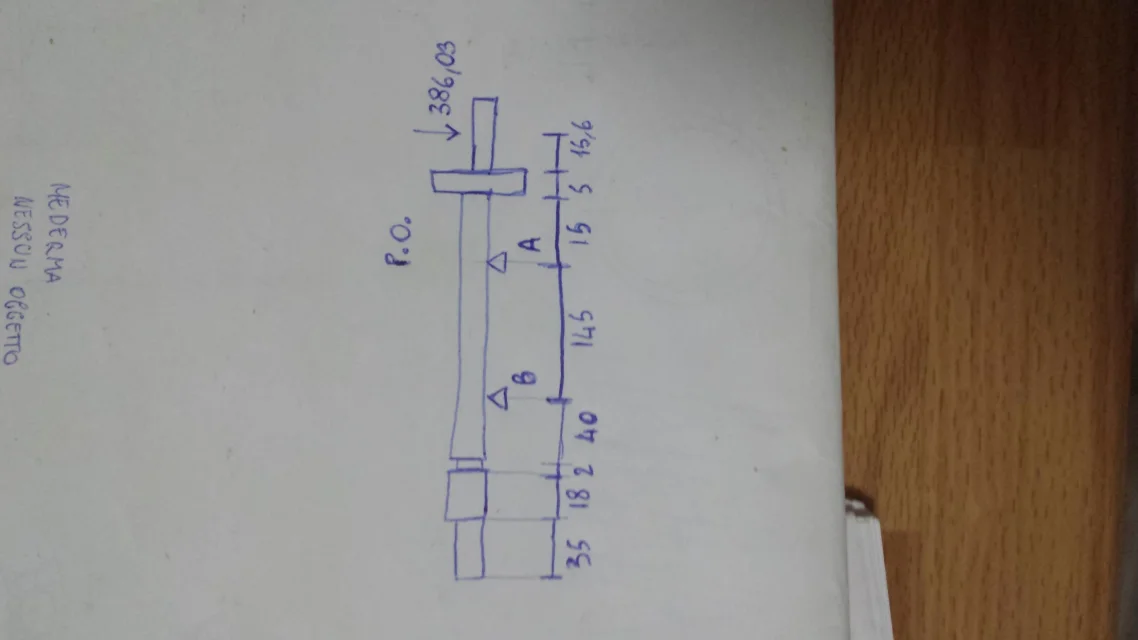
I was only a didactic cop making a project only that I came across a pinion to bounce on a variable section tree (report the projections on the 2 floors attached)....now my question is very simple: would it be appropriate to use a roller bearing in b where the forces in Iko are greater and instead a simple ball bearing in a?
Note 1-the material that constitutes the tree is not taken into account ( cmq tips are appreciated on how to change the geometry of the latter, although the installation must remain astonished, if the diameters and/or the exaggerated lengths are considered)
2- diameters are (from left to right) d1=25; d2=30; d3=25; d4=30; d5=40; d6=25
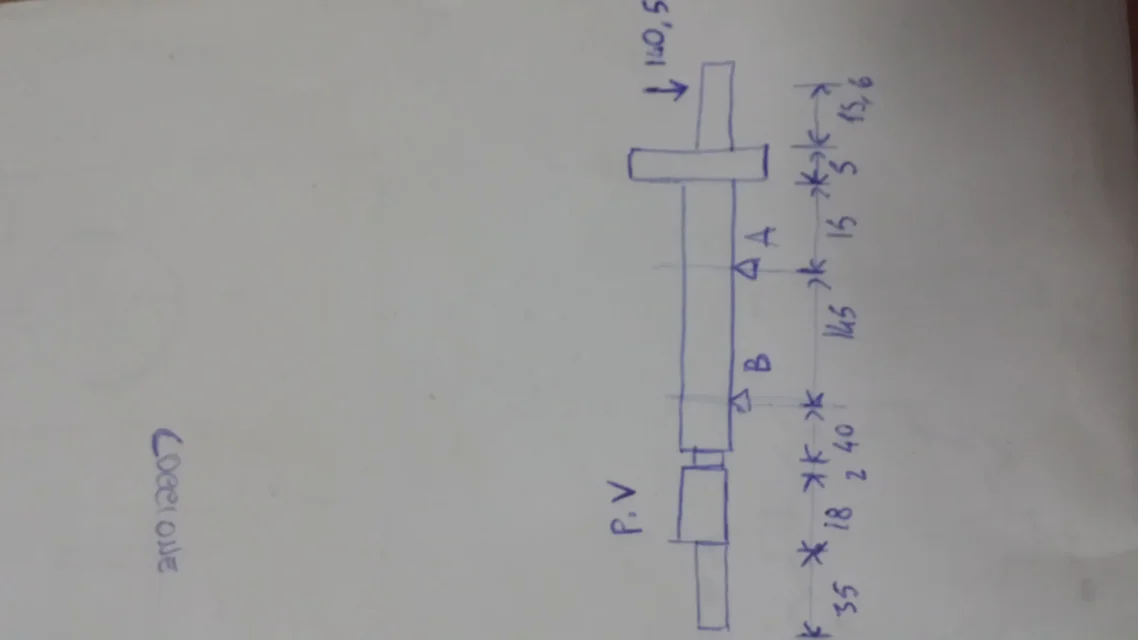
20130727_005606.webp20130727_005606.webppv.webp
 
the type of bearing depends on many factors:
- concept of isostaticity (a hinged bearing and a cart bearing)
- if the radial ball bearing is not enough to resist the radial load you pass to a roller bearing

If you want to mount isostatic, I would say that the roller bearing is a trolley (correctly bound) and the ball bearing is a hinge.

the design of the tree I would say that it can be very different or very equal in function of what the tree itself has to do and how it is placed in the geometry of the reducer.
material is essential for static resistance and even more for fatigue.
 
the shaft connected to the motor puts in motion the pinion everything was thought to transmit a low power about 3.5 kw n1=2350rpm
yes cmq the idea was obviously to mount isostatically. ...only that you are now making me doubts that probably the structure as I thought it would be hyperstatic:confused:
I had predicted that both bearings were in and in b they were completely blocked by special housings on the carcass and was also preventing them in fact every translation would be a mistake?
ps:you could kindly give me an example of bearing bound to embody a cart and one bound to embody a zipper
Many thanks for the availability and excuse me if the questions turn out to be trivial but I do not have much familiarity in this field are a thermomechanical:wink:
 
I realized today of the huge cable written on the previous post only that I can't eliminate it: mad: thanks for mechanical clarification!
 
I attach some manual solutions that indicate hinges and carts. all applications with isostatic locking system.cux-rulli-2.webpcux-rulli-1.webpcux_rulli0.webpHowever, in the classic isostatic configuration you have:
- Ball bearing 1 crown, axially locked both outer ring and inner ring = limited hinge to small angle shifts
- roller bearing version n, axially stuck on the inner ring and on the outer ring (automatically the rollers flow axially of some millimeter) = cart with small rotations

alternative

- Ball bearing 1 crown, axially locked both outer ring and inner ring = limited hinge to small angle shifts
- ball bearing 1 or 2 crowns, locked axially only on the inner ring or only on the outer ring (the free side must be at least in h7 or h7 to scroll) = cart with small rotations
 
very nice and interesting.
I didn't know that roller bearings could also simulate a cart.

I'm sorry if I take advantage of it, but do you also know how to size the case of two ball bearings?
the drawing prof says that in that case it is a hyperstatic system.
How do I do that? I divide the load equally on the two bearings or solve the hyperstatic system and see the binding reaction part that each bearing takes?
 
very nice and interesting.
I didn't know that roller bearings could also simulate a cart.

I'm sorry if I take advantage of it, but do you also know how to size the case of two ball bearings?
the drawing prof says that in that case it is a hyperstatic system.
How do I do that? I divide the load equally on the two bearings or solve the hyperstatic system and see the binding reaction part that each bearing takes?
if in a constraint system (i.e. where you would put a bearing) put 2 or more bearings of the same type or combined, you can get the effect of a bearing Incave where the only allowed thing is rotation around the axis of the bearing hole. if in the other side a system that is able to behave shopping cart, you will get a beam hyperstatic 2.
reazioni_iperstatiche_due.webpthe attached radial bearing can be evaluated in two ways:
- total reaction load divided the number of bearings (if the system is packaged and preloaded) as first hypothesis of first sizing
- load calculated on the individual radial bearings (more correct calculation system in each condition) and evaluated as double reaction: radial in the two orthogonal directions to the rotation axis and as moments around the two orthogonal axes to the rotation axis. to be used for verification.
 
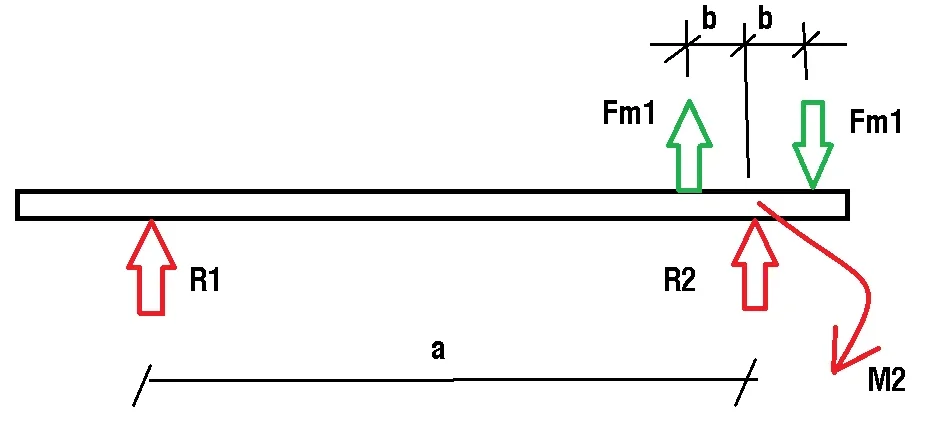
I attach the correct general reasoning scheme for coupling 2 attached radial bearings
multicux.webpIt's the same kind of reasoning you're making on the bronzes or ball sleeves. with p is indicated the admissible pressure on which the various forces weigh. in the case of bearings is little relevant and instead it is necessary to calculate FM,1.

However, if you look for the skf site and spray it well, find the indications for these strange types and you also have the bearing calculation system.
 
I can't follow you. Why then do we distinguish between bearings loaded with x or a or ??

as I did (but I'm not sure I've got it right) you should do it like this:
1) An isostatic system is supposed and reactions are calculated and therefore the bearings to be put.
2) if the bearings are too large compared to the section of the shaft, then two bearings are placed there where the reaction is too high.

3) draw the bearings, calculate the binding reactions of the hyperstatic system so obtained (using the diagrams that you posted you) and then see how the load is broken on the two bearings.

4) at this point you choose the bearing according to the usual formulas and taking into account the 8calcoate load) you have to endure.

Does that work? ?
Thank you.
 
I can't follow you. Why then do we distinguish between bearings loaded with x or a or ??

as I did (but I'm not sure I've got it right) you should do it like this:
1) An isostatic system is supposed and reactions are calculated and therefore the bearings to be put.
2) if the bearings are too large compared to the section of the shaft, then two bearings are placed there where the reaction is too high.

3) draw the bearings, calculate the binding reactions of the hyperstatic system so obtained (using the diagrams that you posted you) and then see how the load is broken on the two bearings.

4) at this point you choose the bearing according to the usual formulas and taking into account the 8calcoate load) you have to endure.

Does that work? ?
Thank you.
bearings loaded with x or to or are special oblique contact bearings or conical rollers and serve to hold the load according to the system. a mode can be preferred to high if you want the stress to be discharged towards the center or towards the outside.

bearing choice:
1) I decide if I want an isostatic or hyperstatic system according to the following reasons: high or low loads, rough or slender trees, obvious or unclear thermal expansion etc
2) calculation of reactions to supports and not bearings
3) Calculation of bearing reactions if they are composed of multiple bearing units (two or more attached)
4) I make calculation at minimum duration or choose from catalog a random bearing (or why I need some encumbrance) and verify it with force agents

alternative
1) I decide if I want an isostatic or hyperstatic system according to the following reasons: high or low loads, rough or slender trees, obvious or unclear thermal expansion etc
2) calculation of bearing reactions if they are composed of multiple bearing units (two or more attached) using hyperstatic formulas if it is
4) I make calculation at minimum duration or choose from catalog a random bearing (or why I need some encumbrance) and verify it with force agents
 
I'll give you an example where we have a hyperstatic case. It was deliberately designed because:albero.webpassieme_albero_cux_1.webp- the left bearing does not have great radial load
- the right bearing is very stressed
- the right bearing must be very rigid to the bending of the tree because you want to have a bending arrow in the order of cents of millimeter
- thermal expansion compensation is made by the right bearing
- the left bearing is a zipper
- the right bearing is a cart with very small rotation, practically a sleeve

So how do I value it?
- isostatic if I make very small rotations induced by bending
- hyperstatic 2 if I consider rotation around the bearings

In both cases I have to calculate the radial component of the double bearing on the right and use the formula I mentioned before for the sleeves/bronzines after considering the main reaction that falls in half between the two bearings.

everything is relative, depends on the considerations, depends on the reality of the facts, depends on how accurate the calculation is.
 
In both cases I have to calculate the radial component of the double bearing on the right and use the formula I mentioned before for the sleeves/bronzines after considering the main reaction that falls in half between the two bearings.

.
I'm not following you here. I consider hinge on the left and sleeve on the right.
in the sleeve calculate the moment (binding reaction) and then turn that moment into the two forces that generate the couple.

from how you write, instead, I first calculate the moment in the sleeve, after I pretend that it is a support and calculation the binding reaction: In practice I calculate the reactions considering two different types of wine and after overlapping the effects.

Isn't he wrong?
Thank you.
 
I'm not following you here. I consider hinge on the left and sleeve on the right.
in the sleeve calculate the moment (binding reaction) and then turn that moment into the two forces that generate the couple.

from how you write, instead, I first calculate the moment in the sleeve, after I pretend that it is a support and calculation the binding reaction: In practice I calculate the reactions considering two different types of wine and after overlapping the effects.

Isn't he wrong?
Thank you.
what I said is different: you calculate the whole structure as "a" and r1 r2 m2 revenues and then when you're finished you focus on the extreme right and fm1 calculations that are the reactions to the real bearings (2 you use two radials attached)schema.webp
 

Forum statistics

Threads
44,997
Messages
339,767
Members
4
Latest member
ibt

Members online

No members online now.
ciao
Back
Top