mainagioia
Guest
Good morning.
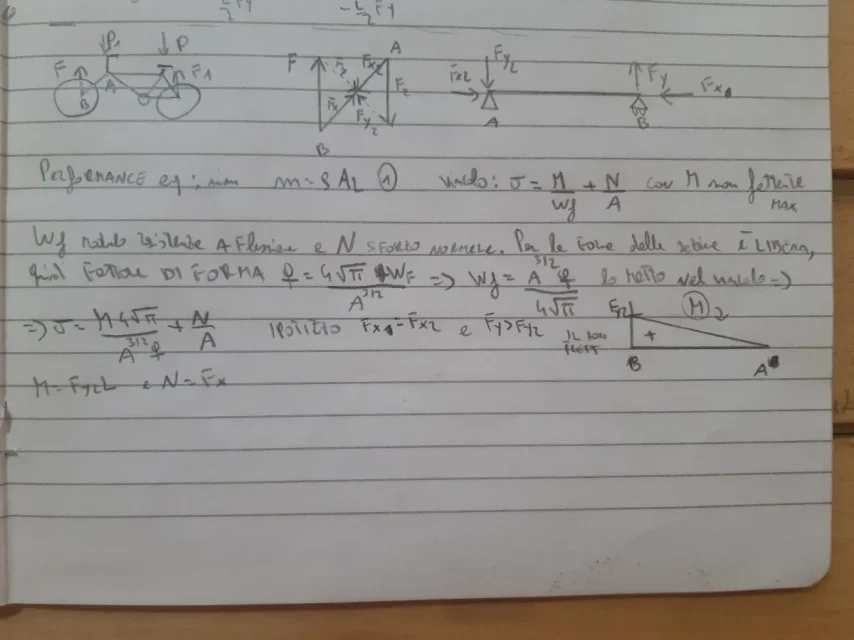
Somo a mechanical engineering student. I saw an exercise on the ashby book for the choice of materials and I have a doubt. says to choose a material for a fork of a bicycle, and draws the material index (i.e. the coefficient that contains all the parameters that depend on the material to choose). However, it does not explain how it proceeds. I have speculated that the fork is the ab segment, and that it is loaded with the f force as represented in photo. I therefore assumed to see it as a supported beam and tried to obtain the total sigma by adding the contribution of bending and compression (I ask if it is right). At this point I should get the section area to which it is a free parameter as fi to insert it in the performance equation and find the material index, but I can not express to. if there was no normal effort, I would do it quietly and the result would come out also, but with that no, so I don't know if you can give me some disappointment about it. Do I have to put hinge in b? in that case n=0? Thank you.
Somo a mechanical engineering student. I saw an exercise on the ashby book for the choice of materials and I have a doubt. says to choose a material for a fork of a bicycle, and draws the material index (i.e. the coefficient that contains all the parameters that depend on the material to choose). However, it does not explain how it proceeds. I have speculated that the fork is the ab segment, and that it is loaded with the f force as represented in photo. I therefore assumed to see it as a supported beam and tried to obtain the total sigma by adding the contribution of bending and compression (I ask if it is right). At this point I should get the section area to which it is a free parameter as fi to insert it in the performance equation and find the material index, but I can not express to. if there was no normal effort, I would do it quietly and the result would come out also, but with that no, so I don't know if you can give me some disappointment about it. Do I have to put hinge in b? in that case n=0? Thank you.