• This forum is the machine-generated translation of www.cad3d.it/forum1 - the Italian design community. Several terms are not translated correctly.

bike shaft

  • Thread starter Thread starter REMO1
  • Start date Start date

REMO1

Guest
Hello, everyone, since it's the first time I write, I take advantage of it to introduce myself... I am a contracting craftsman and work on cnc machining centers in the branch of engines .

for passion I am building a 4tempi bicylinder motor boxer using as sample the bmw 4valvole moto boxer.

I managed to build the engine shaft from the top even if it's not my job and I made it rectify and then balance.

The problem is the balance, or rather, a balance of about 80g has emerged, which has been solved by removing material on the jaws.

Now, I'm told to be a drawing problem and I'd like to understand how to see where to intervene.

I add that the total center of the tree is in place and also with the additional masses (fake biella) .

I also read other discussions about it but not on a bicylinder.

thanks to all

I attach photos of the tree.BILANCIA.webpWe
 
Hello and welcome.
I tell you in two words a topic that is actually very complex and deserves much more deepening.

your beautiful tree (compliments for initiative!) must be balanced both statically and dynamically.
is defined Static balance when the center of gravity falls on the rotation axis. so to see it on the cad you should make sure to view the centerpiece and see if it differs from the rotation axis of the shaft itself.
in reality you can see it by resting your tree on a support (maybe on a banquet with two semiboils at the ends) and verify if, given any angle, the tree remains in its position or tends to take a preferential position.

IDynamic balance is a more "complicated" peline because it makes inertia matrices uncomfortable. Unfortunately, I am not good at explaining it, but I can tell you that it is not so much linked to the position of the center of gravity (as in the static balance) but how the mass is distributed.
this because you can have the mass distributed asymmetrically and leave the center center perfectly centered on the axis of rotation.
the juice of the speech is that the distribution of the mass can bring about moments of deviation (dynamic imbalances) despite the center of gravity is perfectly centered. on the cad you should see if the axis of rotation coincides with the main axis of inertia.
These imbalances are disastrous at high speeds.

Sorry about the approximate explanation. . I hope I made you the idea.
 
Thank you pierarg you have been made clear, I have arrived while missing all the theory behind us.

therefore having the center of gravity center center centered on the axis of rotation ( 0.05 mm in y and ok in z) while in x is 3.3mm to dx respect the half-works (the tree in reality is longer to dx ) I deduce that it is all question of dynamic balance , and not being master of these calculations I have to look for a cad that calculates him in my place.

I to draw use mastercam that is certainly not the maximum, but it calculates volume -> mass -> center of gravity -> moment of inertia and stops here .
What do you know do more (I have a friend using it) or what do I have to look for, but the most land possible?

Thank you for your patience

ps : I must remove the books of mechanics itis .
 
I don't think rhino can give you these characteristics because it is a modeler of nurbs surfaces.
solids that you see on rhino are not "full" but are only external surfaces. inside are empty.
I don't think the software can give you this information.
 
I'll probably have to turn to a pro before you said "on the cad you should see if the axis of rotation coincides with the main axis of inertia. What did you mean, autocad? Catia? proe?

Thank you.
 
I was referring to any solid modeler cad 3d.
maybe with the 3d module of autocad you can view them.
 
Then I try with autocad... the 2d I know how to use well, but the mass and inertia properties I never used them...... Let's see if I can do something.
thanks pierarg for patience .
 
Please!
I don't know if autocad "classic" can do it.
Maybe try downloading the autodesk free trial version of autocad mechanical.
 
Hello there

as pierarg said you have to make sure that already from drawing your tree is balanced statically and dynamically, at least with a certain tolerance. the first condition the check directly on the cad (baricentro on the axis of rotation) the second also, making sure that the axis of rotation is also the main axis of inertia (in solid edge for example I have the possibility to display the main axes of inertia). you must therefore typically change the masses of the two end counterweights, which are precisely to compensate for the pair of inertia (dynamic balance) that you would have if these were not: couple due to the non symmetry of the tree compared to an orthogonal plane to it. if both cranks had zero outage and not 180 degrees would have intrinsic dynamic balance (it would be the static one in this case, to be reached with counterweights).
Of course the balance should be refined on a balancing machine, but the design must already allow you a "good starting point" and ensure you have enough material to remove from the counterweights.
This obviously applies to the balance of the bare tree!
 
hello paulpaul, thanks to your intervention.
I wanted to ask you two things:
- 1- I'd like to do this with the masses of the "bial bows" inserted on the tree, as if it were a single body.
-2- solid edge exactly what makes you see and the main axis of inertia just displays it or from the coordinates from the baricentro ? I have an imbalance of about 80gr ... is visible on solid edge?

They told me that the balancer usually needs to fix 10-15 gr not more.
Thank you.
 
for point 1 is not wrong, you say right.
I can't answer you because I don't know if. I don't think the sw gives you the imbalance but only the info on the main axes and the center of gravity.
this because unbalance is function of the rotation speed.

we wait for paulpaul who will certainly be much more exhaustive than me.
 
autocad01.webpedge01.webpedge02.webpI made a test with a triangular piece with coordinates of x -46,33 y25 , x-46,33 y-25 , x92,67 y0 thickness 50 mm , with baricentro in x0 y0 and z to half of the thickness.

on solid edge v5 and autocad r14 I get these values, but it doesn't show me anything else.

I still have to try with mechanical ... we see if I find it.

Thank you.
 
Bye-bye

Sorry I was late but I couldn't be very present online.

if we talk about static and dynamic balancing we refer to the only rotating masses, that is the same tree and the "rotating part" of the biella.
then correctly you have to put on the crank pins a " simulation mass" (ring) that precisely simulates the above mass. the biella in fact is characterized by a motion plan that can be made equivalent to that of two masses placed in correspondence of the two holes: one on the crank pin, characterized by pure rotary motion, and the other on the spindle, characterized by pure alternating motion (in reality with this schematization you must also introduce a pair of inertia, associated with the two masses, that however does not enter the balance).
the size of these two masses (but and mr, alternating and rotating part respectively) depends: from the length l of the biella (full holes), its mass m, and the position of the center of the biella itself (a and b, distances of the baricentre respectively from the head and foot hole) according to the formulas:

mr = mb/l
but

mr is therefore the additional mass you have to put on the crank pin.

the rotating forces are intrinsically balanced without counterweights: for their moments, however, they serve the counterweights you have already predicted, so that the main axis with the rotation axis coincide.

with regard to the balance of the alternate forces (pistone + rings + spindle + alternating biella) in a counterposed cylindrical like this are already intrinsically balanced without the need for additional counterweights both those of the first and the second order.
The moments of these forces are not balanced, and they are not even fully balanced with the two additional counterweights you have predicted. In general, the mass increases (compared to the one necessary to balance the moments of the rotating forces, see above) of a certain amount so that at least a partial balance can be obtained. In practice, once the shaft is balanced towards the moments of the rotating forces, the additional pair generated by the two counterweights is 1/3 to 2/3 of the one generated by the alternating forces of the first order.
neither the pairs of the alternate forces of the second order are balancing, unless to introduce additional balancing trees or to put the cylinders on the same plane, but in both cases the construction.

As far as the cad is concerned, I confirm that if you are visuading the main axes. I haven't faced this problem for a long time with solid edge, but you should be able to go back to the axle management by "measure" command.
 
Excuse me if I say a boiata, but in the dynamic balance of the tree, I think we should consider part of the mass of the biellas.
I would advise you to investigate this before proceeding.
 
Excuse me if I say a boiata, but in the dynamic balance of the tree, I think we should consider part of the mass of the biellas.
I would advise you to investigate this before proceeding.
Exactly, just the rotating part. the method of calculation of the mass of this "part" we discussed it before, but at more operational level it is often considered as a rotating part of the 1/3 biella mass of this.
 
View attachment 32298View attachment 32299View attachment 32300I made a test with a triangular piece with coordinates of x -46,33 y25 , x-46,33 y-25 , x92,67 y0 thickness 50 mm , with baricentro in x0 y0 and z to half of the thickness.

on solid edge v5 and autocad r14 I get these values, but it doesn't show me anything else.

I still have to try with mechanical ... we see if I find it.

Thank you.
hi to everyone, I tried with mechanical but I didn't understand anything... I tried with the triangular piece I mentioned, but I didn't get anything.

No one knows how to interpret my three attachments, because we also talk about the main axes of inertia, but I don't get any other information that addresses me about what to change my piece.


Thank you ( ...of patience)
 
as you can see solid edge provides, for each of the three main axes, the "orientations" regarding the reference system. without entering too much into the theory, you must add or remove material on counterweights (or change its shape) so as to make the axis of rotation a main axis of inertia, that is to make null two of the three "orientations" of one of the axes mentioned above. What? depends on how the design reference system was chosen. If the x axis is parallel to the rotation axis, the "orientations" of y and z must be null, i.e. the second two of the table you have linked, while the orientation of the x axis must be equal to 1.
I hope I can get you an example. .
 
remo

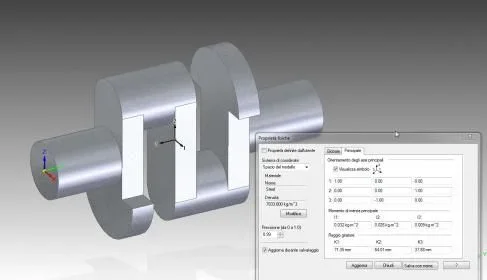
in the photo se1 I sketched a two-necked tree "naturally unbalanced dynamically" similar to what you have to accomplish, at least as a concept. I designed it in an elementary way, so as to try to understand the geometry/balancing relationship: However, it is not very different from certain machines (compressors, pumps). in the photo se1 see a reference system placed so that the y axis is coincident with the rotation axis. you can also see the location of the center with the three main axes of inertia, 1, 2 and 3. It is immediately noted that axis 3 is "tipped down" while instead it should also be coincident with the y axis to have dynamic balance: this is due to the "uncorrect" distribution of the material around the axis of rotation, in particular the absence of an orthogonal symmetry plan to the axis itself. observes in the property window the "orientations" of axis 3 (every point represents a coordinate, x, y and z respectively): 0; -0,99 (3 is oriented towards opposite y, from which the sign "-"); 0.13. to have the coincidence of the axis 3 with the axis y (rotation axis) we must make sure that these "orientations" are respectively: How do you do that? adding material (couplings, always designed in elementary manner) on the sleeves, as seen from photo se2.
I fixed a width and varied the radius until the y and z orientations were respectively -1 and 0: in this way the tree is "drawing" dynamically balanced (and statically). you could have varied the width, thickness, shape, etc., always checking the "consequences" on axis 3.

p.
"orientations" are the famous "directors' asses", i.e. the projections along a terna of a Cartesian axes of a unitary vector oriented in any way in space. being the unitary carrier, these components are reduced to be equal to the small part of the angle between the carrier and the axis considered (simplifying a little), from which the name. in practice they are used to "understand" how a straight is oriented (in this case the main axis) in space and allow to make the accounts of the case.

to take into account the mass of the biellas add on the drawing, in correspondence of each of the two necks, two rings of thickness equal to the width of the biella, concentric to the axis of the necks themselves and mass equal to the mass of the rotating part of the biella (variane the radius). refer them axially to the maschettas in the same way as the biellas are reported.

even if you start from a "balanced drawing", the stage on the balancing machine is however indispensable if the machine to build is of a certain commitment: However, you will be reasonably sure that the subtraction or addition of material in the machine will be contained within certain limits and you will not find yourself in the situation of "not having room to add material" or "not being able to pierce sufficiently to remove it".
SE1.webpSE2.webp
 

Forum statistics

Threads
44,997
Messages
339,767
Members
4
Latest member
ibt

Members online

No members online now.
Back
Top