• This forum is the machine-generated translation of www.cad3d.it/forum1 - the Italian design community. Several terms are not translated correctly.

binding reactions

  • Thread starter Thread starter ansyolitico
  • Start date Start date

ansyolitico

Guest
Hi.
is the first time you dimension the base of a robot
from the manual gives me two moments that discharge, one called overturning and the other of torque, I think that they correspond to the times generated with the maximum load with the axes extended to the maximum and that other for the rotation due to the first axis

looking at the numbers suggest 4 m16 screws with 235 nm clamping pair that should correspond to a 10.9 class screw with 110kn maximum axial preload approximately

now if the moments are 3800 nm and 2400nm with holes 220 mm
I should do 3800/0.22/4=4318 n and 2400/0.22/0.55/4=4958n( 0.55 is friction)
with resultant radq(4318^2+4958^2)=6575n

If I do the safety coefficient between the screw and the single load turns out 16.7.....or I'm wrong something or I don't know

I am doubtful to make
 

Attachments

  • a.webp
    a.webp
    25.6 KB · Views: 39
on the individual screw, the cut given by the moment t and the axial action given by the moment m.
Why do you contemplate friction in the calculation of a force?
 
because overturing from an axial component on the screws, while the torque from a cutting component. They have always taught me that the screws never work to cut. in essence, in addition to the axial force of traction, the cutting force is also won, and in order to do so is the force of friction that is generated through the surface due to the tightening of the screw.

in pennies, I give a load the screw, which crushes the surface where a result is generated which multiplied by the friction becomes a t.
 
I admit I don't understand how you calculated the stresses.

if you have 4 screws, willing to form a square of 220mm then you should calculate the traction force due at the moment as:
ft = 3800 / (2*0.22) = 8636 n
and, always in the hypothesis of the square layout with side 220mm and then with diagonal 311mm you will have that the screws on the diagonals form two pairs from which:
fv = fv = 2400 / (2*0,311) = 3858 n

with regard to the resistance to the cut/scorrection:
fvrd = 0,55 * (110 - 0,8*8,636) = 56,7 kn from which coeff. sic = 56,7/3,858=14,6

While I have a little doubt for that traction, and I don't want to write stupid.
in practice one thing to do is to verify that the traction force does not win that of precarious and is widely verified. but then the vine has an axial force different from that of precarious for the presence of the external force of 8,636 kn. but I am not sure if you have to use some coefficients as in the case of the sliding force.
I leave this calculation to some other site attendant.
 
Sorry, I'm trying to say stupid.
We take the traction force for the screw: 110-0,8*8,636 = 103,09 kn
the resistance of a screw is: 0.9*1000*157 = 141300 n = 141,3 kn
therefore the safety coefficient is: 141,3/103,09 = 1,36
I really ask others to understand how to do this.

Thank you and hello.
 
I think we're messing up both of us.
overturing is a moment so it should intervene only interasse divided two ulteriomente two because they are two screws, should be 8636x2=17272n
the torque is a torque therefore is the diameter (just as the calculations you).
then you have 17 272n, 3858n

0.8 I didn't know what it was

the yielding screw resistance of a 10.9 100x9=900 mpa, the core of a m16 is 14.363 mm, with section 162 mm2 so as to have a yielding resistance of 162*900=145821 n

If I have to ensure that the cut due to the pair is always won, I would have 3858/0.55=7014

the precarious is 110k-17272*2=>7014*2

I would say more verified

But I'm being straniated by the security co-eff.
 
Thank you. News.
I'm finally clearer now. I have always imagined that with the application of an external force there should be an increase of the traction force but I had no clear how to quantify it. the interesting thing is that in your document an increase coefficient of 1/9=0,11 and a decrease of 1-1/9=0,89 is indicated. reasonable values in the assumptions considered.
the legislation, therefore, indicates in 0.8 the coefficient of decrease and consequently that of increase of the traction force in the screw is 0.2.
in fact the increase of force in the vine requires that it is definitely verified also her.
this means that life will be urged by an increased traction force:
110 + 0.2x8,64 = 112 kn
widely less than 141,3 kn. therefore here the safety coefficient is worth 1,26.
the sliding verification is therefore:
0.55x(110 - 0.8x8,64) = 56,7 kn > 3,86 kn. Verified
sliding safety coefficient = 56.7 / 3.86 = 14.7
ÖansyoliticoI recommend reading the document Newsyou will find the explanation of the coefficient 0.8 that I had used at first in my calculations (in the document is 8/9 but we are there. the norm indicates the value 0,8).
I also recommend that you read point 4.2.8.1.1 of ntc18 where all the necessary formulas are reported for this type of verification. find everything you need for your verification.
Moreover the right traction force is what I calculated. if you are not convinced imagine to take in pairs the screws: tense and compressed.
you have a total of two couples: force x arm x numbercoppie = moment
ft x 0.22 x 2 = 3,8 knm = ft = 8,64 kn
 
I go to review my old design prof's notes
I remember that you used the diameter of hazelnut to verify the screw
 
but the ntc are in the construction field or even mechanical, these things affect me

do I refer to these structures?
 
ntc18 (and structural eurocodes) are the reference for building works. They are not designed for machines.
but I am still a good reference for you mechanics.
the main difference is that in ntc18 we work with limit states and therefore we use partial safety coefficients; normally they are multipliers for loads and partitions for resistors. a single coefficient is not used. in particular with more materials you lose the concept of only coefficient.
the method is based on the reconstruction of the resistors and moves the verifications in the space of the stresses.
 
space of stresses? seems the space of phases or that of hilbert

never heard of this definition. I think I've got to get some stuff back.
 
I mean simply: axial action, cutting, bending moment, torque etcc..
compared to the method of admissible tensions where you calculated, precisely, tensions (and then moved into the space of tensions) here instead you reconstruct the axial action resistant, the resistant moment etcc.
are defined as resistant domains (linear and non-linear) within which the points representing the stresses must be contained.
the method also incorporates the aleatorial aspects (it was called semiprobabilistic method to limit states).
 
Look, maybe they explained it and didn't call it that way, maybe I don't remember. but these are words I have never heard sincerely. in constructions of machines made the structure and diagrams of the internal reactions, axial, cutting moment. we have done virtual jobs, the method of forces, that of the movements and then get the matrix of rigidity and make a sort of fem in matlab, but those terms you never heard. but it may be that it does not remember. Now I check the design notes but I'm almost sure that they always made me use the diameter of hazelnuts, and the triangle of bolt verification had made it to check the airtight seal of a pressure cylinder flange. but just fall from the pear
 
Hello everyone

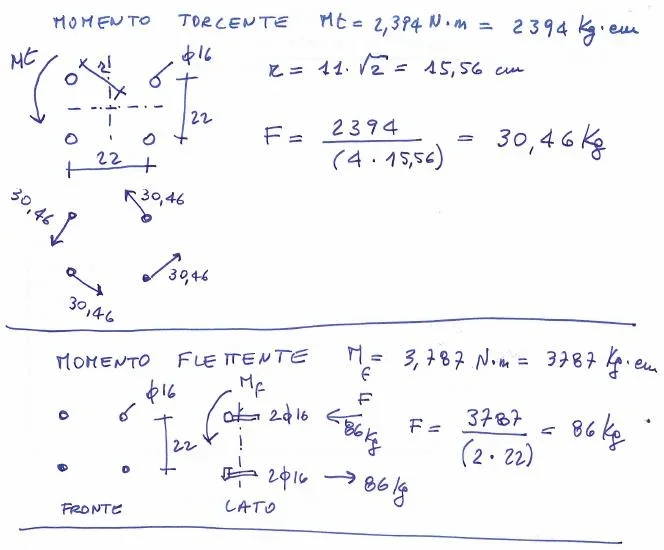
the external torque moment must be balanced by the cutting forces on the bolts acting in radial direction compared to the center of the bolting
each bolt has an arm of 15.56 cm and must bear a force of 30.46 kg.

the flender moment must be balanced by the traction forces on the bolts.
the force depends on the size of the base plate.
if the rotation makes pin on the edge of the lower bolts, the two upper bolts have an arm of 22 cm and are subject to a traction of 86 kg eachone
Bye.
Reazioni.webp
 
@betonieraHello betoniera.
I didn't really want to draw for laziness. Thank you for thinking about it.
just the process but look that you must have read a zero instead of an 8 because in the calculation of forces due to the torque: 2394 / (4*15,56) = 38,46 kg and not 30,46 kg.
Since they match almost all numbers, it seems like a reading error.
Öansyoliticothe criterion of verification of the limit states, basically, you have to see it more like a change of the point of view. The concept of differentiating coefficients according to the type of actions, resistance, how they combine, the type of verification etc.
even if you do not use it is however convenient to have at your disposal this huge vademecum that are ntc18. substantially today it is used instead of the old cnr10011. Consider that what is found in ntc18 is the same as in eurocode 3 (for the steel part).
 
Last edited:
... looks like a reading errorIt's true, I see a little blurred and I often make mistakes like this.
Last but not least, I'm used to reasoning in kg and, indeed, I can't reason in n or kn.
Bye.
 
@betonieraI'm just saying the last thing.
ansyolitoc has indicated in 3800 nm and 2400 nm as values of moments because it is definitely an American document where the comma separates the thousands. you use the point to separate decimals.
I took his values just to have numerical correspondence.
you should have used 38000 kg*cm and 24000 kg*cm for moments (or if you prefer 37870 and 23940 kg*cm).
in practice you miss a factor 10. At least I interpret it like that.
 
You're probably right.
In fact, I felt too low
then: mt =2394 n*m = 239,4 kg*m = 23940 kg*cm.
all values are wrong with a factor 10.
I think I'm irreparably aged.
Hi.
 

Forum statistics

Threads
44,997
Messages
339,767
Members
4
Latest member
ibt

Members online

No members online now.
Back
Top