• This forum is the machine-generated translation of www.cad3d.it/forum1 - the Italian design community. Several terms are not translated correctly.

bit size

  • Thread starter Thread starter gtemp
  • Start date Start date

gtemp

Guest
Good morning.
a client gave me the en of the boat that is building and the breaking load of the top, asked me to dimensional a bitta.
I am a consultant to the iso 3913 and the table of figure 1 shows that I have to make a bitta dn 160.
now, always using iso 3913 I'm calculating the breaking load f using the values related to dn 160

steel 360 n/mm^2 - yeld stress 235 n/mm^2

d= 168.3 mm
from = minimum outer diameter of the tube = 166.617 mm
(d-1%)-2(t-15%)= 149.617 mm
tmax= 60% of yeld stress = 141 n/mm^2
♪ [pigreco*Tmax*(Da^2-da^2)]32 = 74417 n about 7 t

If I did not make mistakes, the result is greater than that tabled.
Now I ask myself:
1- the calculation is right?
2- if the calculation is right, is there a security factor to be multiplied to the found value?

Thank you.
 
Good morning.
the bitta is so defined:

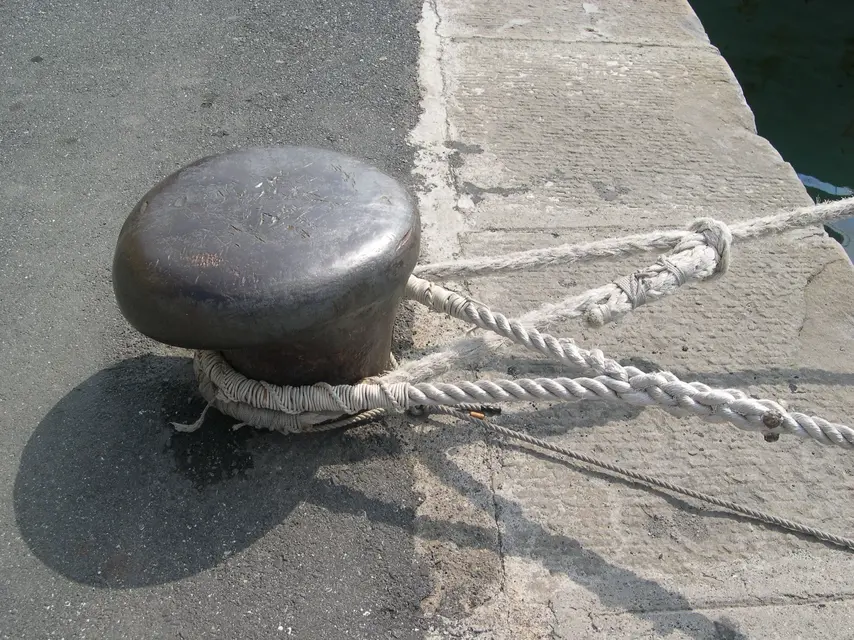
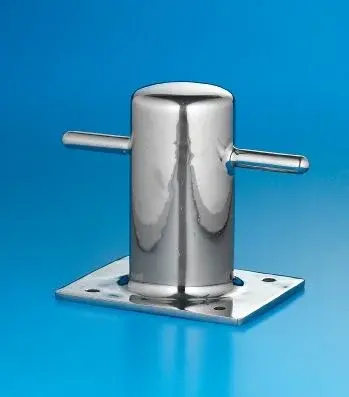
bitta is the nautical term with which it is indicated a low and robust column, which is located on the docks of the ports and on the bridges of the boats, and to which are tied or wrapped the mooring cables

1/32 is given by the formula reported on the iso

tmax=32f/pigreco*(from^2 to^2)
 
He forgives any of my straphalcions but I don't know what a bitta is.
prof: "Tell me, how do I decarburize the cast iron? "
"Well, injecting oxygen or air... "
"Is that enough? "
All: "well... yes..."
prof: "you know what a bit is? "
all: "no.... :confused:"
prof : "the bitta is that column that is located in the ports to moor the boats"
all: "ha.... :confused:"
"You know... made of cast iron. but in trieste despite the bora do not become steel! You know why? because to make decarburation happen it is essential that the cast iron be melted!"

:biggrin:
 
... I consult the iso 3913 and from the table of figure 1 it turns out that I have to realize a bitta dn 160.
now, always using iso 3913 I'm calculating the breaking load f using the values related to dn 160
don't you have a chance to consult the unv? bits are already sized and, even if you have to make one of "design", you can take them to reference.
until 3 when I return to the office I can't tell you which onev is, but if you need to know or have the reference dims, I can check.
I don't know what a bit is.
I'll give you three different types.
one from dock, one from bow and one from boat.
 

Attachments

  • Bitta.webp
    Bitta.webp
    869.5 KB · Views: 16
  • bitta%20prua.webp
    bitta%20prua.webp
    8.6 KB · Views: 26
  • Bitta4.webp
    Bitta4.webp
    33.3 KB · Views: 24
Can you tell me where to find these regulations?
Thank you.
I looked for a bit with google but even if I find many references to the unv, I do not find the address to which to request them.
If you can wait a few days, I'll give you all the info you need.
 
Good morning.
a client gave me the en of the boat that is building and the breaking load of the top, asked me to dimensional a bitta.
I am a consultant to the iso 3913 and the table of figure 1 shows that I have to make a bitta dn 160.
now, always using iso 3913 I'm calculating the breaking load f using the values related to dn 160

steel 360 n/mm^2 - yeld stress 235 n/mm^2

d= 168.3 mm
from = minimum outer diameter of the tube = 166.617 mm
(d-1%)-2(t-15%)= 149.617 mm
tmax= 60% of yeld stress = 141 n/mm^2
♪ [pigreco*Tmax*(Da^2-da^2)]32 = 74417 n about 7 t

If I did not make mistakes, the result is greater than that tabled.
Now I ask myself:
1- the calculation is right?
2- if the calculation is right, is there a security factor to be multiplied to the found value?

Thank you.
I found iso 3913 and the formulas are what you wrote.
as soon as I get home check on the cafiero and then on the unv.
but the safety factor you have not already inserted it considering 60% of the yield, i.e. a degree of about 1.6?
Then we can discuss whether it is a sufficient value but it seems to me that it is the safety factor (or the cold gave me to the chiorba).
then if you have a 7 ton shot, you have to take a look at the bridge on which the bitta insists.
 
Last edited:
Thank you for your help. I'll wait with impatience.
for the bridge the problem is not my :)
Thank you.
 
Christmas holidays are over and we went home. I have thus given, by curiosity, a read to the copy of the “manual of the naval technician”, published in 1926, which I guard as a relic.
only for informational reasons, I thought I would reproduce the method used at the time (up to 85 years ago) for biting.
common-type bits: ordinary, cast iron, sometimes for lightness of molten steel; generally used in the merchant navy, often even in the war navy; normal equipment for each bastion, 4 of 1^ size and 4 of 2^ size, equally distributed prora in proximity to the salt muline and aft near to the tonnage winches, and an affordable number of bits for the bedding services, along the walls on the open deck of the ship; rigidly connected with the hull through passing pins and with the interposition of an oak wood heel between each bitta and the metal strip of the hull.
the diameter of the bitta (d) is usually established in relation to the mooring cable, or length l of the hull. the proportion of the bitta is executed in relation to the diameter d, supposed this = 1.

for casting steel bits the thickness may be slightly reduced. each bitta will be fixed to the hull by means of eight passing pins of the diameter = 0.11 d + 5mm.
in the attached pdf you will find the text, tables and the reference design (also in holiday touches me will work!) :biggrin:
 

Attachments

thanks exatem for the document,
the first table is clear, given the length of the hull I find the diameter of the stem of the bitta, the second table instead is a little less.

Are the various values factors to get the other bit size given the diameter?

or, do I have to multiply to x to excel? ? ?

Thank you.
 
thanks exatem for the document,
the first table is clear, given the length of the hull I find the diameter of the stem of the bitta, the second table instead is a little less.

Are the various values factors to get the other bit size given the diameter?

or, do I have to multiply to x to excel? ? ?

Thank you.
Yes, they are coefficients depending on the diameter.
Keep in mind that it is a table of 1926.
When I get back to the office, I'll give you some more recent data.
Bye.
 
Thank you very much.
You know I'm desperately looking for where I can buy the manual that you have, I want to give it to the baby, that is for my birthday.
:smile:
 
Thank you very much.
You know I'm desperately looking for where I can buy the manual that you have, I want to give it to the baby, that is for my birthday.
:smile:
"the manual of the naval technician" of f. cafiero.
I have a copy of it from 1926 that I found years ago on e-bay and that I bought on the fly.
I have another one in the office in 1957, but it's not mine. is the property of the administration.
Unfortunately that of 57 is the last edition, printed by the typography "modern" of spice.
We contacted the typography but I don't think they'll ever reprint it.
today it would be completely rewritten updating it to the regulations in force.
still remains a nice text to have in the library was nothing but for the historical value.
if you find it in some market or on some site, buy it (before I do it:biggrin:).
Bye.
 
Last edited:
an update on the subject.

from the manual of the naval technician third edition 1957 - f. cafierothe disposition of bittens, hollows, thorns, galloccies, rollers, rings and the like, is dependent on the type and size of the ship, as well as the special service to which it is used, subject to other indoor installations.
calculation of the naval bitta
bittens are calculated so that the cable breakage load still has a safety stress on the bit, taking into account any reinforcements and weakening due to the nailing.
bitten proportional moment: mf=f*h where: f cable or chain breaking effort; h lever arm; to be considered only the stress at the bending or only at the cutting according to the > 0.25d or l<0,25d being of the diameter of the bitta.
biting
bits can be connected to the hull by means of nails or passing pins, if merged and overlapped to the bridge; crossing the bridge and arrested and connected to a reinforcement sheet set under the bagli if of considerable size and robustness and fuss. a first verification of the nailing can be made taking into account the cutting effort f; the admissible stress must be k > f :sn; being "s" the section and "n" the number of chiavardes, usually 6-8.
then the manual continues with tables for the sizing according to the type of ship, the size, etc. etc.

I looked at the one on the bits is 5771.1 - naval bits with parallel stems.
for the unv, list Italian naval norms, it seems impossible but I can not find any address.
my list (from 1987) only reports genova, via iv November n° 6.
 
just to do the point of the situation.
both the iso, and the cafiero, and I also believe the unav report as sizing the bending stress (although I have placed only the formulas of the cutting stress of the iso).
at this point I use all three calculation models from the iso, unav and cafiero, to make a comparison?
Thank you.
 

Forum statistics

Threads
44,997
Messages
339,767
Members
4
Latest member
ibt

Members online

No members online now.
Back
Top