
• This forum is the machine-generated translation of www.cad3d.it/forum1 - the Italian design community. Several terms are not translated correctly.

boolean operations together?!? ! ? !

  • Thread starter Thread starter Sp4rk0
  • Start date Start date

Sp4rk0

Guest
Hi, I wanted to know if there's a way to use Boolean functions in a set.
I already have two tubes created in two different parts, I have to put them in a set and mate them with a certain inclination,
Is there a possibility with some quick function to create the exact hole for the coupling of the two tubes or do I have to make an extruded cut? ?
if I create the two tubes in the same part I use it pairs and with the subtraction I get the precise hole, but in this case the parts have already been created. . .
Thank you, morning.
 
I also needed to know if solidworks did boolean operations, like, "you're gonna take." then I discovered that solidworks does it but only with two separate parts, i.e. two different files. If you want to do an addition with a cube and a ball, you should have two separate files and then use the comamando "combine" in English and add or subtract them. . .
 
if you already have a set with the tubes positioned you can:
- activate the part to drill
- copy the outer surface of the pipe you will use to make the hole (offset surface with distance 0)
- use this surface as a cut (input>cut with surface)
consider that in this way you have an active external connection (so it will automatically update to any variation) that depends both on the axieme and on the side.
 
if you already have a set with the tubes positioned you can:
- activate the part to drill
- copy the outer surface of the pipe you will use to make the hole (offset surface with distance 0)
- use this surface as a cut (input>cut with surface)
consider that in this way you have an active external connection (so it will automatically update to any variation) that depends both on the axieme and on the side.
Thank you very much!!! I actually did this but I thought it was possible to do some other way, thanks again, morning.
 
In the assemblies instead of the matching command there is the cavity command, which allows to subtract one part from another. change in the context of the assist the part "to dig" and select the command insert\functions\cavita'. you select the body to be subtracted, and this will form a cavity in the modified body.
instead to connect one body to another there is, just below, the joint command. same behavior as the previous one.
 
Thank you very much!!! you have opened a world and solved many problems!!! thank you so much! !
 
Actually, what you're saying doesn't make me do it, at least not together... on the parts, but in the assemblies no... and cavities and conjuncts are part of the mold controls. .
 
Actually, what you're saying doesn't make me do it, at least not together... on the parts, but in the assemblies no... and cavities and conjuncts are part of the mold controls. .
"cavity" and "conjuncts", together, only work that, as had already indicated oldwarper, you have to change a part, which will be the basic part from which to subtract the other or to which to join it.
 
Good morning I read this conversation again.
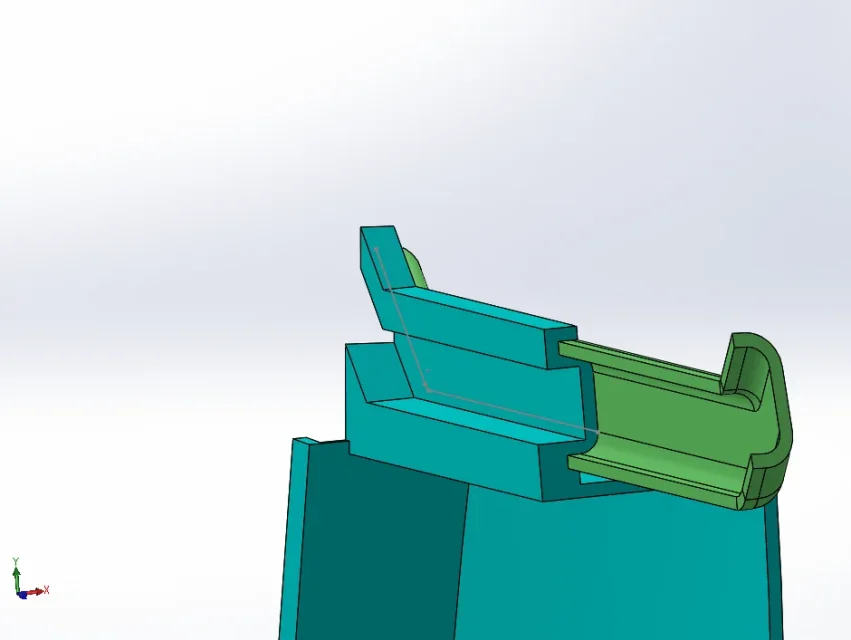
If you want to create a support (blue) that fits into the green one, I have to shape according to the green profile trend or use an ad hoc command?
I don't think it's correct with the cavity command, is there anything complementary?

greetings

fly
 

Attachments

  • Immagine151.webp
    Immagine151.webp
    21.7 KB · Views: 5
in combination nn you can do boleane operations but you can solve by saving the axieme as part and dealing the whole in multibody.

idem uses the multibody copy the part to be framed (if you need tolerance for nn having the 0 scale set the copied part) and remove the copied part in this way you have the perfect enclosure
 
in conjunction nn you can carry out bolean operations
I know if that's possible. there are cavity and conjunct functions that can only be used in changing part in the environment together.
 
in combination nn you can do boleane operations but you can solve by saving the axieme as part and dealing the whole in multibody.

idem uses the multibody copy the part to be framed (if you need tolerance for nn having the 0 scale set the copied part) and remove the copied part in this way you have the perfect enclosure
I didn't understand the part of tolerance. .
 
hi volaff in my field (stamps and molding) it is necessary to establish the tolerance for both assembly (e.g. insert a plug of 10 in a hole of 10 needs press and often to heat the female part to make the material dilate and to let the plug enter better) than for work for example if a particular will work at 90° it is necessary to determine how much it will spread and leave the right tolerance for nn to incorrect grips.
 
massivonweizen
thanks to the right now I will also try in conjunction with the commands you suggested. when I happened I had solved saving everything as part then having solved I took that as the correct way:)
 
hi volaff in my field (stamps and molding) it is necessary to establish the tolerance for both assembly (e.g. insert a plug of 10 in a hole of 10 needs press and often to heat the female part to make the material dilate and to let the plug enter better) than for work for example if a particular will work at 90° it is necessary to determine how much it will spread and leave the right tolerance for nn to incorrect grips.
I understood why tolerance but not how to achieve it in sw.
In fact, with the cavity command, for example, you get a "female" part of a m"mask" starting at tolerance 0, without any tolerance or offset.
 
hi I usually use the scale command that allows to make bigger or smaller all the particular, once climbed I go to subtract it. is the same procedure that I use to calculate the rites of the material. I'll play a video in English https://www.youtube.com/watch?v=ur4gzoy4xiw
Thank you very much.
Could you attach an easy scale and subtraction sample file?

:
the problem is to understand which is the scale factor to use.
I'll explain.

if I wanted a surface offset of 2 mm I have a finite measurement not a scale factor (to be calculated " ad hoc")
 
volaff, I'll give you the example you asked me. I started from a plug of 10, I copied the element, climbed 1.2 +20% and got the plug of 12 with the 2 mm extra light, then I bound it to the solid and subtracted, inserted the plug of 10.
in this case I climbed according to cordinate only the diameter leaving the length of the bar unchanged. in other cases I call all the particular. not always is an orthodox method but often speeds up the work especially on imported details.
 

Attachments

volaff, I'll give you the example you asked me. I started from a plug of 10, I copied the element, climbed 1.2 +20% and got the plug of 12 with the 2 mm extra light, then I bound it to the solid and subtracted, inserted the plug of 10.
in this case I climbed according to cordinate only the diameter leaving the length of the bar unchanged. in other cases I call all the particular. not always is an orthodox method but often speeds up the work especially on imported details.
Thank you very much
 

Forum statistics

Threads
44,997
Messages
339,767
Members
4
Latest member
ibt

Members online

No members online now.
Back
Top