
• This forum is the machine-generated translation of www.cad3d.it/forum1 - the Italian design community. Several terms are not translated correctly.

calcolo volume

  • Thread starter Thread starter aerox
  • Start date Start date

aerox

Guest
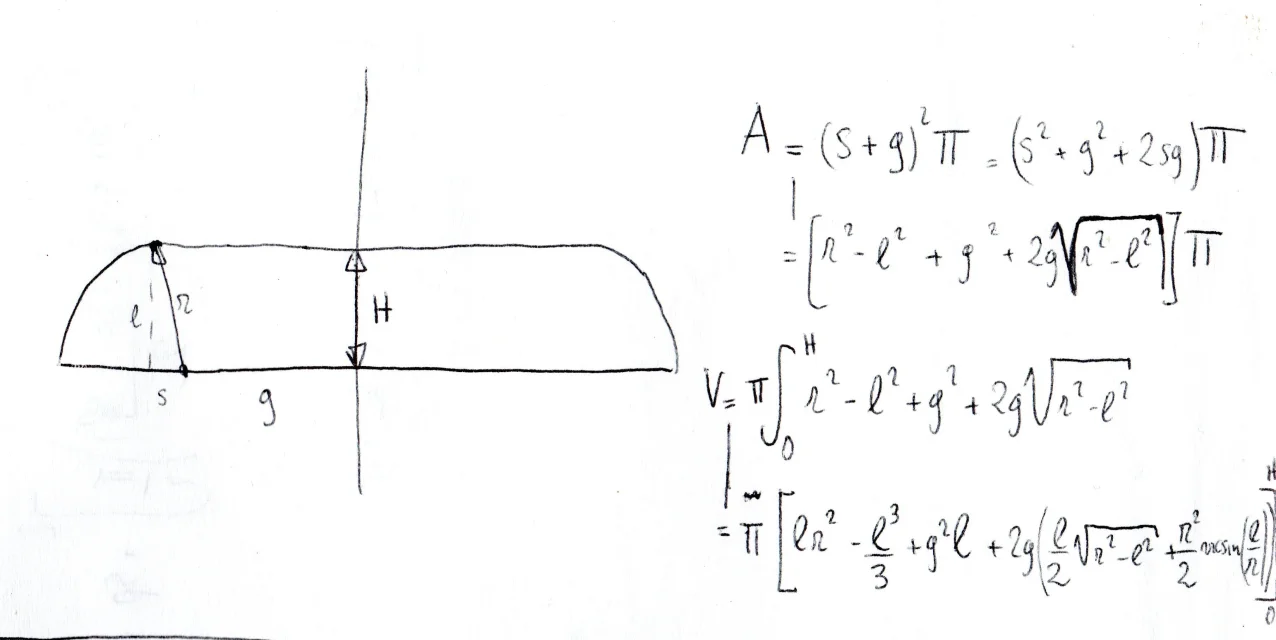
img008.webpGood morning to all, I didn't sleep tonight to try to solve this problem: I want to calculate the volume of a ball section. the problem is that the radius of the curve is not equal to the base radius... the design should be explanatory.

I have dared this integral that "numerically" seems right but I do not put my hand on fire

(r))

that according to my weak abilities becomes

(l) (l)(l)(l)(l)(l))(l))(l))(l))(l))(l))(l))(l))(l))(l))(l)(l))(l)(l))(l)(l)(l)(l)(l))(l)(l))(l)(l)(l)(l)(l)(l)(l)(l)(l)(l)(l)(l)(l)(l)(l)(l)(l)(l)(l)(l)(l)(l)(l)(l)(l)(l)(l)(l)(l)(l)(l)(l)(l)(l)(l)(l)(l)(l)(l)(l)(l)(l)(l)(l)(l)(l)(l)(l)(l)(l)(l)(l)(l)(l)(l

Good Sunday to all, I am at home with the percui influence this is the only thing I can do:p :)

Hi.
 
check the integral and do it to wolfram whistle and if you want to verify, draw the solid with a 3d modeler and make them calculate the volume. compare the two and see if it is right or wrong.
 
Thanks for the link, I didn't know it, I try it right away. cmq I have done some tests with swx and calculates the same values :) I will have to think a moment how to calculate the volume thinking that the above object is to horizontal development and is "filled" upwards... I'm done tonight so step!

night at all
 
question more than ever idiot: but if you considered solid as half of the sum of two spherical caps and a cylinder you didn't simplify your life? :confused:
 
Sorry I'm late! I think you can't do it as you say, because that bombed bottom is filled with water, maybe it was spherical;-)
Now my problem is to think if instead the bottom is part of a horizontal reservoir and then with its filling way... I have to think about how to set the integral properly, without doubt there are three integration zones in relation to the value of the filling quota.
 
I remember something like that seen at the university but I've never been good at these things... for now I have managed to find the area of the second circle segment according to the height of the segment (which is equivalent to the level of the filling liquid), now I have to try to integrate in some way ;)

Good Saturday to all!
 
I tried to think about it but for now the bulb has not turned on, the solid in question is this:
spicchio.webpthe known things are r and r, and the height h, who helps me to set an integral (I think triple) that allows me the correct theoretical calculation of the volume to vary the filling quota h?? ?
 
it takes the good guldino: the only two integrals that you have to do are one for the calculation of the radius portion area and the other to find the centerpiece of the portion itself respect a reference that you will decide (that then it is also useful to calculate the centerpiece of the whole section)... :finger:
 
I thought about it but I don't understand how I could apply guldino pimp if the solid is not generated by a rotation around the axis: perhaps the image I posted "inganna", I explain better, suppose to have a bowl placed vertically (as in figure) and hypothetically to fill it with a fluid: it is seen that the liquid rises vertically, so the volume that is created is not the result of the rotation of a flat figure around an axis (or better what I am interested in is the result of a portion of this volume subdued from the plane defined by the liquid quota).

according to my logic you should apply a double integral, the first calculates a vertical slice, that is the area (depending on the filling quota), the second should give me the volume according to the curve that I can not think how to write it... In short, I am in the high sea with this matter:
 
I thought about it but I don't understand how I could apply guldino pimp if the solid is not generated by a rotation around the axis: maybe the image I posted "inanna"
deceives a lot also because in the first you put an h that makes this variable think as filling, in the second it seems there is a positioning error.
Could you post an image in which they are clear x,y,z and h?
thanks and hello
 
an idea came to me following the idea of the pimp... Now I see if I can put it in excel;-)
 
looking at the figure to me seems a solid of revolution that has as a generating section a "right trapeze" that instead of having the right side has the piece of radius circumference r. therefore when you calculated the area of that section and the center of gravity respect the "axis" r with guldino you are affixed! :finger:

always if I did not wrong to interpret the photo....
 
guldino.webpI don't remember well, but I think that by doing as you say I calculate at the end the volume of the opening "picchio" theta, instead I would like to calculate the volume of that snitch but cut with that plan, that plan has the geometric meaning of the "level" of filling. Now if I calculate the volume of the clove (that I should have succeeded with guldino) and to this remove the volume of a triangular prism (it should not be difficult) I should find the volume sought ;-)
I have little time to test but I can tell you what's coming out of it:) in the meantime thanks a thousand counterblow hammer for your answers;-
 
the good guldino... !

the calculations as a complete revolution and divide it for the relationship between the corner and the corner of your revolution all in radiant... .

And voilà! the game is made... .
 
by dividing the guldino result for (2pi.greco/beta) you get the spice, but I fear (looking the sketch posted) that you do not make a stern, as with this system you get the volume of the spice cut with two normal planes to the circular trajectory stopped to beta, while you need that of the snipe cut with a normal plan to the face of the incriminating field.

I think I'm going to have to go back to everything I said :rolleyes: and tell you that it takes an integral triple to solve this. but! luckily it is an integral triple for layers, therefore on excel create a quite dense map of the values of the individual layers according to the coordination l; at this point you just need to integrate these layers from o÷l and the game is done. :cool:

p.s.: to do the integrals with excel you find by handing out on the net how to implement the method of knights-simpson on excel obtaining very reliable results... :mixed:
 

Forum statistics

Threads
44,997
Messages
339,767
Members
4
Latest member
ibt

Members online

No members online now.
Back
Top