
• This forum is the machine-generated translation of www.cad3d.it/forum1 - the Italian design community. Several terms are not translated correctly.

calculation bolt lock

  • Thread starter Thread starter gil
  • Start date Start date

gil

Guest
I would like to deepen the argument of the tightening of bolts in building buildings, but I discover with dismay my great ignorance in this matter. I therefore ask your help and understanding.
the standard ntc2018 clearly indicates what are the clamping values for preload bolts.1.pngalso indicates the method of calculation.
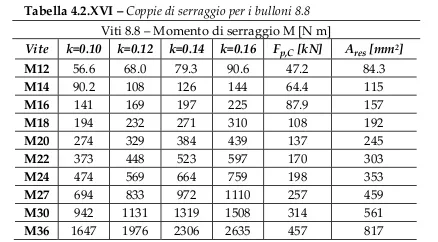

2.pngI'm going to try. we take the case of a bolt m16 with k=0,16
m=0,16 * 16 * 0.7 * 157 * 800 = 225’075 value 1’000 times higher than in table. Why?
ps: 157 is the resistant rated superifice of a m16 according to uni en 15048-1
800: it's the tensile strength in nmmq

how to calculate the traction of the bolt (preload) in relation to the clamping?
 
I'm going to try. we take the case of a bolt m16 with k=0,16
m=0,16 * 16 * 0.7 * 157 * 800 = 225’075 value 1’000 times higher than in table. Why?
I throw them: why to is expressed in mm2?
 
I'm a chicken. thanks for the correction.

225'075 n*mm / 1000 = 225 n* m

and of course the prepayment will be = 0,7 * 157 *800=87'920
I'm thinking about it tonight, and I see if I get the rest. because I had a lot of doubt.
 
to redeem myself from the acuteness written in the first post, I write explanation.

ntc 2018 cap. 4.2.8.1.1 establish that:
the moment of tightening m for such unions is equal to:
m= k × d × 0.7 ares × ftbk [4.2.6.1]
where:
d is the nominal screw diameter
ares is the resistant area of the screw
ftbk is material resistance
k is indicated on the package tags for the three functional classes

for example we consider a bolt m16, having a resistant area of 157mmq, cl 8.8 with yield resistance 640n/mmq, breaking 800n/mmq , value k =0,16 with controlled clamping.
the yield strength for traction of the screw will be:
rs = 157mmq x 640n/mmq = 100'480n
the breaking resistance for traction of the screw will be:
rr = 157mmq x 800n/mmq = 125'600n

However, the legislation establishes a calculation for safety with reductive coefficients specified in Chapter 4.2.8 tab.4.2 xiv:
γ m2
γ m3 for slu 1,25
γ m3 for sle 1,10
γ m7 controlled clamp 1.0
γ m7 uncontrolled clamping 1,1
paragraph 4.2.8.1.1 is indicated that:
(...) a friction bolt will be calculated by taking a preload force of 70% of the last tensile strength of the bolt. the heat of the precarious force (...) is equal to:
fp,cd = 0.7 x ftbk x ares / γ m7 [4.2.62]
so in our case we get
fp,cd = 0.9 x 800 n/mmq x 157 mmq / 1,25 = 90'432n
the moment of tightening m (...) is equal to:
m = k x d x fp,c = k x d x 0,7 x ares x ftbk [4.2.61]
applying
m = 0.16 x 16mm x 0.7 x 157mm x 800 n/mmq = 225'075 n mm
or 225'075 n mm / 1000 = 225 n m

from which we can verify that the voltage of the screw is:
fp,c = m / (k x d) = 225'075n mm / (0,16 x 16mm) = 87'919n

since
(1) fp,c < fp,cd
2) rr x 0,7 = fp,c
values are consistent.
in case the moment of tightening is not reported on the tags of the packages, but compaia the only factor k can be referred to the tables indicated in the norms

Now I have this doubt. the bolts for constructions not from preload type uni en 15048-1as they have to lock? ok, that you are not required to check the pair, but I suppose there will be a maximum indication somewhere in the rules. Otherwise in theory one could even screw them to bare hands.
 
The screws normally pull 70% of the yield regardless of whether they are special preload bolts certified or not.
Then it depends on the application, it could also suffice 1nm of tightening always and anyway because if the structure loads on the head of the bolt from m16 it will be she to resist that force. certainly is an irresistible practice because with little you have an unstable structure.
then returns to 70% rs...as a maximum value for non-strength screws, as mentioned by uni en 1993-1-8:2005 and following:[math]f_{p,cd}=\frac{0,7•f_{ub}•as}{\gamma_{m7}}[/math]however as reported qui, the sb bolts pull up to grip condition, so maybe 30% without reaching 70% since there is no measurement.
 
Last edited:

Forum statistics

Threads
44,997
Messages
339,767
Members
4
Latest member
ibt

Members online

No members online now.
Back
Top