
• This forum is the machine-generated translation of www.cad3d.it/forum1 - the Italian design community. Several terms are not translated correctly.

calculation section slot

  • Thread starter Thread starter Alarast00
  • Start date Start date

Alarast00

Guest
fessura.webpHello everyone,
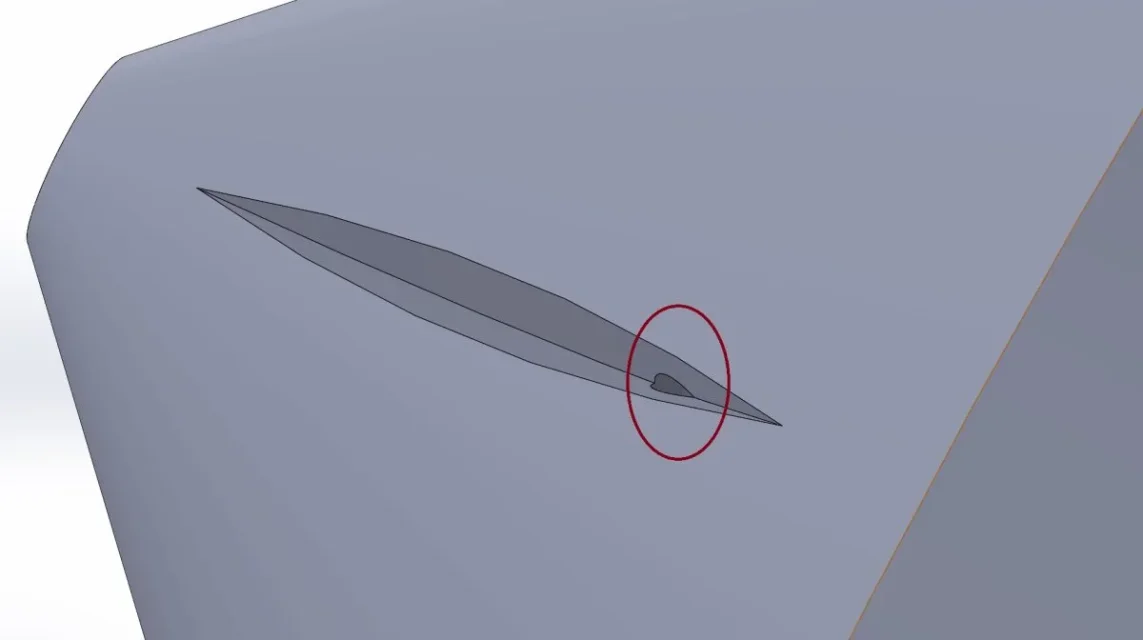
I would have the need to calculate the section of the slot shown in the attached images, the purpose is to be able to correctly size the flow of a fluid that crosses it. the slot is obtained by a non-passing hole with a tilted round tip (hole.jpg) and then intersected with a cut obtained by a disc cutter with triangular section cutter (cut.jpg). can you use solidworks to measure the slot area?

Thank you.
 

Attachments

  • hole.webp
    hole.webp
    14.3 KB · Views: 21
  • cut.webp
    cut.webp
    17 KB · Views: 21
measuring instrument and selections all surfaces
Thanks for the quick response, but I need to measure the "hole", the section that will be crossed by the fluid, not the surfaces around. the measuring tool allows me to select the edges of the slot and get a sort of perimeter, not the section (area) of the hole.
 
create a surface with the edges of the hole and get the area
or, being the hole formed by two triangles, you calculate the ogbune area and then do the sum
 
Last edited:
Hello, I assume I don't know solidworks, but I think the concept is worth all cad..
the measurements carry out them on something "existing" and then you can measure the area of a surface (full), but not the area of a hole (empty). .
reason why, or do as suggested by boulders, or do in sequence:
- cut with disc brake
- misuri area of surfaces generated by cutting
- cutting with round toe tool
- remixes area of surfaces generated by cutting disc cut
- for difference between the 2 areas find the hole area.

Hi.
 
Hi.
a clarification: the section is not represented by two triangles because there is the processing of a spherical tip immediately under the cut of the disc cut, it is a "ball pin" (perdonate me the term not really technical).
I still think I found a solution: I selected the slot profile and used the "surface filling" function by getting the ball pin, at that point with the measuring instrument I managed to measure the area. I have not yet been able to verify whether in reality the flow corresponds to the calculations with the surface found, but I think it is geometrically correct (to tell the truth I have some doubt :) )
surface
 
I still think I found a solution: I selected the slot profile and used the "surface filling" function by getting the ball pin, at that point with the measuring instrument I managed to measure the area.
create a surface with the edges of the hole and get the area
or, being the hole formed by two triangles, you calculate the area of each and then do the sum
And it's not the same thing?
 
Hi, you questioned me. .
perhaps the area of the ball clove is not exactly correct, to calculate the passage section. .
the surface indicated by stones (a blend between the 2 arched edges) represents the minimum passage section. .
Even though, do you need to be so precise?
where is it? Thermoplastic injection?

hello and good work.
 
Hi, you questioned me. .
perhaps the area of the ball clove is not exactly correct, to calculate the passage section. .
the surface indicated by stones (a blend between the 2 arched edges) represents the minimum passage section. .
Even though, do you need to be so precise?
where is it? Thermoplastic injection?

hello and good work.
I agree, according to me to calculate the spherical surface in the perforated area is an approximation for excess.
 
make the doubt come to me too:d
I tried to cover the sections to better understand, it seems to me that the ball's eye is realistic... I try to add two images with the view in section in conjunction with the slot, in the second, I highlighted the filled surface I created (it distinguishes the blue profile).

are dosing nozzle holes accuracy is quite important but apart from that (which would require empirical verification given load losses) I would like to understand geometrically what is correct to select.
Sections
 
to take away your doubts, take a ball of balls, and a cylinder clove, who has the minor area wins. .

also because, in section, the ball-pipe generates an arc, while the cylinder clove generates a line, which is why the lower area should be that of the cylinder coil.
 
I'll tell you what. but the passage area is not the one that corresponds to what you see looking at the hole perpendicular to its axis? I mean, if you make a drill hole the passage area corresponds to a circle. I hope I explained.
If you do a dwg with view of the slit on the floor I make a measure with autocad
 
I'll tell you what. but the passage area is not the one that corresponds to what you see looking at the hole perpendicular to its axis? I mean, if you make a drill hole the passage area corresponds to a circle. I hope I explained.
If you do a dwg with view of the slit on the floor I make a measure with autocad
the reasoning also for me is right, it forms an ellipse and the area is calculated with a perpendicular view to the hole
 
si, e ni...@massivonweizen If the hole intersects the throat not in the axis, and then the opening that is formed is not on the axis of the hole, you can not do so. .
to plant that slot you have to create a floor between the 2 extreme points of the eye, and with a "symmetrical" angle to the 2 faces of the throat.. .
then you can measure the section as projection of the edges on that floor.
 
We exaggerate the situation.. If that hole was passing.. would be perfectly circular and its area would be given by the size of the tip.
 
Yes, if it were passing, but instead the crack is formed in the intersection between the spherical point hole and the triangular throat, and not in the hole axis. .
unless the hole axis is on the same plane and orthogonal to the circumference of the throat. .
 
Yes, if it were passing, but instead the crack is formed in the intersection between the spherical point hole and the triangular throat, and not in the hole axis. .
unless the hole axis is on the same plane and orthogonal to the circumference of the throat. .
I don't insist, but it's less messed up than it looks.
the section should be calculated with a perpendicular view to the direction of the hole (point) and in the specific case a kind of ellipse is formed.
a simple dxf or dwg
 

Forum statistics

Threads
44,997
Messages
339,767
Members
4
Latest member
ibt

Members online

No members online now.
Back
Top