• This forum is the machine-generated translation of www.cad3d.it/forum1 - the Italian design community. Several terms are not translated correctly.

calculations that do not return on load losses

  • Thread starter Thread starter Giacomo Lepore
  • Start date Start date

Giacomo Lepore

Guest
Hi.
I really need help getting out of this situation. I'm not an expert on plumbing, so maybe I made a few trivial mistakes, be clementi.

I have a hydraulic system consisting of two parallel pumps, a distributor, some rubber tubes and fittings and then finish on a hydraulic motor. Mix flow and pressure at the entrance of the hydraulic motor and pressure to the pumps. the system works around 260 bars and a range between 60 and 75 liters per minute depending on the load applied to the engine.

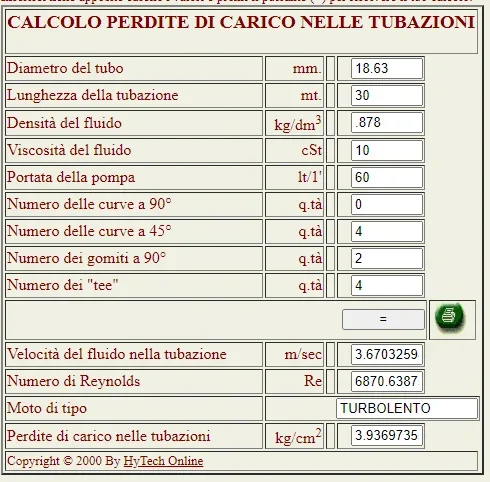
I try to calculate the loss of load between the two measuring points of the pressure (use darcy-weisbach with lambda obtained from the formula of colebrook-white) and I find myself a couple of bars. but I mix 30 with a tube of 3/4''' and 60 with a tube of 1/2''. then I try to make calculation with this site: <https://digilander.libero.it/hytech/calcolo tubation.html> and the results are very close to my calculations (I think the online computer uses blasius, I colebrook, so I should be slightly more accurate).

Can you help me figure out how a couple of bars spread to become 60 bars in reality?

I tried to impose an equivalent length such as to get 30 bars in one condition waiting for me to find 60 in the other, and instead so I find more than 100 bars of pressure drop, so something is happening that is less than square than speed.

I would give you some extra data, but I don't know, ask.

Thank you.
 
the load losses you have in your system are not only due to the length of the pipes but to the concentrated losses each fitting, valve, elbow etc.
each fitting has the central hole which is smaller than the tube...so the total pressure falls.
 
the load losses you have in your system are not only due to the length of the pipes but to the concentrated losses each fitting, valve, elbow etc.
each fitting has the central hole which is smaller than the tube...so the total pressure falls.
Hi.
concentrated load losses were considered in the calculation. but also those depend on v^2.
 
What length do the pipes have?
Do parallel pumps work simultaneously? If yes, how are the pumps flow distributed? 50% and 50%?
 
It would be convenient to have a plumbing scheme to understand how leaks are distributed. .
 
What length do the pipes have?
Do parallel pumps work simultaneously? If yes, how are the pumps flow distributed? 50% and 50%?
about 30 meters. pumps turn at the same speed and therefore have flown 50% and 50%.
 
Yes, it would be nice for me to know how they built the plant. . .
Clearly, you didn't design this plant. but in order to calculate the load losses you will have to have a small hydraulic scheme to understand how to apply the load losses (curves, fittings, adhesives, pumps etc.). then in the first post you say that you misuse the incoming pressure and send it to the pumps. in this way the hydraulic data only of the pumps and not of the plant. I can't figure out how the plant is conformed.
 
Try to measure the pressure to the head of the distributor, I would not like there was a problem there
 
so before or after the p distributor on the branch you have 260 bars? After that the branch enters the dotted area and at the exit you have in reality 60 bar in the calculations 3.83 bar.
I have 260 bars before the distributor.
It's as you say, misuro 60, calculation 3.83. if the pressure drop was the distributor, this would have a k=960 while normally the k is between 0.3 and 2.

Moreover, if I put a concentrated loss with k=960, when I change the tubes and put them from 3/4 calculation 21bar and I mix 26 (24% more, it is not little). therefore the formula that shapes the concentrated load loss is not centering the phenomenon.
 
I have 260 bars before the distributor.
It's as you say, misuro 60, calculation 3.83. if the pressure drop was the distributor, this would have a k=960 while normally the k is between 0.3 and 2.

Moreover, if I put a concentrated loss with k=960, when I change the tubes and put them from 3/4 calculation 21bar and I mix 26 (24% more, it is not little). therefore the formula that shapes the concentrated load loss is not centering the phenomenon.
the distributor is the p or the treated area. In my opinion I think it's the p and of course your pressure gauge has it installed before the user. That's what you're saying. .
in any way try to post the calculations so we can check them eventually.
 
Try to measure the pressure to the head of the distributor, I would not like there was a problem there
If so, I think it would have a problem with the pumps, right? practically should dispose of the pressure difference. .
 
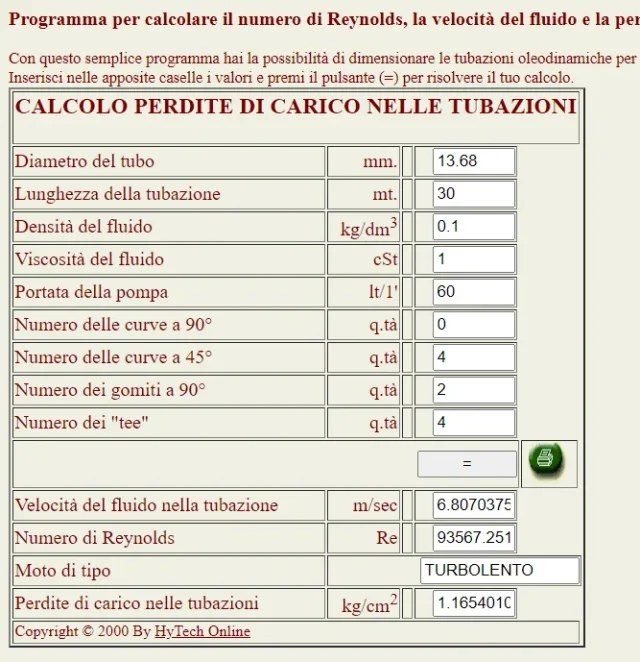
1.webpthe cst of the water at 20° is pairs to 1. I have rounded to 0.1 kg/dm^3 and I turn out to be about 1 bar.
So, as you say, you should be in the pressure gauge near the user (theoretical) 259 bar instead of 60 bar.
 
the cst of the water at 20° is pairs to 1. I have rounded to 0.1 kg/dm^3 and I turn out to be about 1 bar.
So, as you say, you should be in the pressure gauge near the user (theoretical) 259 bar instead of 60 bar.
is hydraulic oil with viscosity 46 cst. the temperature of use is about 80°c that brings viscosity to 10cst.

That's right. I should find 246 bars and I'll find 200.
 
is hydraulic oil with viscosity 46 cst. the temperature of use is about 80°c that brings viscosity to 10cst.

That's right. I should find 246 bars and I'll find 200.
ops I ask vein I was not attentive to the pressures in play and I banally hypothesized water.. ?
but inside the dotted area is there any other device (pressure reducer) installed?
 
is hydraulic oil with viscosity 46 cst. the temperature of use is about 80°c that brings viscosity to 10cst.

That's right. I should find 246 bars and I'll find 200.
but does not the pressure also depend on the downward resistance? maybe you have too yielding load and then turn part of the piezometric energy into kinetic energy of the fluid column? in what conditions of use do you find 200 bars instead of 260 waits?
 

Forum statistics

Threads
44,997
Messages
339,767
Members
4
Latest member
ibt

Members online

No members online now.
Back
Top