• This forum is the machine-generated translation of www.cad3d.it/forum1 - the Italian design community. Several terms are not translated correctly.

calculator chain development wrapped between two pinions/corons

  • Thread starter Thread starter MauroTC
  • Start date Start date

MauroTC

Guest
taken from a return of inspiration and paranoia from orange area :rolleyes:, I spent a few hours making a new tool, to calculate the correct development of a chain, wrapped between two pinions/corons, which as (almost) always share with colleagues designers.
even if at present everything can be obtained almost automatically with graphic sw, (autocad mechanical, inventor, etc...) I wanted to do something that would allow to obtain the chain ring with a few clicks.
use is intuitive and there is little to say, just enter the 4 input data and get the theoretical development; as it will hardly "beak" a combination of step / dp that give rise to a chain with number of whole shirts, the program will recommend the correct distance to get a chain with a certain number of links.
Taking confidence you can also use it to find developments in belts on pulleys (ignoring knitting step). . .
It's some kind of beta version, so if you find any magicians, please let me know... :sneaky:

I put the link and not the attachment only because so it maintains a unique position and replace it more easily with any subsequent updates.
developmentcategories
 
I take advantage of the topic for my curiousness: why should the number of links of a chain always be equal?
What is the so-called "falsa mesh" that you put when the shirts are odd?
Thank you.
 
Strange! :unsures:
If I put your own values to me it's okay
(although non-existent dp values)

Let's try to wait for more feedback. . .
Could it be because I opened it with openoffice?
Maybe open source blocks don't work. . .
 
This topic has already been dealt with on the forum and references to official and comprehensive guides have been made for the sizing of transmission chains.
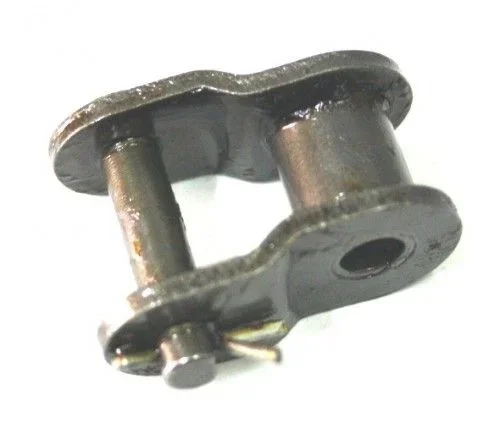
the mesh moth serves as joint by number of odd knits. Just look at a serious catalog.
a complete spreadsheet example, using serious standards and catalogs, you can find it qui....qui.
 
done.
But he doesn't say why I have to use a number of shirts.
thanks the same
try drawing the chain plates rods: a closer and a wider one....you do it for a few steps and then ask yourself how to close the chain ring. you will find the logic of the thing alone.
Screenshot_20210221_064248.jpgthe mesh made with straight plates is more resistant than the false mesh which is made from folded sheet.
joint mesh61z+C0O8vrL._AC_SX425_.jpgfake jersey449189.jpeg
 
taken from a return of inspiration and paranoia from orange area :rolleyes:, I spent a few hours making a new tool, to calculate the correct development of a chain, wrapped between two pinions/corons, which as (almost) always share with colleagues designers.
even if at present everything can be obtained almost automatically with graphic sw, (autocad mechanical, inventor, etc...) I wanted to do something that would allow to obtain the chain ring with a few clicks.
use is intuitive and there is little to say, just enter the 4 input data and get the theoretical development; as it will hardly "beak" a combination of step / dp that give rise to a chain with number of whole shirts, the program will recommend the correct distance to get a chain with a certain number of links.
Taking confidence you can also use it to find developments in belts on pulleys (ignoring knitting step). . .
It's some kind of beta version, so if you find any magicians, please let me know... :sneaky:

I put the link and not the attachment only because so it maintains a unique position and replace it more easily with any subsequent updates.
developmentcategories
a control that is missing is the collision of the pinions. If the distance is less or equal to the sum of the two rays of head... they beat each other.
other thing much more functional is to insert the number of teeth and to obtain the primitive diameter not the contrary.

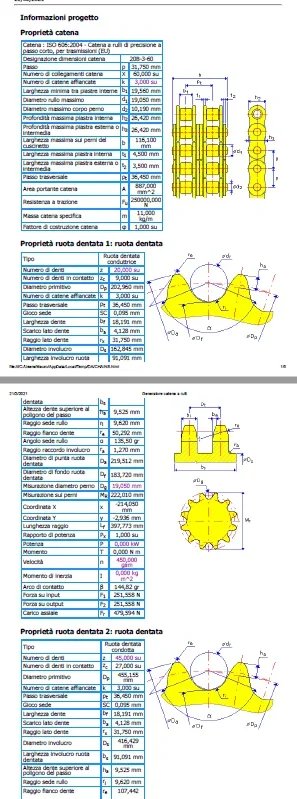
I did a solution quality test and I would say they are equivalent:Screenshot_20210221_070109.webpScreenshot_20210221_065437.webp
 
taken from a return of inspiration and paranoia from orange area :rolleyes:, I spent a few hours making a new tool, to calculate the correct development of a chain, wrapped between two pinions/corons, which as (almost) always share with colleagues designers.
even if at present everything can be obtained almost automatically with graphic sw, (autocad mechanical, inventor, etc...) I wanted to do something that would allow to obtain the chain ring with a few clicks.
use is intuitive and there is little to say, just enter the 4 input data and get the theoretical development; as it will hardly "beak" a combination of step / dp that give rise to a chain with number of whole shirts, the program will recommend the correct distance to get a chain with a certain number of links.
Taking confidence you can also use it to find developments in belts on pulleys (ignoring knitting step). . .
It's some kind of beta version, so if you find any magicians, please let me know... :sneaky:

I put the link and not the attachment only because so it maintains a unique position and replace it more easily with any subsequent updates.
developmentcategories

Hi, the link doesn't work.. .
 
a control that is missing is the collision of the pinions. If the distance is less or equal to the sum of the two rays of head... they beat each other.
other thing much more functional is to insert the number of teeth and to obtain the primitive diameter not the contrary.

I did a solution quality test and I would say they are equivalent:View attachment 61078View attachment 61079
ah but my tool did not want to have any particular calculation, but only get a "great" of chain to the flight, having the few basic data as chain type, dp and interasses.
I myself, however, rely mainly on the aid of the 3d programme, which in my choice makes me a tide of calculations and checks (of which I would not even be able. . . ) [vedi immagini] and more gives me solids.
you're right that it would be more logical to start from z, but I wanted to leave it a little more versatile; from the dp (with a catalog under hand) to be able to use it also in the search for length of smooth straps (where there is no step and therefore z). as said only a "banal" calculator of development of transmission element, between two pulleys/pignons, that you go to find arithmetically the branches tense between the two tangents and the angles wrapped and sum them, then proposes a possible adjustment, when needed.. .
(a maximum verification on the collision does, but taking into account the dp instead, as it would be right, the de; unfortunately I did not find a relationship that allowed me to find the de according to the few available data. . . )
 

Attachments

  • Trasm-2.webp
    Trasm-2.webp
    41.4 KB · Views: 43
  • Trasm-1.webp
    Trasm-1.webp
    57.3 KB · Views: 41
Last edited by a moderator:

Forum statistics

Threads
44,997
Messages
339,767
Members
4
Latest member
ibt

Members online

No members online now.
Back
Top