
• This forum is the machine-generated translation of www.cad3d.it/forum1 - the Italian design community. Several terms are not translated correctly.

car jack design

  • Thread starter Thread starter Leonardo26
  • Start date Start date

Leonardo26

Guest
Good evening to all, I'm a mechanical engineering student. for the examination of constructions of machines I have to make a jack for cars. in the sizing of the screw of maneuver I found "topples". once I determined the force that acts on the screw I dimensional it to specific pressure, but on the internet I couldn't find a supplier that also provided me with the admissible pressure for that type of screw. Someone can help me, and if I can tell me if I did the process well.
attach photos of the jack to design, sheet with procedure and excel sheets for calculations.
Thank you in advance for your help.
 

Attachments

the specific admissible pressure is determined by the material of which the screw is made and its surface heat treatment, if performed. find the tabulate value in general.. .
 
I would say that the screw of maneuver, in this crik, is not subject to pressure, but to traction.
Moreover the measure 12 x 03 is wrong, not only in writing.
If you want the maximum performance with the least effort, you have to choose a fine step, e.g. 1,25, provided for the diameter of 12 mm.
it would be good to make a clearer and less transparent writing.
 
in this video is explained the mechanism with the crick rhombus cinematism for cars.
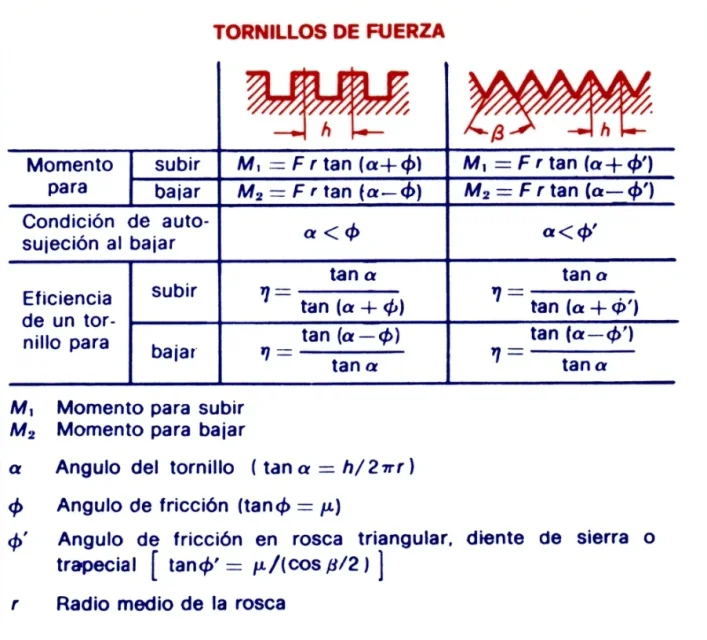
with regard to the horizontal screw of maneuver, it is subject to traction. therefore as all screws of maneuver will follow the following laws:Screenshot_20240209_233409_OneDrive.webptherefore I would taxically exclude the peak load being traction and not compression; the intake threads are subject to specific pressure by distributing the force on the area of the number of intake threads. the propeller will be subject to cut trying to tear it from the hazelnut.
I suggest you see This is what debate.
normally such a dimensioning must be expected to stay away from the yield, say at least 1.5 times, so the specific pressure value can determine it according to the chosen material.
the surface treatment will certainly improve the characteristics of friction and therefore also of the contact area.
definitely a fine step screw will be more efficient. not too fine otherwise you lose the benefit of fine adjustment, less effort.
other thing, on a hand lever it is normally expected to apply no more than 15kg man force.
 
I would say that the screw of maneuver, in this crik, is not subject to pressure, but to traction.
Moreover the measure 12 x 03 is wrong, not only in writing.
If you want the maximum performance with the least effort, you have to choose a fine step, e.g. 1,25, provided for the diameter of 12 mm.
it would be good to make a clearer and less transparent writing.
it is wrong as writing is right, but it was just a note to find it in the catalog. But I don't understand why he says it's wrong, if it's taken from a catalog for manoeuvre.
 
in this video is explained the mechanism with the crick rhombus cinematism for cars.
with regard to the horizontal screw of maneuver, it is subject to traction. therefore as all screws of maneuver will follow the following laws:View attachment 70384therefore I would taxically exclude the peak load being traction and not compression; the intake threads are subject to specific pressure by distributing the force on the area of the number of intake threads. the propeller will be subject to cut trying to tear it from the hazelnut.
I suggest you see This is what debate.
normally such a dimensioning must be expected to stay away from the yield, say at least 1.5 times, so the specific pressure value can determine it according to the chosen material.
the surface treatment will certainly improve the characteristics of friction and therefore also of the contact area.
definitely a fine step screw will be more efficient. not too fine otherwise you lose the benefit of fine adjustment, less effort.
other thing, on a hand lever it is normally expected to apply no more than 15kg man force.
I watched the video, and I came to the same result in calculating the force to which the screw is subject.
as admissible pressure value I took the yield load (catalogue material an aisi304 rp0,2=210 mpa) and divided by 1.5 .
Thank you.
 
it is wrong as writing is right, but it was just a note to find it in the catalog. But I don't understand why he says it's wrong, if it's taken from a catalog for manoeuvre.
hi, I wanted to point out how the mechanical organs' acronyms must be precise, especially the screws, whose profile can be of different types, depending on the uses they are intended for.
you don't tell us what profile of the thread you chose, for example picture, trapeze or other, but at the exam you will have to say it and, you will also have to say that it is at a principle.
In short, the more the data is complete and accurate, the more suggestions will be targeted.
 
in this video is explained the mechanism with the crick rhombus cinematism for cars.
with regard to the horizontal screw of maneuver, it is subject to traction. therefore as all screws of maneuver will follow the following laws:View attachment 70384therefore I would taxically exclude the peak load being traction and not compression; the intake threads are subject to specific pressure by distributing the force on the area of the number of intake threads. the propeller will be subject to cut trying to tear it from the hazelnut.
I suggest you see This is what debate.
normally such a dimensioning must be expected to stay away from the yield, say at least 1.5 times, so the specific pressure value can determine it according to the chosen material.
the surface treatment will certainly improve the characteristics of friction and therefore also of the contact area.
definitely a fine step screw will be more efficient. not too fine otherwise you lose the benefit of fine adjustment, less effort.
other thing, on a hand lever the application of no more than 15kg of man force is expected.
ciao @meccanicamg You said something very interesting (in my opinion) and it's the part I put in bold.
I happen to have to make a project of a manual door and supported by two gas springs
(the door has two handles for its opening and its closing). not entering too much in the speech, I tell you that it came to me on 10 and 13 kg per handle (respectively for opening and closing). Do you know what norm we discuss this? i.e. the 15 kg from which standard does it come?
 
ciao @meccanicamg You said something very interesting (in my opinion) and it's the part I put in bold.
I happen to have to make a project of a manual door and supported by two gas springs
(the door has two handles for its opening and its closing). not entering too much in the speech, I tell you that it came to me on 10 and 13 kg per handle (respectively for opening and closing). Do you know what norm we discuss this? i.e. the 15 kg from which standard does it come?
I don't know where it comes from anymore. in reality there is a norm that indicates the forces that man can exercise if at height life, whether on the ground or if towards the ceiling. If I find it, I'll tell you the rule number.
 
other thing. @leonardo26 the screw with what material is made?
I see if I can find something between the multitudes of files/puntes I have.
 
I don't know where it comes from anymore. in reality there is a norm that indicates the forces that man can exercise if at height life, whether on the ground or if towards the ceiling. If I find it, I'll tell you the rule number.
I had definitely evaluated different regulations but uni iso 11228-1:2022 “Ergonomy-Manual Movement” and its derivatives say that a man raises 25kg and a woman 15kg.
 
from the safety standards, it can be added to what is said, that male adolescents can lift 15 kg, while females 10 kg, always in normal conditions.
 
from the safety standards, it can be added to what is said, that male adolescents can lift 15 kg, while females 10 kg, always in normal conditions.
It is true, now that I remember, some companies "grosse", had imposed me at its time 10kg maximum force to rotate a handle of a gear that moved a cart to make a manual mold change on rail.
 
Good morning, I'm always taking this project.
I wanted to ask you a suggestion regarding the bearing to be mounted and how to connect the nut to the trapeze screw.
from calculations on the size of the trapezoid screw I chose a tr16.
for the sizing of the bearing I took the force acting on the screw of maneuver once it begins to rise, or with angle of 17 degrees. In reality, I try to add a photo, it seems to me that it is a radial bearing, but it does not come back because the screw is subject to traction, and therefore axial load. so I would mount an axial bearing. I thought I'd go to work the end of the non-threaded trapeze bar and bring it to a diameter of 15mm (because I didn't find 16 but 15 or 17 bearings). would you mount an axial or oblique bearing?
Then I don't know how to fix the nut to the screw.
I also attached the overall design, to finish and with radial bearing (so wrong).
Thank you.IMG_0396.webpbecause
 

Attachments

the horizontal manoeuvre screw will see only horizontal thrusts to generate pantograph forces. being long and lean will be subject to peak load.
Such a deal could have as a bearing a pure axial. If you want to spend more, you can mount a conical roller axial.
If you have to make a seat with a sturdy chin shoulder you have to return your tree below the bottom screw diameter.
 
Good morning, I'm always taking this project.
I wanted to ask you a suggestion regarding the bearing to be mounted and how to connect the nut to the trapeze screw.
from calculations on the size of the trapezoid screw I chose a tr16.
for the sizing of the bearing I took the force acting on the screw of maneuver once it begins to rise, or with angle of 17 degrees. In reality, I try to add a photo, it seems to me that it is a radial bearing, but it does not come back because the screw is subject to traction, and therefore axial load. so I would mount an axial bearing. I thought I'd go to work the end of the non-threaded trapeze bar and bring it to a diameter of 15mm (because I didn't find 16 but 15 or 17 bearings). would you mount an axial or oblique bearing?
Then I don't know how to fix the nut to the screw.
I also attached the overall design, to finish and with radial bearing (so wrong).
Thank you.View attachment 70766because
the axis of the screw and therefore also of the nut, must cross on the same floor the two axes with support pins side brackets.
if the female thread doesn't get it directly on the support, the nut must weld it on the inside.
the screw pin on the bearing, you can get it by screwing a wreath on the end of the thread, held in place by a plug.
This wreath could have a shoulder that enters the bearing, eliminating the problem of the inner diameter of the bearing.
at the top of the jack, the element that goes into contact with the car, must have a very limited oscillatory movement.
this is achieved by gearing the two side brackets between them, with some teeth obtained at their tops.
 

Forum statistics

Threads
44,997
Messages
339,767
Members
4
Latest member
ibt

Members online

No members online now.
Back
Top