
• This forum is the machine-generated translation of www.cad3d.it/forum1 - the Italian design community. Several terms are not translated correctly.

component bending during a thermal cycle

  • Thread starter Thread starter stef_design
  • Start date Start date

stef_design

Guest
Hey, guys.
I have a normal aluminum plate.
during a thermal cycle (from tx to ty) the flet component of a value.
How do I simulate this situation in ansys wb? ! ?
Is it a transitional thermal analysis? ! ?

thanks:wink:
 
Hi.
I better explain the situation in the hope that some of you experts will help me:

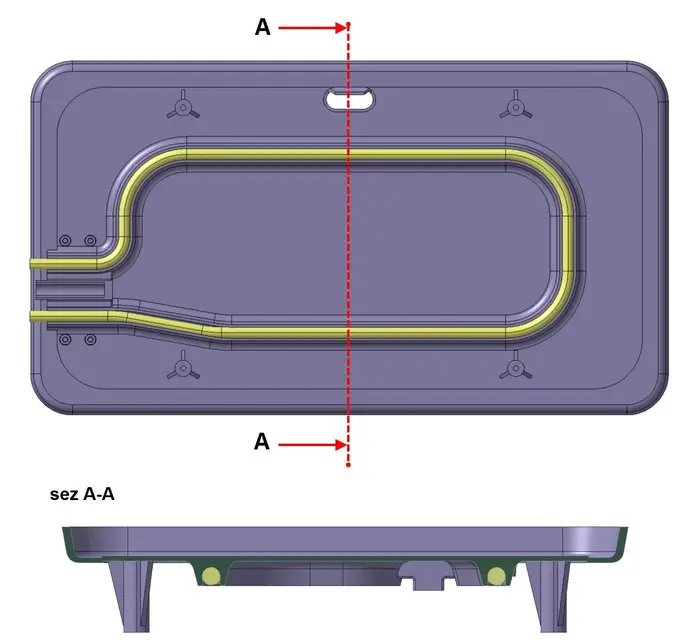
I have a plate in the upper with a resistance.
the temperature graph of the resistance is that attached.

at the first peak, where a t of the resistance of 240°c, we have a t on the plate of 340°c (at the center) while at the sides of 170°c.

this large temperature difference creates the classic "banana effect" to the plate (conception of the material). once off the resistance the plate is deformed of 5mm. in practice the sides rise of 5mm.
How can I simulate everything in ansys?!?I thought, I do a transient thermal analysis. I build a phase tot with different temperatures (following the graph), but how do I simulate the deformation of the plate? ! ?Thank you:
 

Attachments

  • Piastra+Resistenza2.webp
    Piastra+Resistenza2.webp
    61.4 KB · Views: 11
  • Grafico.webp
    Grafico.webp
    59.5 KB · Views: 16
Hi.
I think before I throw myself to fish in the calculations it would be necessary to make some preliminary assessment and explain to me. .
Is the final deformation permanent? or will it be removed when the load ceases?
Because if it's permanent, you probably have the maximum deflection of the plate as much as the temperature differences are greater, I imagine more towards the start of the simulation (in terms of time and looking at your charts) than at the end, so you could just understand the worst thermal distribution and then make a static alcohol under those conditions...how do you do? in classic ansys with a minimum of apdl you can transfer to each step the displacement delta consequent thermal delta to the structural model. with the wb I don't know even if the new version 12 that I still don't get out of the box has this possibility for sure... in the end we could make an attempt together if you place the geometry.

 
First of all, thank you for the zaxxon answer.
deformation is permanent.

the die-cast piece is perfect (after molding) once brought to temperature it deforms and thus remains (for ever).
I have available ansys wb11 (which is what I know a little:tongue:).

then going for steps:
1-make a transitional thermal analysis, trying to reproduce the temperature chart
2-I look at the total temperature of childbirth
3-maybe I do a mechanical analysis to look at the deformed z. What do you say? !

How could I do that?
thanks again:finger:
 
I'm going a little bit by heart that I don't have in front of the tool.
I would do this:
with the wb11 impose all the temperatures known on the model (resistance 240 on the sides 170 and in the center 340, of course you have to properly prepare the geometry), and turn a stationary thermal analysis.
then if there is not a possibility, by right-clicking on the temperature results to insert a structural static analysis with automatic mapping from the thermal results, then mechanically ties the system into the new branch that appears to you and you are finished.
I'm sure you can do this with the wb11.

See you soon.
 
with the wb11 impose all the temperatures known on the model (resistance 240 on the sides 170 and in the center 340, of course you have to properly prepare the geometry)
excuse, how do I set the temperature to the sides of 170°c and to the center °c340, if the model is a unique solid? ! ?
split, cad, the plate in two areas? !
Thank you:
 
You don't have to act on the solid.
It is enough that you break the surface of the solid with forms that suit you to apply the temperature bond.
e.g. on the sides you can make a rectangular surface, and at the center a circular surface, and then there apply the constraints.

What are you doing?
 
a small observation: I see from the chart that the temperature goes up to 200° and more... the aluminum melts at 540° if I don't remember badly.. .
These 2 things make me think of a word that is called creep (following material at high temperatures).
by experience when approaching half the melting temperature of a material the effects of the creep can be at least heavy: the characteristics of the material are already scarce (at 200° with aluminum the module of young drops of 20% and the tensions of yielding and breaking more than 50%), and then this begins to flow! ! !
analysis is very complex: You can also do it in wb but you need a few lines of apdl to define the creep of the material.
Unfortunately it is very difficult to find data on the creep, and this complicates the thing a lot!
 

Forum statistics

Threads
44,997
Messages
339,767
Members
4
Latest member
ibt

Members online

No members online now.
Back
Top