
You are using an out of date browser. It may not display this or other websites correctly.
You should upgrade or use an alternative browser.
You should upgrade or use an alternative browser.


panormus
Guest
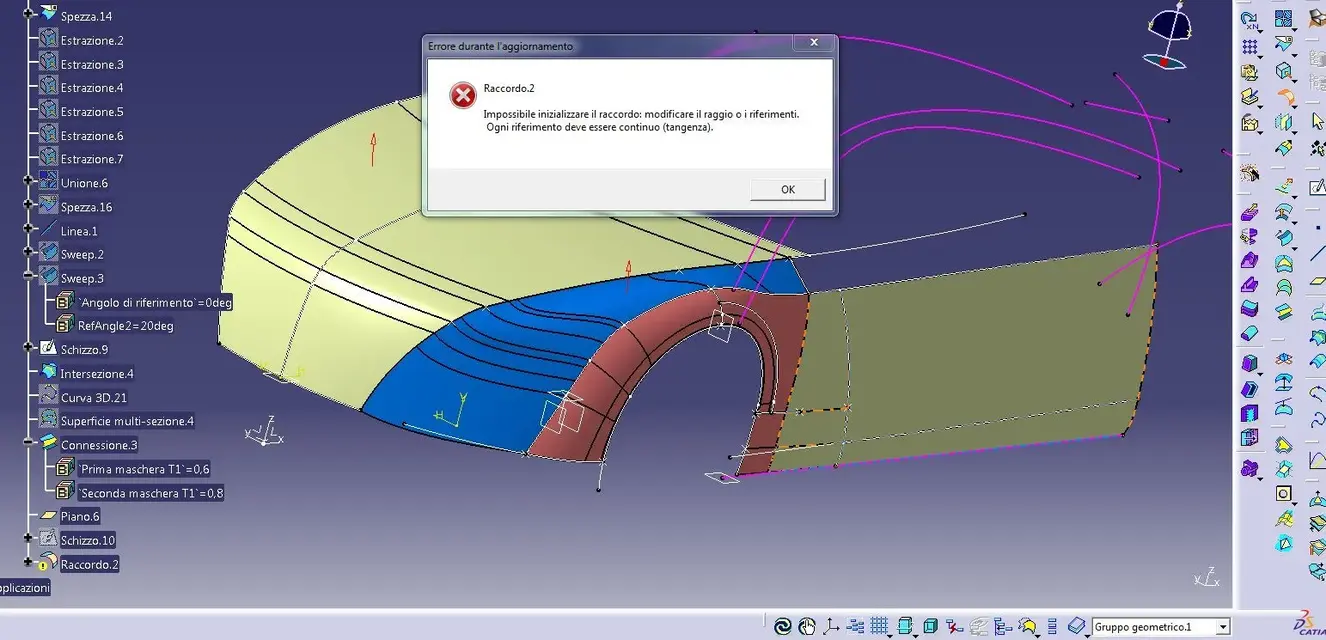
barlafus
Guest
a fillet between those surfaces will come, aesthetically, a little slutty.. .
However, as exercise goes well.
Pay attention to the red darts: the "center" of the fillet (center radius of the arc (in section) of the circle that will be rested on the surfaces.
in your specific case, click on the darts and flip them both down.
then, just for info, on the outside car you do not use 'normal' fillets, but this is all another story.. .
However, as exercise goes well.
Pay attention to the red darts: the "center" of the fillet (center radius of the arc (in section) of the circle that will be rested on the surfaces.
in your specific case, click on the darts and flip them both down.
then, just for info, on the outside car you do not use 'normal' fillets, but this is all another story.. .
panormus
Guest
variable fillets?a fillet between those surfaces will come, aesthetically, a little slutty.. .
Why? on the internet there is a video where the guy made a couple of perfect fittings.However, as exercise goes well.
Pay attention to the red darts: the "center" of the fillet (center radius of the arc (in section) of the circle that will be rested on the surfaces.
in your specific case, click on the darts and flip them both down.Thank you.then, just for info, on the outside car you do not use 'normal' fillets, but this is all another story.. .
solved between hood and blue surface, but not solved between blue sup and pink sup.
flaviobrio88
Guest
why you need to make minimum fillets in g2
nino66
Guest
even without examining in detail the surfaces I would say that the fillet does not do it because the 2 sup support passes by having a edge, then they will pass in tangence on some points and then again to edge but perhaps in the opposite direction and if you then put a radius too small can not calculate it. try as first to increase even a lot of radius if you do not see changes you have to remake the central supercie (blue) perhaps by building it in another way and then the final result and directly proportional depending on how you do the surfaces of support or theoretical (so it is said in jargon).
You always have to try to have a good edge if you want the radius to turn right. .
Good training. . .
You always have to try to have a good edge if you want the radius to turn right. .
Good training. . .
panormus
Guest
fillet in 2g. I certainly ate them. are deliciouswhy you need to make minimum fillets in g2

maxopus
Guest
g2=continuity in curvature, above a certain value (depending on the house ... let's say above 3-5 mm depending on the case) you have to use the "conical" rays ... is the automotive beauty:fillet in 2g. I certainly ate them. are delicious
barlafus
Guest
panormus, somewhere in the forum you will find debates related to 'class a' and continuity in g1, g2, g3. complex concepts for those dealing with aesthetic maths that have as objective the maximum possible quality of the surfaces that represent the model (definition very, very tight).g2=continuity in curvature, above a certain value (depending on the house ... let's say above 3-5 mm depending on the case) you have to use the "conical" rays ... is the automotive beauty:
remaining on the piece, for your work fortunately are concepts that you will not need. When you verify that the curvature of your model is pleasant, you are more than fine and you can give yourself a good aperitif! (see posts where we explained some of these concepts)
Fulvio Romano
Guest
I would not do that blue surface with a "fillet", but with a four-sided surface, the one that in alias is called "square".
start with drawing the edges, two are identified by the green and pink surfaces, two others are designed by curves. the curves must be tangent with the surfaces, even better, in tangence with the edge of the surface. It's not the same. being in tangency with the edge is a more stringent bond than being in tangency with the surface.
then, create the surface for four edges that have g1 or g2 continuity on adjacent surfaces. for this type of surface I suggest g1. g2 compels the surface to be higher, and in little space this can generate oscillations. and the equation [G2 = Classe A] e [G1 = non Classe A] It is what is more wrong to say.
attentive to those orange curves inside the surface, isoparametrics. The more they are, the more the surface is "burnt". correspond to knots that bind the polynomial equations of the nurbs. if the program adds it means that with a "natural" nurbs it cannot respect the binding conditions, and then it must add "roba in the middle". If he does, it means you're forcing the surface to do something that doesn't want to do, and the result is "bad". mathematically define "bad" is not possible, as otherwise it is not possible to define mathematically "class a".
start with drawing the edges, two are identified by the green and pink surfaces, two others are designed by curves. the curves must be tangent with the surfaces, even better, in tangence with the edge of the surface. It's not the same. being in tangency with the edge is a more stringent bond than being in tangency with the surface.
then, create the surface for four edges that have g1 or g2 continuity on adjacent surfaces. for this type of surface I suggest g1. g2 compels the surface to be higher, and in little space this can generate oscillations. and the equation [G2 = Classe A] e [G1 = non Classe A] It is what is more wrong to say.
attentive to those orange curves inside the surface, isoparametrics. The more they are, the more the surface is "burnt". correspond to knots that bind the polynomial equations of the nurbs. if the program adds it means that with a "natural" nurbs it cannot respect the binding conditions, and then it must add "roba in the middle". If he does, it means you're forcing the surface to do something that doesn't want to do, and the result is "bad". mathematically define "bad" is not possible, as otherwise it is not possible to define mathematically "class a".
panormus
Guest


panormus
Guest
Well about hisoparametrics I don't know how to "contain" them, but I think their presence is inevitable (correct me if I'm wrong) since even those who have made the tutorial I'm following them (see attachment).I would not do that blue surface with a "fillet", but with a four-sided surface, the one that in alias is called "square".
start with drawing the edges, two are identified by the green and pink surfaces, two others are designed by curves. the curves must be tangent with the surfaces, even better, in tangence with the edge of the surface. It's not the same. being in tangency with the edge is a more stringent bond than being in tangency with the surface.
then, create the surface for four edges that have g1 or g2 continuity on adjacent surfaces. for this type of surface I suggest g1. g2 compels the surface to be higher, and in little space this can generate oscillations. and the equation [G2 = Classe A] e [G1 = non Classe A] It is what is more wrong to say.
I don't know what to do to make g1 rather than g2 etc. but to follow the suggestion of the barlafus I will acquire a text (we accept suggestions).attentive to those orange curves inside the surface, isoparametrics. The more they are, the more the surface is "burnt". correspond to knots that bind the polynomial equations of the nurbs. if the program adds it means that with a "natural" nurbs it cannot respect the binding conditions, and then it must add "roba in the middle". If he does, it means you're forcing the surface to do something that doesn't want to do, and the result is "bad". mathematically define "bad" is not possible, as otherwise it is not possible to define mathematically "class a".
in the same annex it is seen that the guy creates fittings and then divide the surfaces and remake the connection surface between the bonnet and the fender (say, to understand, draw them in orange).
Attachments

Fulvio Romano
Guest
You're right, I've been wrong.Well about hisoparametrics I don't know how to "contain" them, but I think their presence is inevitable (correct me if I'm wrong) since even those who have made the tutorial I'm following them (see attachment).
if you make a surface that connects two surfaces, and the two surfaces on board have isoparametrics, in correspondence of these they will have (unless to use advanced techniques) to start isoparametrics also on the connection surface. isoparametrics will be aligned with those of the edge surfaces, and this is physiological, as seen in the image of the tutorial.
In your model there are more isoparametrics, not in correspondence with those of the onboard surfaces, and as if not enough, the corresponding ones are not in tangency, but they form a strange angle.
My parents are suggestions to do a well done job. Consider that 80% of "experts in modeling" do not even know what is an isoparametric, make plans (plans!!) with internal isoparametrics, and a complete dashboard of instruments can weigh also 80mb. The same dashboard I let him into a 2mb file.
panormus
Guest
The guy's got no more, I assume he doesn't work "clean" too.
However repeat is only a temporary surface at least seems from the tutorial.
However repeat is only a temporary surface at least seems from the tutorial.
panormus
Guest

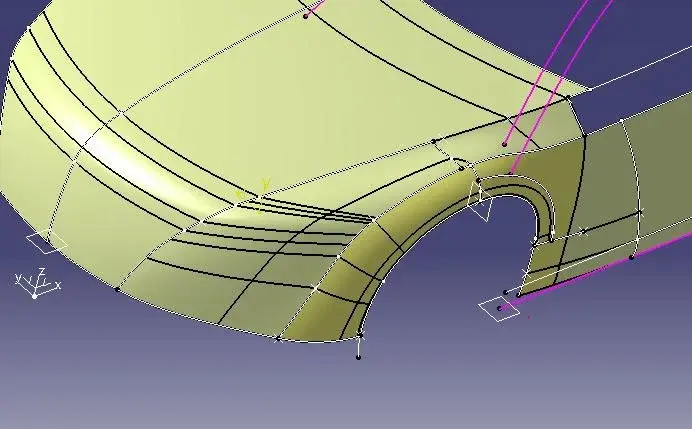
panormus
Guest

Fulvio Romano
Guest
maybe because you selected a face (as the error says) and not the edge?Why do you think it tells me that there are no living edges to be told when the edge is alive?
I don't know. I don't know the command. I threw it so...
panormus
Guest
No, I've selected the edge and then I've got on the edge.maybe because you selected a face (as the error says) and not the edge?
I don't know. I don't know the command. I threw it so...
panormus
Guest

maxopus
Guest
Do you have any idea how many people work on a new vehicle's style modeling?It takes time. .
and you are only at the "skin", then you have to divide it into the various components, create the thicknesses, attacks, hinges, the doors (complex axes), the pillars, the crystals, the seals.
are tens of thousands of hours of work.