
• This forum is the machine-generated translation of www.cad3d.it/forum1 - the Italian design community. Several terms are not translated correctly.

control blade

  • Thread starter Thread starter MBT
  • Start date Start date

MBT

Guest
send to all
I am facing a problem that generates some perplexity, see if someone has specific experiences about it
I would like to make a template for the profile control of a work piece. in summary, check whether or not the profile responds to the design (generated with a few thousand points)
the design is issued with only a few control points, with the precise 3 digit quotas after the comma, and integrated by the cad profile or the coordinates of the various points
I wonder. being a dima and since the profile is generated with over 500 coordinates, does it make sense to indicate tolerances?
general tolerances are too wide for this application, at least those commonly used
Are there any more? How do you behave in these cases?

thanks to all for your opinions
 
I would like to point out that without seeing piece/dima it is difficult to answer, but to think of any control tool without tolerances seems to me a wrong approach.
the control blades are realized to check that the piece falls into the field of tolerances indicated by the designer, therefore the tolerances with which the equipment is constructed will be adequate to the control to which they are intended.
if your piece does not require specific tolerances you may also enter a valid tolerance for all odds and indicate it expressly on the drawing.
For example, the piece has +/- 1mm tolerance, I put valid tolerances for all quotas at +/-0.5mm.
 
Hi.
na time we were doing control blades for the movie industry
all the contour rested on a panel or sheet metal
where the view was drawn in the plant without tolerances
and the view in the plant with the tolerances indicated in more and less
everything was tinot in two colors white and red
when the piece to check remained in the white zone was good
when he occupied the red zone or escaped from the white was from waste
tolerances were always wide
but you must respect those
also because who decided if the piece was good or to discard was not a technician
but the operator to the molding
that it is
plastic injection
merger
gravity shell fusion
sheet metal or laser cutting etc.
Thank you very much
 
the problem is a joint fur.
the sense of the dima in my case is to check that the piece follows the desired profile.
the idea was to use the blue of prussia to verify the answer between piece and dima. a more qualitative than quantitative control.
But it starts from the assumption that the dima is perfect. follow exactly the desired profile. but how do you restrict the accuracy of a profile if you are not the quotas of the profile itself?
now your question will be: "Why are there no quotas?? ? ? "
simple, because the profile comes out of a spreadsheet that generates the x and y coordinates of the profile based on a complicated algorithm based on stellar and planetary calculations.... and such coordinates (with precision to the micron) is passed to those who build the piece (and the diamond...)
Now, on the drawing there are only a couple of odds and these can also be tolerated... but for those who are not there?


Here... This is a fantastic question for those who "the design is not needed!" How does it work in these cases?? ? how do I impose precision at a quota that does not exist? and who builds it as he knows what to do?
 
I will be very interested in the progress of the discussion.
I guess you can't see a profile picture to understand a little better, can you?
 
I guess you can't see a profile picture to understand a little better, can you?
Are you kidding? ? ?

Do you want them to kill me or, worse, fire me? ? ? ?

If I spread such a design, I could wake up in the morning and find on the bedside table a glass with inside my gonads! and the delgatto administrator who smiles at night behind the head of the bed, while the head human reservoir removes the surgeon gloves still dirty of my blood. . .
 
the problem is a joint fur.


Here... This is a fantastic question for those who "the design is not needed!" How does it work in these cases?? ? how do I impose precision at a quota that does not exist? and who builds it as he knows what to do?


:36_3_2:

:4404:

:4406::4406:
 
the problem is a joint fur.
the sense of the dima in my case is to check that the piece follows the desired profile.
the idea was to use the blue of prussia to verify the answer between piece and dima. a more qualitative than quantitative control.
But it starts from the assumption that the dima is perfect. follow exactly the desired profile. but how do you restrict the accuracy of a profile if you are not the quotas of the profile itself?
now your question will be: "Why are there no quotas?? ? ? "
simple, because the profile comes out of a spreadsheet that generates the x and y coordinates of the profile based on a complicated algorithm based on stellar and planetary calculations.... and such coordinates (with precision to the micron) is passed to those who build the piece (and the diamond...)
Now, on the drawing there are only a couple of odds and these can also be tolerated... but for those who are not there?
if you have the coordinates of the points expressed precisely to the micron why can't you define the tolerance for each coordinate? obvious that putting them on the profile design (I imagine it is some type of curve) can be complicated, but to define them in the table should not be a problem. the profile is secret and if the sveli dissolve you in the acid, then I go intuition and I think that using the dima with blue prussia as a match to verify coordinates to the micron is at least difficult and probably aleatory, since the dima is built from the points you need to check and maybe then should have a precision to the tenth of micron
why not put the piece under a coordinate measuring machine, detect both the profile and the coordinates that generated it and compare the numbers?
Here... This is a fantastic question for those who "the design is not needed!" How does it work in these cases?? ? how do I impose precision at a quota that does not exist? and who builds it as he knows what to do
and daje!
explain why you say that there is no quota on a drawing (by hindering the fact that it would be over 500...) when the same quota is present on a table, it has generated a curve that has been imported in a cam (presummary, because you are definitely park of information :rolleyes:) to generate the tool path with which that profile was milled.
 
if you have the coordinates of the points expressed precisely to the micron why can't you define the tolerance for each coordinate? obvious that putting them on the profile design (I imagine it is some type of curve) can be complicated, but to define them in the table should not be a problem.
no, but passing a xl sheet to the supplier with coordinates is one thing...
to write them on a drawing and (at handle) to add tolerance to each quota is another.
the profile is secret and if the sveli dissolve you in the acid, then I go intuition and I think that using the dima with blue prussia as a match to verify coordinates to the micron is at least difficult and probably aleatory, since the dima is built from the points you need to check and maybe then should have a precision to the tenth of micron
why not put the piece under a coordinate measuring machine, detect both the profile and the coordinates that generated it and compare the numbers?
and you have all the reasons. But sometimes things must be done not because they are right but because they must satisfy the neuronal desires of the leaders.
even gods can nothing against human stupidity
Besides, I have for my hands a profile with almost atomic precision and I already know that when the piece will be mounted and operational this precision will go to grandchildren of mubarak... But go explain it to him!
and daje!
explain why you say that there is no quota on a drawing (by hindering the fact that it would be over 500...) when the same quota is present on a table, it has generated a curve that has been imported in a cam (presummary, because you are definitely park of information :rolleyes:) to generate the tool path with which that profile was milled.
Let us draw for a moment the philosophies behind the piece and suppose for a second that this precision is truly indispensable. . .
Let's pretend I've got the piece. the curve is obtained by interpolation of points with precision 1 micron. on the design is written in clear letters and in double language "require to the technical office the coordinates of every single piece"
the customer receives the drawing and also receives the sheet with the 500 and broken coordinates.
I get the piece in the house. I take it, I mix it with my sub-atomic precision instrument and I find that it is out of 5 tenths of mm. of millimeter, he.. not of atom.. .
Now, I context the piece and the supplier tells me "my good... the general tolerance for that quota is +/- 0.6 mm. with 0.5 mm of error I am still in tolerance, so the piece is acceptable."
and I answer him?
Now I have three possibilities, in my opinion.
option a) I take the shot and I give myself some thrush
option b) I put on the drawing the 500 and coordinate routes in a table (it will be a sheet a0 only of numbers...) with alongside each coordinate its tolerance
c) I make a design "out of standard" where I write "for profile coordinates tolerance is +/- 0.001. because such a statement is not covered by the rules of design, according to me

What would you do?
 
I'm not sure I understand 100%, but basically you have a curve described with a set of points. Now, let's skip the nyquist-shannon theorem, and let's say that through those three-digit decimal points (believing that the measure makes it in the climate room... but that you changed your job?!) you get your nominal curve.
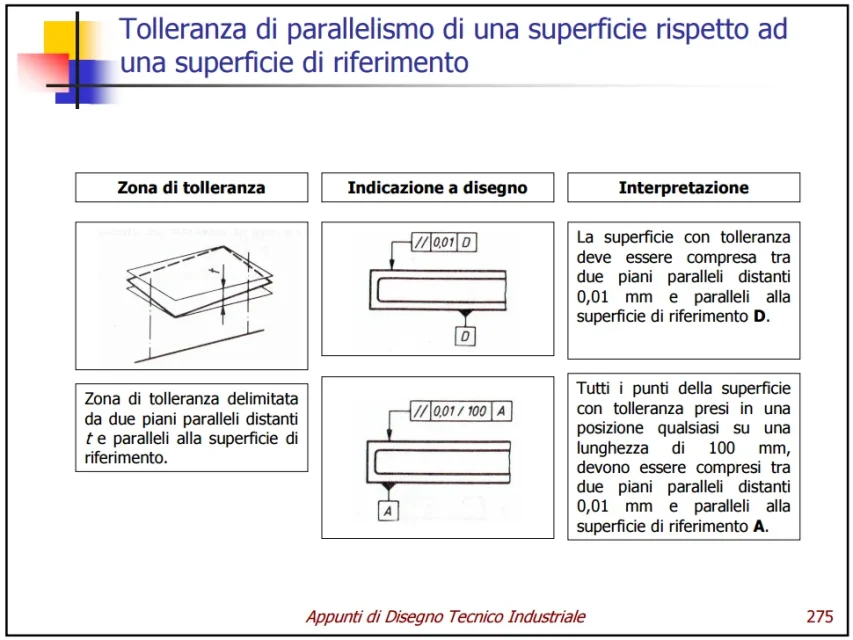
at this point in the image below you see described geometric tolerances to impose the maximum deviation of a surface from the nominal one.Schermata del 2016-12-03 15:45:41.webpbuild a dime whose tolerances are an order of magnitude lower than the ones with which you have made the piece, sprinkles it well of blue of prussia, that the rub to comparison prove envy, and it supports it.

if on the initial design lacks the indication of tolerances means that on the design there is written the equivalent of "this is the design, but you do what you can". If that's really how he waits for me to go get the popcorn.. .
 
I'm not sure I understand 100%, but basically you have a curve described with a set of points. Now, let's skip the nyquist-shannon theorem, and let's say that through those three-digit decimal points (believing that the measure makes it in the climate room... but that you changed your job?!) you get your nominal curve.
at this point in the image below you see described geometric tolerances to impose the maximum deviation of a surface from the nominal one.View attachment 45616build a dime whose tolerances are an order of magnitude lower than the ones with which you have made the piece, sprinkles it well of blue of prussia, that the rub to comparison prove envy, and it supports it.

if on the initial design lacks the indication of tolerances means that on the design there is written the equivalent of "this is the design, but you do what you can". If that's really how he waits for me to go get the popcorn.. .
Oh, forget it. that otherwise I get the colic
 
Oh, forget it. that otherwise I get the colic
And I'm afraid you'd pass directly to the ulcer with your blade. on a curved profile depending on the points where the dima touches the piece you may find yourself with shocks in other areas one hundred times greater than the required tolerance. You could never do significant contact control. with the blue of prussia then... I have the only road is the relief with measuring machine and comparison of the relief with the cad model. the rest is to fix it metaphysical:wink:
 
as I have already said, the precision necessary for the correct functioning of the piece is of the order of the half millimeter. even greater, honestly.
However... there are the famous "products" or "dishes" or "experts" that have established a highly advanced method of calculation (in the sense that no one wanted and had remained there...) with micrometric precision
useless to object that such precision is useless. explain that geometry deforms for other causes before even being put into operation is time lost
Given the size in play and the features of the piece, putting everything under a goddess is counterproductive for two reasons:
1) the goddess herself would have difficulty detecting the profile (unless taking special heads, but it is not the case)
2) likely the profile would be out of measure. for sum of things. but this would not lead the "believers" to review their opinions but only to unleash a war against suppliers forcing them to do things at the limit of mechanics

that of the dima is an elegant idea that came to placate the souls.... but the problem was to guarantee the precision of the dima, at least formally
the tolerance of form (of which I was completely forgotten) egregiamente to our case.
 
as I have already said, the precision necessary for the correct functioning of the piece is of the order of the half millimeter. even greater, honestly.
I've escaped... I had remained at a very high-precision profile that you expected would deform once installed but that you had to check referring to the quotas with precision to the micron.


that of the dima is an elegant idea that came to placate the souls.... but the problem was to guarantee the precision of the dima, at least formally
the tolerance of form (of which I was completely forgotten) egregiamente to our case.
the dima would make sense if you could display the overlap compared to the processed profile, as if they were on two layers of the cad, to evaluate the offset of the real piece compared to the dima. but to use a dime that will lean on the profile to evaluate (even to the eye) the maximum deviation can be completely melted. you may be abundantly in tolerance but have some point with a huge shock just because the dima touches in the two extreme points of the profile or in two singular points that create that bastard condition.
 

Forum statistics

Threads
44,997
Messages
339,767
Members
4
Latest member
ibt

Members online

No members online now.
Back
Top